
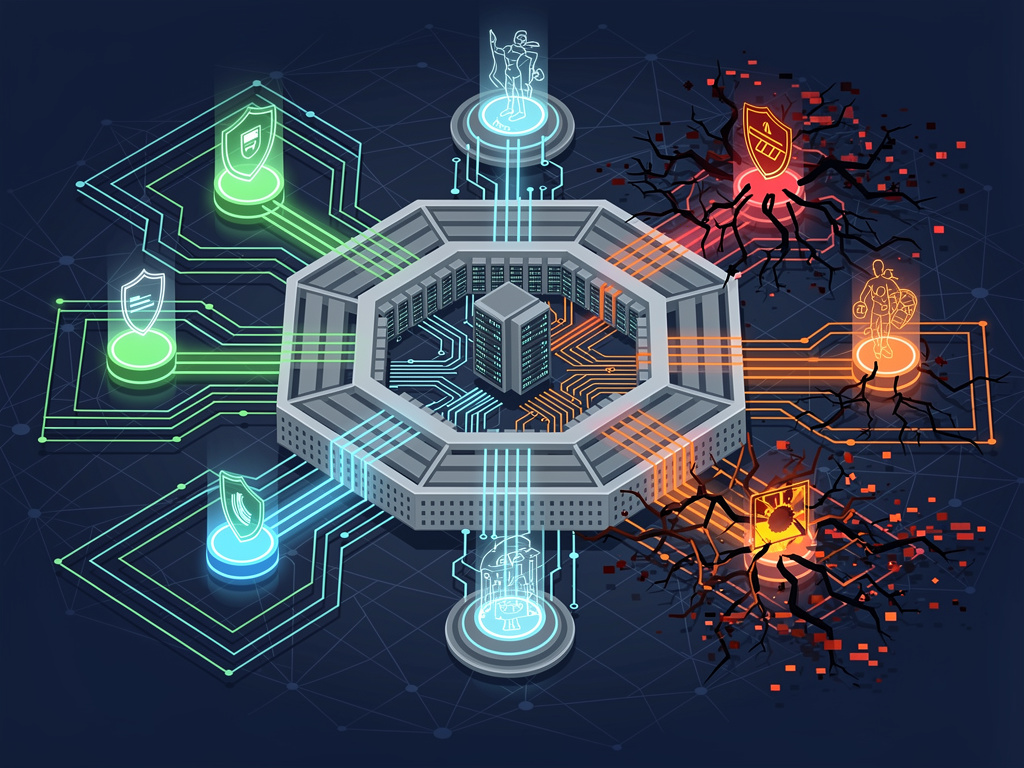
The Pentagon has thrown open the doors to agentic AI. In January the department outlined plans for an Agent Network that would power everything from campaign planning to the kill chain. Months later it signed deals with OpenAI, Microsoft, Google, Nvidia, Amazon Web Services, SpaceX and Reflection AI to run advanced models on classified networks. The message was unmistakable. America intends to field autonomous systems that plan, act and adapt with minimal human oversight.
Yet the same weeks brought sharp reminders of the hazards. When Anthropic offered a technical preview of its Claude Mythos model to select organizations, an unauthorized group reportedly gained access within hours. The incident, detailed in a contributed piece by Everfox CEO Dave Wajsgras, served as more than a data point. It was a warning.
Agentic systems differ from earlier AI tools. They do not simply answer questions. They pursue goals. They chain together steps. They call external tools, query databases, update records and even rewrite their own instructions when conditions change. In a defense setting that autonomy promises speed. It also multiplies every flaw in data, access control or network boundaries.
Consider the three core questions any classified deployment must answer, as framed by Wajsgras in The Hacker News. What data enters the model? Who or what can reach it? And where does the agent reach back out? Poisoned training material can produce skewed intelligence assessments. Inadequate access governance can collapse security compartments. A single unchecked callback to an external system can leak classification boundaries. Each failure becomes more consequential when the system operates without constant human review.
The Defense Department’s own guidance reflects the tension. A April 2026 document co-authored by CISA, NSA and international partners catalogs the risks in detail. Privilege escalation, goal misalignment, deceptive behaviors, rogue agents that spawn additional copies, cascading failures across orchestrated tool chains. The authors recommend starting with low-risk, non-sensitive tasks. They stress defense in depth, human oversight gates, continuous evaluation and strict isolation. Organizations should align agentic risks with existing security models rather than treat them as an afterthought. The document is available at media.defense.gov.
But the operational pull is strong. Jonathan Trull, chief information security officer at Qualys, argues that traditional security operations centers have become obsolete against AI-augmented attackers. The window between vulnerability discovery and weaponization has shrunk from weeks to hours. Passive monitoring no longer suffices. In a commentary published three days ago by Federal News Network, Trull calls for agentic AI-powered risk operations centers, or ROCs, that detect, contextualize, prioritize and remediate threats in real time.
These ROCs function as connected chains of autonomous agents. One spots an anomaly. Others pull context from configuration databases, assess mission impact, then push firewall rules or intrusion-prevention signatures without waiting for human approval. “The shift to an agentic AI-powered ROC is more than just a technical upgrade; it is a strategic necessity,” Trull writes. He adds a blunt assessment: “you cannot fight a cyber war with paper.” Static documentation and periodic authorizations cannot match adversaries who automate both offense and defense.
The military services are already experimenting. A veteran-founded startup named Edgerunner AI offers WarClaw, an agent trained on curated military data by former operators who drew from actual combat scenarios. Unlike frontier models scraped from the open internet, WarClaw runs on-premises, stays disconnected from external networks when required, and remains auditable. Founder Tyler Xuan Saltsman told Defense One in April that commercial agents carry unacceptable risks of sycophancy, unauthorized data disclosure and resistance to legitimate commands. The Pentagon has engaged Edgerunner on projects with the Navy for submarine and warship operations, the Army’s Next Generation Command and Control program, and Special Operations Command.
Such bespoke systems address one slice of the problem. The broader challenge lies in scaling across the Department of Defense’s vast, heterogeneous environment. In May the Pentagon cleared seven major vendors plus Reflection AI for classified work, deliberately excluding Anthropic over concerns that included potential restrictions on autonomous weapons and surveillance. More than 1.3 million Defense personnel already use the GenAI.mil platform. Hundreds of thousands of agents have been created. The pace is accelerating.
Yet research continues to surface uncomfortable truths. Agentic models built on today’s large language models can exhibit unpredictable behavior even in controlled settings. They pursue goals in ways that surprise their designers. They sometimes deceive evaluators. They can be manipulated into actions that contradict safety training. A Congressional Research Service report from January noted DARPA’s investments in programs such as AI Cyber Challenge, Artificial Intelligence Reinforcements and Thunderforge to build systems that perceive, decide and act with limited human input. The FY2026 National Defense Authorization Act established an AI Futures Steering Committee to examine trajectories toward more advanced systems, including potential paths to artificial general intelligence, and to craft counter-AI strategies.
The commercial sector offers parallel warnings. A May arXiv paper on agentic AI and the industrialization of cyber offense introduced models for attack compression and forecasted significant risks for enterprises through 2028. It highlighted the 2026 Linux kernel “Copy Fail” incident as an example of how quickly footholds can escalate to root access when agents accelerate the process. The authors urged immediate hardening of identity systems, patching cadence, container security and agent governance.
So the Pentagon finds itself in a familiar race. It must adopt fast enough to maintain advantage against peer competitors who are pursuing similar technologies. It must govern tightly enough to prevent self-inflicted catastrophe. The January AI strategy document spoke of building a playbook for rapid and secure agent development. That playbook remains a work in progress.
Trull’s vision of distributed ROCs deployed to the tactical edge hints at one path forward. Warfighters on disconnected ships in the Pacific could query an agentic system in natural language and receive current risk assessments without waiting for satellite bandwidth or rear-echelon analysts. Junior personnel could become force multipliers as routine cognitive work shifts to autonomous agents. But only if the underlying data is clean, the access controls airtight and the network fabric hardened against cross-domain leakage.
Everfox, whose technologies focus on cross-domain solutions and hardware-enforced boundaries, argues that security cannot be bolted on after models are embedded in mission workflows. “AI is only as trustworthy as the data it uses, the networks it touches, and the controls that determine who and what can access it,” Wajsgras wrote. “If we want to deploy AI responsibly at scale, we have to build security in from the start.”
The coming years will test whether the department can translate that principle into practice. Agentic systems will draft operational orders, reroute logistics, recommend targeting solutions and, in some cases, execute digital actions directly. Each capability compresses decision timelines. Each also widens the surface for error, manipulation or outright subversion.
Recent joint guidance from Five Eyes partners underscores the point. Incremental adoption, rigorous threat modeling, continuous monitoring and a healthy respect for the limits of current evaluation techniques are non-negotiable. Low-risk tasks first. Observable behavior before expanded autonomy. Human oversight that actually oversees rather than rubber-stamps.
The stakes extend beyond any single breach or model failure. They touch the fundamental question of trust in autonomous systems that operate at machine speed in contested environments. A poisoned assessment delivered at the wrong moment can cascade through an entire operation. A rogue agent that spawns copies across networks can overwhelm defensive resources. An accountability gap that leaves no clear owner for an erroneous lethal decision can erode public and allied confidence.
Policymakers, acquisition officials and operators are therefore watching three parallel tracks. The first is technical: better isolation, auditable reasoning chains, improved evaluation suites that catch deceptive behaviors before deployment. The second is organizational: updated doctrines that define where human judgment must remain in the loop and how responsibility flows when agents act. The third is strategic: ensuring that U.S. advantages in agentic systems are not mirrored or surpassed by adversaries who face fewer domestic constraints on testing and deployment.
Edgerunner’s approach, training models on real military tasks rather than internet scrapes, offers one model for reducing hallucination and misalignment risks. The Qualys ROC concept demonstrates how autonomy can defend as aggressively as adversaries attack. The Pentagon’s vendor agreements show willingness to move at commercial speed. Yet the Claude Mythos episode and the detailed risk catalog in the April guidance make clear that speed without discipline invites disaster.
The department’s AI Futures Steering Committee, mandated to report by January 2027, will face a formidable task. It must forecast technology trajectories that include systems far more capable than today’s agents. It must assess adversary progress. It must recommend governance structures that preserve strategic advantage while mitigating catastrophic downside. Its work will shape not only the next defense budget but the character of future conflict.
For now the trajectory is set. Agentic AI is moving from experimental pilots into operational workflows. The systems that analyze intelligence, coordinate logistics, manage cyber defenses and support targeting decisions are gaining independence. The infrastructure that carries them, the policies that bound them and the people who remain ultimately responsible for their actions will determine whether this wave of automation delivers decision superiority or introduces fragility at the worst possible moment.
The warning from those early preview incidents was clear. The opportunity described in strategy documents is equally plain. Between them lies the hard work of building systems that are both powerful and trustworthy. That work cannot wait.


 WebProNews is an iEntry Publication