
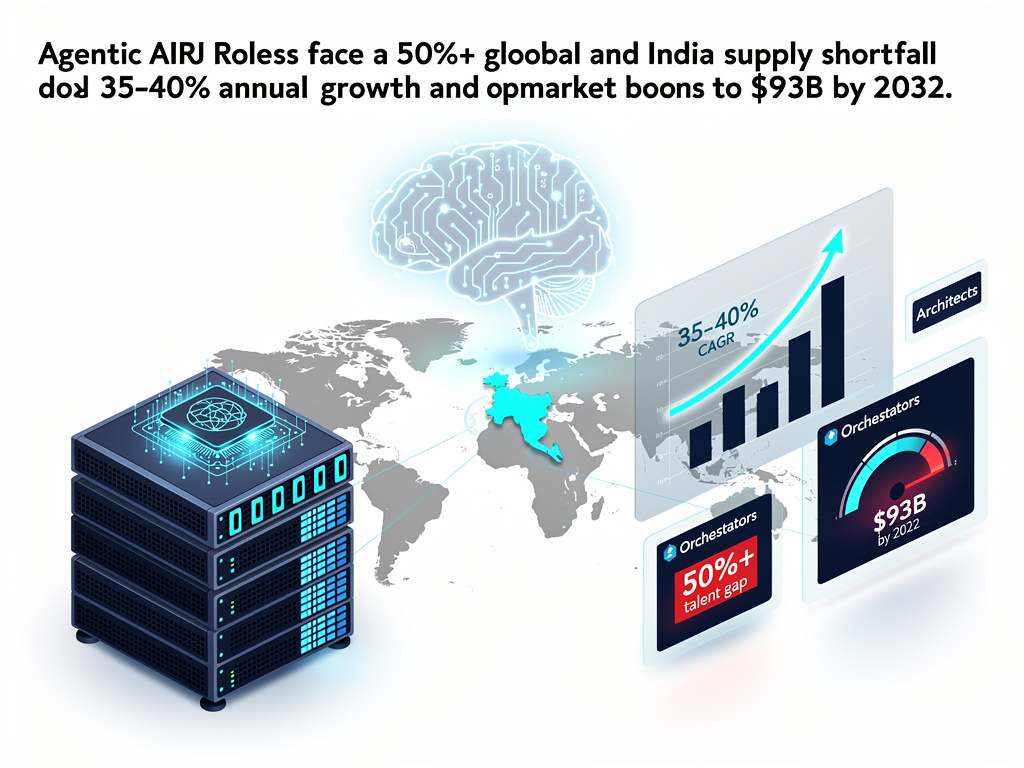
India’s technology sector faces a widening chasm in agentic AI expertise, with roles projected to expand 35-40% annually amid a demand-supply mismatch exceeding 50%, according to a Quess Corp report highlighted in The Economic Times. Agentic AI, systems capable of autonomous planning, decision-making and action, powers everything from multi-agent orchestration to enterprise automation, fueling hiring frenzies in Bengaluru and Hyderabad, which account for 62% of such positions.
Quess Corp CEO Kapil Joshi emphasized the opportunity for Indian professionals, noting the shift positions them for global technology leadership. Salaries for senior agentic AI roles have surged 20-28%, reflecting intense competition among global capability centers, IT services firms and startups. The report pegs India’s agentic AI market at $276 million in 2024, eyeing $3.5 billion by 2030.
Global Echoes of the Shortage
The talent drought extends worldwide, with 94% of engineering leaders citing agentic AI skills gaps as autonomous systems enter production, per a GlobeNewswire release on Interview Kickstart’s findings. Roughly half of large enterprises now run agentic systems for infrastructure optimization and development automation, building governance frameworks that latecomers struggle to match. By 2026, adoption could hit 40-50% in technology sectors, narrowing first-mover edges.
New positions like agentic architecture specialists and multi-agent orchestration engineers command premiums due to scarce supply, often filled by upskilling senior software and DevOps talent. Engineering teams prioritize architects for multi-agent collaboration and platform engineers for inter-agent communication, state management and observability.
Enterprise Push Meets Production Hurdles
Camunda’s 2026 State of Agentic Orchestration report reveals 73% of organizations acknowledge a gap between agentic AI ambitions and reality, with only 1 in 10 use cases reaching production due to risk, complexity and skills deficits, as detailed in BusinessWire. Most agents remain chatbots or assistants, siloed from end-to-end processes, stalling 48% of deployments.
IDC warns skills shortages could cost the global economy $5.5 trillion by 2026 through delays, quality issues and lost revenue, with over 90% of enterprises facing critical gaps. Computerworld notes AI talent demand outpaces supply two-to-fourfold, hindering ROI for two-thirds of AI experimenters.
India’s Acute Agentic Deficit
India grapples with under 100,000 agentic AI professionals against a 200,000 need by 2026, per executives from BCG, Everest Group, TeamLease and Adecco in another Economic Times article. Only 40% of demand is met, with AI architects scarcest. BCG’s Ankush Wadhera highlights agentic AI’s potential for ‘service as software’ in vertical solutions.
Adecco India’s Karthikeyan Kesavan points to soaring salaries and competition. AnalytixLabs’ AI Skill Gap Report forecasts 1 million AI pros needed by 2026, but only 450,000-500,000 skilled in AI/ML, with GenAI engineering up 178% year-over-year and senior shortages acute.
Market Forecasts Signal Urgency
MarketsandMarkets projects the agentic AI market from $7.06 billion in 2025 to $93.20 billion by 2032 at 44.6% CAGR, driven by generative AI, orchestration and reinforcement learning. Precedence Research sees $199.05 billion by 2034 at 43.84% CAGR. Gartner anticipates 40% of enterprise apps embedding agents by 2026’s end.
Salesmate.io pegs the market at $52.62 billion by 2030 with 46.3% CAGR, noting 80% enterprise app integration. EY’s AIdea of India 2026 report shows 24% of leaders deploying agentic AI, evolving from assistive to autonomous digital teammates.
Skills in the Spotlight
Andrew Ng stresses demand for developers leveraging AI for rapid engineering, prompting, RAG, evals and agentic workflows, outpacing 2022 coders. Experienced pros blending fundamentals with AI tools thrive, while recent CS grads face unemployment from outdated curricula.
Interview Kickstart launched courses addressing gaps in agent design and multi-agent systems. MHI’s 2026 supply chain trends rank talent shortages first, demanding tech-savvy pros as AI scales. IMF’s Skill Imbalance Index urges education and reskilling in high-demand economies like India.
Deployment Realities and Risks
Deloitte predicts 2026 narrowing of AI promise-reality gaps via process redesign, with Toyota using agents for supply visibility. Yet 73% of orgs per Camunda lack guardrails, risking siloed agents. Forbes warns of breaches and atrophied critical thinking, pushing AI-free assessments.
Gartner’s 1,445% surge in multi-agent inquiries underscores orchestration needs, with protocols like Anthropic’s MCP standardizing connections. Nextgov/FCW sees 2026 as agentic AI’s year, demanding cloud scaling.


 WebProNews is an iEntry Publication