
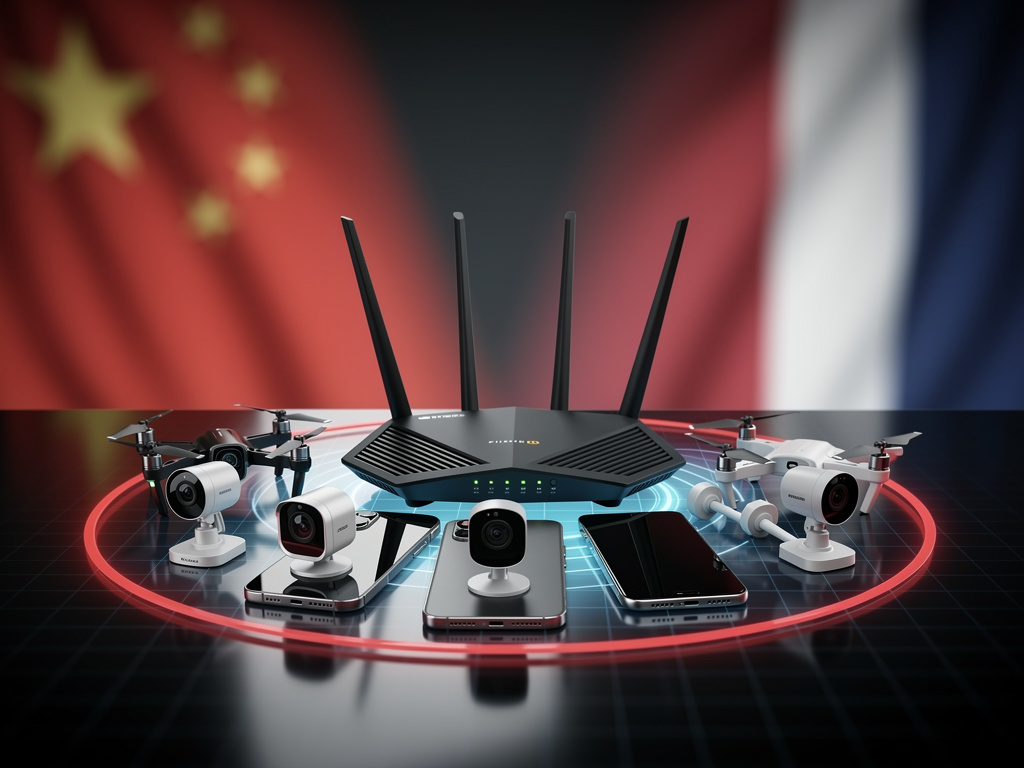
The TP-Link router ban was just the opening salvo.
In late 2024, the Trump administration moved to block Chinese-manufactured routers from American networks, citing national security risks tied to firmware vulnerabilities and potential state-sponsored surveillance. Now, according to multiple reports, the federal government is actively considering extending similar restrictions to a far broader category of consumer electronics — including mobile phones, surveillance cameras, and other connected devices with Chinese-made components. The implications for American consumers, retailers, and global supply chains are staggering.
The expansion was first detailed by CNET, which reported that the Commerce Department and other agencies are evaluating whether devices manufactured by Chinese firms — or containing critical Chinese-sourced chipsets and firmware — pose an unacceptable risk to U.S. infrastructure. The review isn’t limited to obscure industrial equipment. It encompasses devices that sit in millions of American homes and businesses right now: smartphones from brands like ZTE, security cameras from Hikvision and Dahua, and drones from DJI.
This isn’t hypothetical anymore. It’s policy in motion.
The legal scaffolding for these potential bans rests on a 2019 executive order — later codified and expanded — that grants the Commerce Department authority to prohibit transactions involving information and communications technology (ICT) that poses national security threats from foreign adversaries. The original order, signed during the first Trump administration, was used sparingly. Its second iteration is being applied with far greater ambition. The TP-Link action demonstrated the government’s willingness to act against a company that commands roughly 65% of the U.S. consumer router market, according to estimates cited by multiple outlets. Extending that logic to phones and cameras would affect an even larger swath of the consumer electronics market.
The security concerns aren’t invented from whole cloth. U.S. intelligence agencies have warned for years that Chinese-manufactured networking equipment could contain backdoors — intentional or otherwise — that allow Beijing’s intelligence services to intercept data, monitor communications, or even disable critical systems during a conflict. The FBI, NSA, and CISA issued a joint advisory in late 2024 highlighting vulnerabilities in Chinese-made routers that had been actively exploited by state-linked hacking groups, including the campaign known as Volt Typhoon, which targeted American critical infrastructure.
Cameras are a particular sore point. Hikvision and Dahua, both partially state-owned, have already been placed on the FCC’s “Covered List” of communications equipment deemed a threat to national security. Congress banned federal agencies from purchasing their products back in 2019 through the National Defense Authorization Act. But millions of their cameras remain operational across American cities, businesses, schools, and homes. The new push would go further — potentially barring their sale entirely within the United States and requiring removal from sensitive installations.
And then there are the phones.
ZTE, which nearly collapsed in 2018 after the Commerce Department banned it from purchasing American components, has since rebuilt its supply chain with greater reliance on domestic Chinese chips. That makes it, paradoxically, both less dependent on U.S. technology and more suspect in Washington’s eyes. Huawei, already effectively banned from U.S. markets since 2019, remains the most prominent example of how far these restrictions can reach. But ZTE still sells devices in the U.S. through smaller carriers and prepaid channels. A formal ban would shut that door entirely.
The broader question — the one that keeps trade lawyers and supply chain executives awake — is where the line gets drawn. Virtually every smartphone sold in America contains some Chinese-manufactured components. Apple’s iPhones are assembled in China by Foxconn and other contract manufacturers. Samsung sources components from Chinese suppliers. Qualcomm, the dominant American chipmaker for mobile devices, manufactures some of its chips at facilities with Chinese ties. A policy that targets devices “manufactured in China” or “containing Chinese components” without careful scoping could inadvertently disrupt the entire consumer electronics industry.
Administration officials have signaled that the focus, at least initially, will remain on devices from companies with direct ties to the Chinese government or military — a distinction that would spare Apple and Samsung but ensnare Hikvision, Dahua, ZTE, and potentially dozens of smaller brands that sell budget electronics through Amazon and Walmart. According to CNET, Commerce Department officials have been meeting with industry representatives to discuss how a broader ban might be structured without triggering mass disruption to retail supply chains.
That’s a delicate needle to thread.
The retail impact alone could be substantial. Budget security cameras from Chinese brands dominate Amazon’s best-seller lists. Small businesses across America rely on inexpensive Chinese-manufactured surveillance systems. Replacing them with American, Korean, or Japanese alternatives would mean higher costs — sometimes dramatically higher. A Hikvision commercial camera system that costs $2,000 might run $5,000 or more from a non-Chinese competitor. For a small retailer or restaurant owner, that’s not a trivial expense.
The drone market presents an even starker picture. DJI controls an estimated 70% or more of the global commercial drone market and an even larger share of the U.S. consumer market. The company’s products are used by law enforcement agencies, fire departments, agricultural operations, filmmakers, and hobbyists. Congress has already moved to restrict DJI — the Countering CCP Drones Act, passed by the House in 2024, would effectively ban new DJI products from operating on U.S. communications infrastructure. But the Senate version stalled amid lobbying from agricultural and public safety groups that argued no adequate American-made alternative exists at comparable price points.
So the administration may act unilaterally where Congress has hesitated.
The geopolitical context makes the timing unsurprising. U.S.-China relations remain at their most strained point in decades, with tensions over Taiwan, trade tariffs, and technology export controls creating a feedback loop of escalation. China has retaliated against previous U.S. tech restrictions by limiting exports of critical minerals like gallium and germanium — materials essential for semiconductor manufacturing. A broader device ban could prompt further Chinese retaliation, potentially targeting American companies operating in China or restricting rare earth exports that the U.S. defense industry depends on.
Beijing’s response to the TP-Link ban was swift and predictable. Chinese government spokespeople accused Washington of using national security as a pretext for protectionism, a charge that resonates with some American trade analysts. “There’s a legitimate security concern at the core of this,” one former Commerce Department official told reporters, “but there’s also a significant industrial policy component. Washington wants to rebuild domestic manufacturing capacity for these devices, and bans are one way to create market space for that.”
The industrial policy angle is hard to ignore. The CHIPS and Science Act, signed in 2022, allocated $52 billion to boost domestic semiconductor manufacturing. New fabrication plants from TSMC, Samsung, and Intel are under construction in Arizona, Texas, and Ohio. But chips are only one piece of the puzzle. The U.S. has virtually no domestic manufacturing base for consumer routers, security cameras, or budget smartphones. Creating one from scratch would take years and billions in additional investment — and the resulting products would almost certainly cost more than their Chinese equivalents.
Some industry voices argue that’s a price worth paying. “You can’t have critical communications infrastructure dependent on a strategic adversary,” said a senior fellow at a Washington-based think tank, echoing a sentiment that has become bipartisan orthodoxy on Capitol Hill. Others counter that the threat is overstated and the economic costs underappreciated. Small and mid-size businesses, which form the backbone of the American economy, would bear the brunt of higher equipment costs.
The technical arguments are nuanced. Not all Chinese-made devices pose the same level of risk. A budget security camera that stores footage locally and connects to a home Wi-Fi network is a different threat vector than a Huawei 5G base station embedded in a telecom carrier’s core network. Critics of the broad-ban approach argue that the government should focus on setting rigorous security standards — requiring independent firmware audits, mandating encryption protocols, banning devices that phone home to servers in China — rather than issuing blanket prohibitions based on country of origin.
But the counterargument is that security standards are only as good as their enforcement, and the U.S. government’s track record on enforcing technical standards for consumer electronics is mixed at best. The FCC has limited resources for testing imported devices. Customs and Border Protection can inspect shipments but lacks the technical expertise to evaluate firmware. And Chinese manufacturers have shown a pattern of complying with security requirements on paper while maintaining undisclosed capabilities in practice — a concern that intelligence agencies have raised repeatedly in classified briefings to lawmakers.
The legal challenges will be formidable. TP-Link has already signaled it may contest the router ban, arguing that its U.S. operations are sufficiently independent from its Chinese parent company. Hikvision and Dahua have made similar arguments in the past. Any expansion of device bans will face lawsuits from affected companies, trade associations, and potentially even consumer groups arguing that the restrictions violate due process or exceed executive authority.
Courts have generally given the executive branch wide latitude on national security matters, but the scope of a ban covering phones and cameras would be unprecedented. Previous actions against Huawei and ZTE were targeted at specific companies. A broader prohibition that sweeps in entire product categories manufactured in China would raise novel legal questions about the limits of executive power under the International Emergency Economic Powers Act and related statutes.
Meanwhile, the market is already reacting. Shares of American and allied security camera manufacturers have ticked upward in recent weeks on speculation about expanded bans. Axis Communications, the Swedish camera maker, and Hanwha Vision, the South Korean firm, stand to benefit significantly if Hikvision and Dahua are forced out of the U.S. market. Domestic drone startups like Skydio have seen renewed investor interest as the DJI ban gains momentum.
For consumers, the near-term impact may be modest. Existing devices won’t be confiscated — no one is coming for your TP-Link router or Hikvision doorbell camera. But new purchases could become more expensive and less varied as Chinese brands disappear from shelves. The budget tier of the electronics market, long dominated by Chinese manufacturers competing on price, would thin out considerably.
The longer-term consequences are harder to predict. A decoupling of U.S. and Chinese consumer electronics markets — which is effectively what these bans represent, pursued incrementally — would reshape global trade patterns. Southeast Asian manufacturers in Vietnam, Thailand, and India would likely absorb some of the production that currently occurs in China, a shift already underway due to tariff pressures. But building the factory capacity, supply chains, and workforce expertise to replace China’s manufacturing base is a generational project, not a quarterly adjustment.
And there’s a risk of blowback that extends beyond economics. If the U.S. bans Chinese consumer devices, China could reciprocate by restricting American technology products — iPhones, Qualcomm chips, Microsoft software — in the Chinese market. Apple generates roughly 17% of its revenue from Greater China. A retaliatory ban, even a partial one, would crater the company’s stock and send shockwaves through the entire tech sector.
Neither side wants a full-scale tech war. But neither side seems willing to back down, either. The TP-Link ban crossed a threshold that previous administrations had approached but never breached — restricting a consumer product used by tens of millions of Americans based on the nationality of its manufacturer. Extending that principle to phones and cameras would cross another. Each step makes the next one easier to justify and harder to reverse.
The administration appears to understand the stakes. Officials have reportedly discussed phased implementation — banning new sales first, then restricting government use, then eventually requiring removal from critical infrastructure — to give the market time to adjust. That approach mirrors the Huawei playbook, which unfolded over several years and allowed carriers like AT&T and Verizon to find alternative equipment suppliers. But the consumer market is far more fragmented and price-sensitive than the telecom infrastructure market, making a smooth transition harder to engineer.
What comes next will depend largely on how the TP-Link ban plays out. If the router restriction survives legal challenges and doesn’t cause significant consumer backlash, it will serve as a template for broader action. If it stumbles — in court, in Congress, or in the court of public opinion — the administration may proceed more cautiously.
Either way, the direction of travel is clear. Washington has decided that Chinese-made connected devices represent an unacceptable security risk, and it’s prepared to use the full weight of federal authority to push them out of American networks. The only questions are how fast, how far, and at what cost.
For the American consumer standing in the electronics aisle at Best Buy, the implications are straightforward: fewer choices, higher prices, and the uncomfortable realization that the router, camera, or phone in their hand has become a pawn in a geopolitical contest with no end in sight.


 WebProNews is an iEntry Publication