
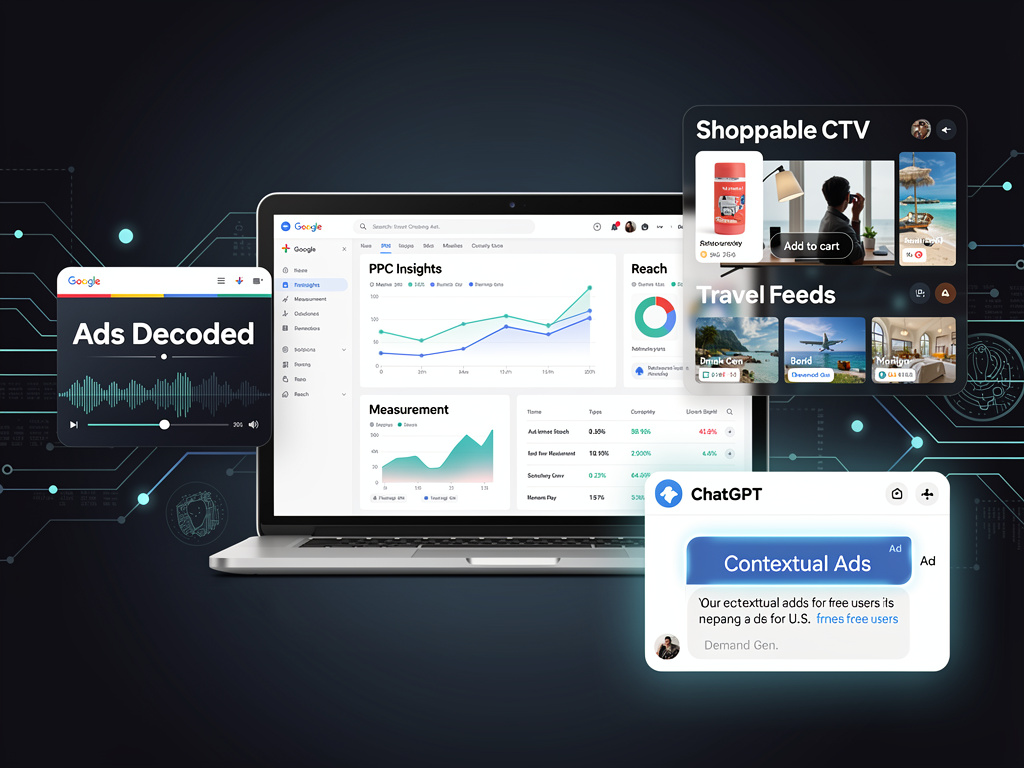
Google Ads is stepping up its game for advertisers grappling with rapid platform changes, launching a dedicated podcast amid expansions in Demand Gen campaigns and as OpenAI tests ads inside ChatGPT. These moves signal a pivotal shift in how brands communicate updates and capture demand across emerging channels.
The new ‘Ads Decoded’ podcast, hosted by Google Ads Liaison Ginny Marvin, debuts its first official episode on January 26, 2026. Pilot episodes already tackled AI Max for Search campaigns and Performance Max channel reporting, drawing praise from PPC pros. ‘The response to our pilot episodes proved that there is a hunger for a different kind of conversation – one that moves past the headlines and announcements and into the mechanics and nuances of how things actually work,’ Marvin said on LinkedIn.
Marketers can submit questions for future episodes, with Marvin promising to highlight overlooked community queries. Feedback has been enthusiastic: Jonathan Milanes called it ‘long awaited’ on LinkedIn, while Tony Adam voiced excitement to tune in, as noted in Search Engine Journal.
Bridging the Information Gap for PPC Pros
This podcast arrives as Google Ads rolls out frequent AI-driven updates, often leaving advertisers scrambling for clarity. Beyond blogs and help centers, ‘Ads Decoded’ offers audio discussions with product managers, aiming to demystify features in real-world practice. PPC land reported early episodes featured managers Karen Zang and Tal Akabas dissecting AI Max betas and PMax transparency tools, addressing advertiser demands for control amid automation.
The initiative responds to confusion over updates like AI Overviews and Performance Max opacity. By fostering direct dialogue, Google positions itself to preempt backlash seen in past rollouts, per industry observers in PPC land.
Advertisers praise the format for busy schedules, with Ben Luong querying submission processes—Marvin replied to drop questions anytime. This real-time engagement could redefine vendor-marketer relations in paid search.
Demand Gen’s New Arsenal Unlocks Upper-Funnel Wins
Google’s January 2026 Demand Gen Drop activates shoppable connected TV (CTV), attributed brand searches, and travel feeds, previewed at Google Marketing Live 2025. Shoppable CTV lets users browse and buy products mid-YouTube ad on TVs, yielding 7% more conversions at matching ROI, according to Google data cited in Google’s blog.
Attributed brand searches reveal campaign-driven branded queries on Google and YouTube, quantifying awareness impact—currently by-request via reps. Travel feeds link Hotel Center data for dynamic ads showing pricing, ratings, and availability. LG Electronics reported 24% higher conversion rates versus paid social and 91% lower CPA, per Google’s case study.
These tools build on 2025’s 26% conversions-per-dollar lift from 60+ AI tweaks, including channel controls and YouTube Shorts eligibility. Video Action Campaigns fully migrated to Demand Gen by late 2025, per Google Ads Help.
Measuring Demand Gen’s Full Impact
Jyll Saskin Gales called for broader attributed search access to justify YouTube spends, while Alexandru Stambari stressed data quality’s role, as shared in Search Engine Journal. Nielsen’s 2024 meta-analysis of 53,000+ YouTube campaigns confirmed AI ads’ ROAS edge across verticals.
2025 saw Demand Gen integrate with Performance Max in the ‘Power Pack’ framework alongside AI Max, per WordStream. Experiments now support custom bid strategies, enhancing testing. For ecommerce, pairing Demand Gen visuals with PMax shopping drove 28% ROAS uplifts in pet supplies cases, noted in WebProNews.
Advertisers must prioritize feeds and attribution; poor setups limit gains. Google’s blog urges creative excellence, with vertical videos boosting Shorts engagement since February 2025.
OpenAI’s Cautious Ad Entry into ChatGPT
OpenAI will test ads for U.S. free and Go tier users ($8/month, now global) in coming weeks, placing sponsored content below responses for conversation-relevant products. Ads are labeled, dismissible, with transparency on targeting and opt-outs for personalization. No ads for under-18s or near health, mental health, politics topics; conversations stay private, no data sales, per OpenAI’s blog.
Plus, Pro, Enterprise tiers remain ad-free. ‘Ads will be clearly labeled and separated from the organic answer,’ OpenAI stated. This funds infrastructure amid $1.4 trillion commitments, with ChatGPT at 800 million weekly users—90% free. Sam Altman once called ads ‘uniquely unsettling’ but softened, eyeing revenue beyond $20 billion run-rate, as in CNBC.
Contextual targeting matches queries like trip planning to hotel ads, without influencing responses. Aggregated metrics only for advertisers. Critics worry trust erosion, but OpenAI prioritizes UX over engagement, per WIRED.
Implications for Advertisers in AI-Driven Channels
ChatGPT ads pioneer conversational commerce, rivaling Google’s AI Mode. Reuters noted potential from high-intent chats, but rivals like Gemini loom if execution falters. Forbes highlighted five principles: mission alignment, answer independence, privacy, control, long-term value.
Google’s podcast and Demand Gen coincide with this, urging diversified portfolios: 70% proven, 20% optimization, 10% testing, per ALMCorp. X chatter from Neil Patel emphasizes Demand Gen’s pre-search reach across YouTube, Discover, feeds.
As platforms evolve, tools like ‘Ads Decoded’ and strict ad safeguards aim to build trust. Brands mastering these—shoppable video, contextual AI, transparent measurement—stand to capture demand in fractured attention arenas.


 WebProNews is an iEntry Publication