
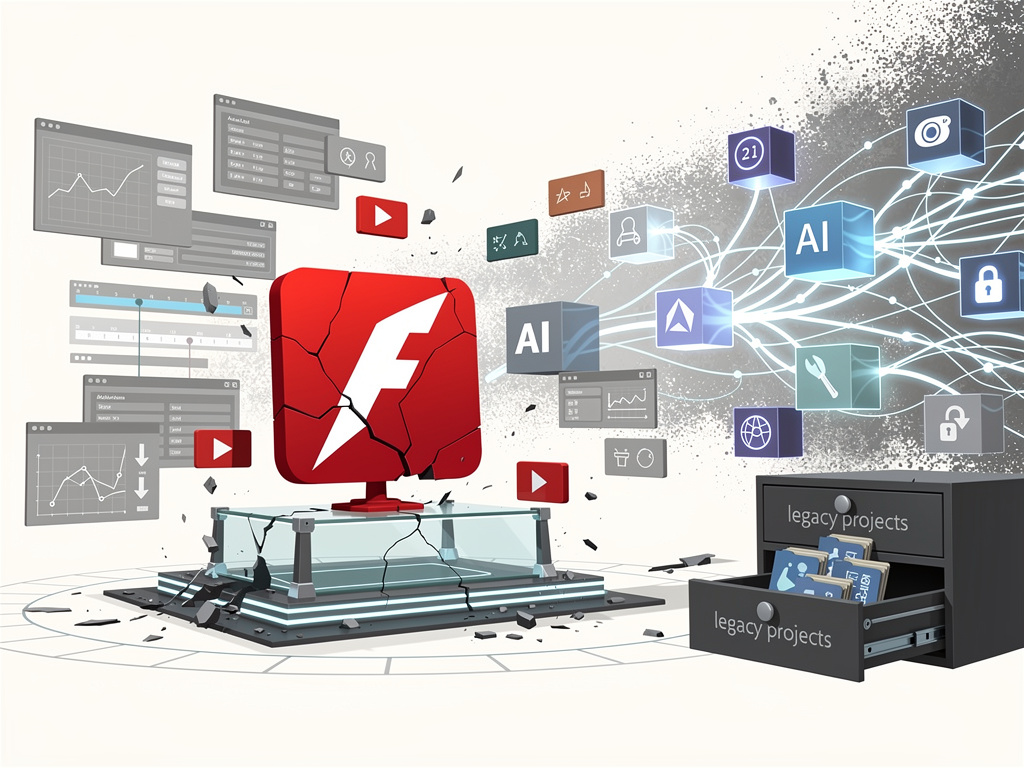
Adobe’s decision to discontinue its Animate application marks a watershed moment in the evolution of digital content creation, signaling the final chapter in a lineage that traces back to the once-ubiquitous Flash platform. The software giant’s announcement has sent ripples through the creative community, leaving professional animators, game developers, and interactive media designers scrambling to reassess their workflows and toolsets. According to The Verge, Adobe will officially sunset Animate, forcing users to migrate to alternative solutions or adapt to fundamentally different production paradigms.
The termination of Animate represents more than just the retirement of a single application—it symbolizes Adobe’s strategic pivot away from traditional timeline-based animation tools toward AI-powered creative solutions and cloud-native platforms. Industry veterans who built their careers mastering Flash and later Animate now face an uncertain future, while younger creators who never experienced the Flash era may struggle to understand the significance of this transition. The decision raises critical questions about software longevity, vendor lock-in, and the preservation of digital creative work in an industry increasingly dominated by subscription models and platform consolidation.
The Flash Legacy and Animate’s Troubled Inheritance
To understand the implications of Animate’s discontinuation, one must first appreciate its complicated heritage. Adobe Animate began life as Macromedia Flash, a revolutionary tool that democratized web animation and interactive content creation throughout the late 1990s and early 2000s. Flash became the de facto standard for web-based games, advertisements, educational content, and experimental animation, powering everything from Homestar Runner cartoons to sophisticated data visualizations. When Adobe acquired Macromedia in 2005 for $3.4 billion, Flash was at the zenith of its cultural influence, embedded in an estimated 98% of desktop browsers worldwide.
However, Flash’s dominance began eroding as mobile computing rose to prominence. Apple’s 2010 decision to exclude Flash from iOS devices—famously justified by Steve Jobs in an open letter citing performance, security, and battery life concerns—accelerated the platform’s decline. Adobe attempted to salvage Flash’s relevance by rebranding it as Animate CC in 2016, pivoting toward HTML5 Canvas output while maintaining support for legacy Flash content. This transformation was meant to position Animate as a versatile animation tool capable of producing content for modern web standards, but the rebrand never fully escaped Flash’s tarnished reputation or addressed fundamental workflow limitations that newer competitors had already solved more elegantly.
Market Forces and the Rise of Specialized Alternatives
The animation and interactive media sectors have fragmented dramatically over the past decade, with specialized tools emerging to serve specific niches that Animate attempted to address with a one-size-fits-all approach. For web animation, tools like Google Web Designer and various JavaScript libraries offer more direct paths to performant, standards-compliant output. Traditional 2D animation studios have gravitated toward Toon Boom Harmony, which provides superior rigging capabilities and production pipeline integration. Meanwhile, game developers have largely migrated to engine-native animation systems within Unity and Unreal Engine, eliminating the need for external animation tools altogether.
This market fragmentation has eroded Animate’s value proposition, particularly as Adobe’s own Creative Cloud ecosystem expanded to include competing products. Adobe After Effects has absorbed much of the motion graphics work that once fell to Animate, while Character Animator offers more intuitive puppet-based animation workflows. The company’s recent investments in AI-powered tools like Adobe Firefly further suggest a strategic direction incompatible with Animate’s traditional timeline-based methodology. Industry analysts note that Animate’s user base had been steadily declining, with many subscribers maintaining access primarily for legacy project compatibility rather than active production work.
The Preservation Crisis and Digital Archaeology Challenges
Adobe’s discontinuation of Animate raises urgent concerns about digital preservation and the accessibility of decades’ worth of creative work. Countless educational materials, cultural artifacts, and commercial projects exist exclusively in Flash or Animate formats, with no clear migration path to alternative platforms. Museums, libraries, and educational institutions that invested in Flash-based interactive exhibits now face the prospect of losing access to these materials entirely, as operating systems and browsers continue removing support for legacy plugins and runtimes.
Digital preservation specialists have long warned about the fragility of software-dependent creative work, but Animate’s shutdown makes these concerns tangible for mainstream creators. Unlike traditional media that can be preserved through format conversion, interactive content often relies on specific runtime environments and proprietary features that cannot be easily replicated. The Internet Archive’s Ruffle project, which aims to emulate Flash content through WebAssembly, offers partial solutions for web-based Flash files, but provides no answer for complex Animate projects utilizing ActionScript 3.0 or advanced timeline features. This preservation gap threatens to create a digital dark age for an entire era of interactive media.
Economic Implications for Professional Creators
For professional animators and studios with substantial investments in Animate-based workflows, the discontinuation presents significant economic challenges. Switching to alternative platforms requires not only software licensing costs but also extensive retraining, potential production delays, and the conversion or recreation of asset libraries. Small studios and freelancers who built their businesses around Animate expertise face particularly acute pressures, as their specialized knowledge suddenly becomes obsolete while competitors already proficient in alternative tools gain market advantages.
The transition costs extend beyond direct software expenses. Production pipelines built around Animate’s specific export formats, scripting capabilities, and integration points must be completely redesigned. Custom tools, plugins, and automation scripts developed over years become worthless overnight. For educational institutions that teach animation using Animate, curriculum overhauls require significant time and resources, while students who invested in learning the platform find their skills devalued before entering the job market. These cascading economic effects illustrate the hidden costs of dependence on proprietary software platforms, particularly those controlled by vendors with shifting strategic priorities.
Adobe’s Strategic Realignment and AI Ambitions
Adobe’s decision to sunset Animate aligns with a broader corporate strategy emphasizing artificial intelligence, cloud collaboration, and next-generation creative tools. The company has invested heavily in generative AI technologies through Adobe Firefly, positioning these capabilities as the future of creative work. This vision prioritizes rapid content generation, automated workflows, and intelligent assistance over the manual, frame-by-frame craftsmanship that Animate embodied. While Adobe maintains that other Creative Cloud applications will continue serving animation needs, the discontinuation signals diminished interest in supporting traditional animation methodologies.
The company’s focus on subscription revenue growth and cloud-native applications also makes maintaining legacy desktop applications like Animate economically unattractive. Each older application requires ongoing compatibility updates, security patches, and customer support—costs that become difficult to justify when user numbers decline and newer products offer higher profit margins. Adobe’s recent financial reports emphasize recurring revenue growth and expansion of AI-powered features, metrics that legacy applications cannot meaningfully contribute to. This corporate calculus, while rational from a shareholder perspective, leaves professional users who depend on stable, predictable tools in an increasingly precarious position.
Alternative Pathways and Industry Adaptation
As the Animate sunset date approaches, creative professionals are evaluating migration strategies and alternative toolsets. Toon Boom Harmony has emerged as the leading choice for traditional 2D animation studios, offering robust rigging, advanced timeline controls, and proven production pipeline integration. For web-focused work, developers increasingly turn to code-based animation libraries like GreenSock (GSAP) or Anime.js, which provide programmatic control and superior performance compared to timeline-based tools. Game developers continue consolidating around engine-native solutions, with Unity’s 2D animation tools and Spine gaining particular traction.
However, no single replacement perfectly replicates Animate’s unique combination of vector drawing tools, timeline animation, and multi-format export capabilities. This functionality gap forces many users toward multi-tool workflows, combining specialized applications to achieve results that Animate handled within a single interface. The fragmentation increases complexity, raises costs, and steepens learning curves—particularly problematic for independent creators and small teams with limited resources. Some users are exploring open-source alternatives like Synfig Studio or Pencil2D, though these options generally lack the polish and feature completeness of commercial products.
Lessons for the Creative Software Industry
The Animate discontinuation offers sobering lessons about software sustainability, vendor relationships, and the risks of proprietary platforms in creative industries. The episode underscores the vulnerability of professionals who build careers around specific software tools controlled by vendors with evolving strategic priorities. While subscription models promise continuous updates and improvements, they also grant vendors unprecedented power to discontinue products, alter features, or raise prices without meaningful user recourse. This asymmetric relationship has prompted growing interest in open-source alternatives and file format standards that reduce dependence on any single vendor.
The situation also highlights tensions between corporate innovation imperatives and user needs for stability and continuity. While Adobe’s pivot toward AI and cloud services may represent genuine technological progress, the transition imposes significant costs on existing users who require predictable, reliable tools for ongoing work. Balancing innovation with backward compatibility and migration support remains an unsolved challenge in the software industry, particularly as development cycles accelerate and market consolidation reduces competitive pressures to maintain legacy products. The creative community’s response to Animate’s sunset may influence how other software vendors approach similar transitions in the future, potentially establishing new expectations around end-of-life support and user data portability.


 WebProNews is an iEntry Publication