
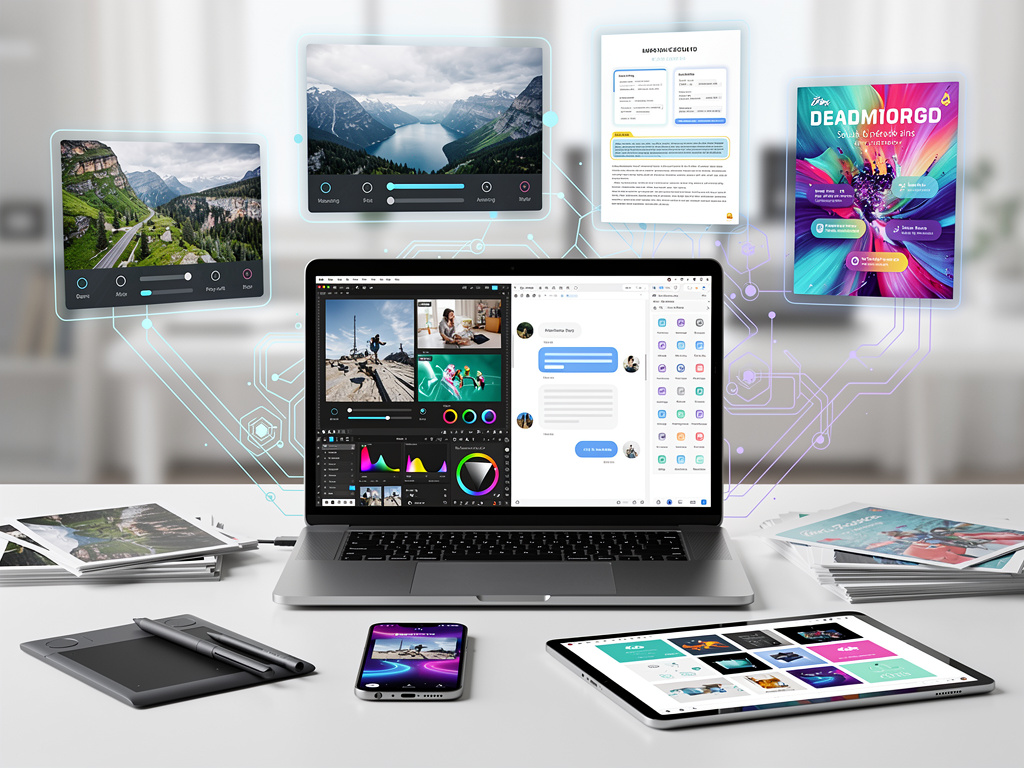
Adobe’s Creative Arsenal Meets AI Chat: A Game-Changer for Digital Design
In a move that could redefine how millions interact with design software, Adobe Inc. has announced a deep integration of its flagship tools—Photoshop, Express, and Acrobat—directly into OpenAI’s ChatGPT. This partnership, unveiled on December 10, 2025, allows users to perform complex editing tasks through simple conversational prompts, effectively bringing professional-grade creative capabilities to a chatbot interface used by over 800 million people worldwide. The integration promises to democratize access to advanced editing, making it as straightforward as chatting with a friend, while potentially reshaping Adobe’s position in an increasingly AI-driven market.
At its core, this collaboration enables ChatGPT users to edit images, manipulate PDFs, and create designs without ever leaving the chat window. For instance, a user might type, “Remove the background from this photo and add a sunset,” and Photoshop’s features would handle it seamlessly. Adobe’s own announcement highlights how this setup leverages the company’s Firefly AI models, ensuring outputs are safe, ethical, and commercially viable. Early reports suggest the tools are available for free, with options to upgrade for more advanced functionalities, marking a strategic pivot for Adobe amid growing competition from open-source AI alternatives.
This isn’t just a superficial add-on; it’s a native embedding that allows for real-time collaboration between human input and AI execution. Users can start with basic edits in ChatGPT and seamlessly transition to full Adobe web apps for finer control. According to details shared in a press release from Adobe, the integration aims to “make creativity accessible” by breaking down barriers for non-professionals, from small business owners designing marketing materials to students editing school projects.
Unlocking Everyday Creativity Through Conversation
The rollout has generated buzz across the tech community, with industry observers noting its potential to lower the entry barriers for creative work. On social platforms like X, users and analysts alike are hailing it as a “milestone for accessible AI,” with posts emphasizing how it bridges conversational interfaces with robust design suites. One prominent thread described it as “ChatGPT plus Adobe equals commercial AI for free,” underscoring the excitement around cost-free access to tools that traditionally required subscriptions or steep learning curves.
From a technical standpoint, the integration relies on Adobe’s ecosystem of AI-powered features, such as generative fill and object removal, now invocable via natural language. This mirrors broader trends where AI assistants are evolving from text generators to multifaceted productivity hubs. For PDFs, Acrobat’s capabilities allow users to summarize documents, extract insights, or even rewrite sections—all prompted conversationally. As reported by The Verge, this means no more app-switching; everything happens within ChatGPT, streamlining workflows for casual and professional users alike.
Adobe’s decision comes at a pivotal time, as the company faces pressure from generative AI upstarts that threaten its dominance in creative software. By embedding its tools into a massively popular platform like ChatGPT, Adobe not only expands its reach but also collects valuable data on user interactions, which could refine future AI models. Insiders suggest this is part of a larger strategy to integrate AI more deeply into Adobe’s suite, building on previous announcements like Firefly’s expansion into video and 3D generation.
Strategic Implications for Adobe’s Market Position
Delving deeper, this partnership could bolster Adobe’s revenue streams in subtle ways. While the base features are free within ChatGPT, users needing advanced edits are funneled toward Adobe’s paid subscriptions, creating a natural upsell path. Financial analysts are optimistic; following the announcement, Adobe’s stock saw a modest uptick, with some projecting it as a counter to the market value erosion the company experienced since ChatGPT’s initial launch in 2022. A post on X from investment-focused accounts echoed this sentiment, noting how Adobe is “dismantling the bear case” by turning AI from a threat into an asset.
Comparatively, competitors like Canva and Figma have already experimented with AI integrations, but Adobe’s move stands out due to the scale of ChatGPT’s user base. This isn’t Adobe’s first foray into AI collaborations; earlier in 2025, the company integrated its Firefly models with other platforms, but this ChatGPT tie-up is its most ambitious yet. As detailed in a TechCrunch article, the integration includes safeguards to prevent misuse, such as content credentials that track AI-generated elements, addressing concerns over authenticity in digital media.
For industry insiders, the real value lies in how this fosters hybrid workflows. Professionals can use ChatGPT for rapid prototyping—say, generating a logo variant—before refining it in full Photoshop. This hybrid approach could accelerate creative processes, potentially reducing time-to-market for campaigns and products. Moreover, it aligns with Adobe’s push toward ethical AI, as the tools are trained on licensed data, avoiding the legal pitfalls that have plagued some rivals.
User Experiences and Early Adoption Trends
Early adopters are already sharing practical examples. On X, creators have posted demos of using the integration to animate elements in images or merge PDFs for business reports, praising the intuitiveness. One user noted, “Adobe just added ChatGPT to Photoshop—prompt-based edits are a game-changer,” highlighting the shift toward AI-assisted creativity. This resonates with broader discussions on platforms where AI is seen as augmenting, not replacing, human designers.
However, challenges remain. Not all Photoshop features are fully replicated in ChatGPT; complex tasks still require the desktop app, which might frustrate power users. Privacy concerns also loom, as data processed through ChatGPT could raise questions about ownership and security. Adobe has addressed this by ensuring that user files remain under their control, with opt-outs for data usage in AI training, as per their official statements.
Looking at the competitive arena, this integration positions Adobe against tech giants like Google and Microsoft, who have their own AI-enhanced productivity tools. Microsoft’s Copilot, for example, integrates with Office apps, but lacks the creative depth of Adobe’s suite. By partnering with OpenAI, Adobe gains an edge in the conversational AI space, potentially attracting a new demographic of users who might never have considered premium design software.
Technological Underpinnings and Future Horizons
Under the hood, the integration leverages APIs that allow seamless handoffs between ChatGPT and Adobe’s cloud services. This technical synergy is built on years of AI development at Adobe, including advancements in neural networks for image manipulation. A Reuters report underscores how this enables users to “edit images, design graphics, and manage PDFs” directly, with the chatbot acting as an intelligent intermediary.
For developers and enterprises, this opens doors to custom integrations. Businesses could build ChatGPT bots that automate design tasks, such as generating branded content on the fly. Industry experts predict this could lead to a surge in AI-driven content creation, with Adobe at the forefront. Posts on X from tech conferences earlier in 2025, like Adobe MAX, foreshadowed such moves, with announcements about AI tools that “flip the design industry upside down.”
As we peer ahead, this partnership might evolve to include more Adobe products, like Illustrator or Premiere Pro, expanding the scope beyond images and documents. The integration also ties into global trends toward accessible tech, particularly in emerging markets where high-end software was previously out of reach. Adobe’s focus on inclusivity—making tools available to ChatGPT’s vast audience—could drive adoption in education and small enterprises, fostering a new generation of digital creators.
Broader Industry Ripples and Ethical Considerations
The ripple effects extend to the creative economy. Freelancers and agencies might find their workflows transformed, with AI handling rote tasks, freeing time for innovation. Yet, this raises questions about job displacement; while Adobe insists AI is a tool for enhancement, critics argue it could commoditize certain skills. Discussions on X reflect this duality, with some celebrating the “democratization of design” and others wary of over-reliance on AI.
Ethically, Adobe’s approach emphasizes transparency. Features like automatic watermarking for AI-edited content help combat misinformation, a growing concern in an era of deepfakes. This aligns with regulatory pushes in the U.S. and Europe for accountable AI, positioning Adobe as a responsible player.
In the grand scheme, this integration signals a convergence of AI and creative software, where chat interfaces become the new canvas. For Adobe, it’s a bold step to future-proof its business, blending its heritage of innovation with the cutting edge of generative AI. As users experiment and feedback shapes iterations, this could mark the beginning of a more intuitive, AI-infused creative era, accessible to all who can type a prompt.


 WebProNews is an iEntry Publication