
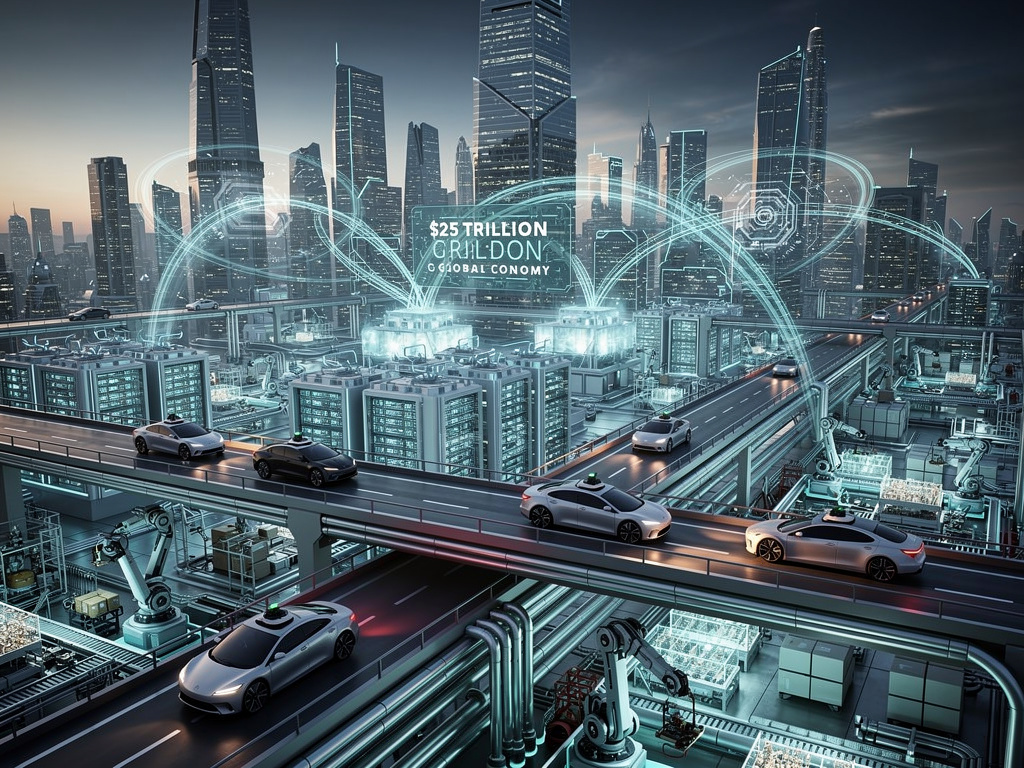
Morgan Stanley’s Adam Jonas, freshly minted as the bank’s global embodied AI strategist, is casting wide nets into uncharted waters of robotics and automation. Drawing from his lobster-fishing analogy, Jonas trawls overlooked corners of innovation, betting that humanoid robots, autonomous vehicles and drones will soon outnumber humans. His bold forecasts, detailed in the inaugural Robot Almanac, project $25 trillion in annual robot sales by 2050, a figure that encompasses hardware, software and services across industries.
In a Wall Street Journal profile, Jonas warns that American firms must lead this charge or risk ceding ground to global rivals. ‘If we don’t, someone else will,’ he declares, echoing concerns about China’s rapid roboticization. His vision includes 1.4 billion robots yearly by mid-century, with 10% deployed in the U.S. and 28% in China, transforming sectors from healthcare to logistics.
Jonas’s journey from auto analyst to robot oracle began in 1996, but pivoted dramatically after meeting Elon Musk in 2008 at SpaceX. ‘I was kind of rewired,’ Jonas recounted to the Journal. His prescient 2011 Tesla call, dubbing it ‘America’s Fourth Automaker’ with a $70 target, propelled the firm’s market cap to $1.4 trillion today, dwarfing the next 22 automakers combined.
From Detroit Skeptic to Tesla Prophet
Jonas’s provocative style shone in earnings calls, prompting eye-rolls from Musk and shout-outs from Detroit CEOs like Ford’s Jim Farley, who credited his ‘activist investor point of view’ for sharpening management. General Motors’ Mary Barra echoed the praise during his final auto coverage call in October. Now, unburdened by legacy autos, Jonas eyes private markets where buzziest firms trade shares pre-IPO amid dwindling public listings.
The Robot Almanac, co-authored with 30 Morgan Stanley experts and released in December, charts robotics hardware growing from $91 billion today to $540 billion by 2030, $2.7 trillion by 2035, and $25 trillion by 2050. Supply chains and maintenance could multiply revenues further, Jonas projects in the report.
Recent updates amplify his outlook. Morgan Stanley now expects Tesla to deploy 1,000 robotaxis by end-2026, per Sherwood News, tempering Musk’s 1,500-unit 2025 goal. Analysts maintain 1.597 million vehicle sales and 64 GWh energy storage for Tesla in 2026, with robotaxi catalysts front-loaded in H1.
Humanoids Enter the Fray
Humanoid robots anchor Jonas’s ‘Cambrian explosion of bots.’ Morgan Stanley pegs the market at $5 trillion by 2050, with adoption accelerating post-2030, according to a Morgan Stanley report. By then, the U.S. could host 63 million units, impacting wages by $3 trillion, as forecast in an earlier outlook.
Elon Musk, a Jonas muse, stunned Davos 2026 attendees by predicting robots will outnumber humans and AI surpass intelligence, per Euronews. He touted Tesla Optimus sales by end-2027, capable of chores with reliability and safety. WIRED noted Musk’s barrage of forecasts on humanoids, space and aging, though his timelines often slip.
Jonas himself put skin in the game with a $200 deposit on 1X’s Neo humanoid, priced at $20,000 and due late 2026. Remotely piloted initially via VR, it stirred family privacy debates in his Westchester home, as detailed in the Journal profile.
Tesla’s Twin Pillars: Robotaxis and Optimus
Tesla’s robotaxi rollout hit Austin roads in June 2025 after years of delays, with Musk vowing U.S.-wide spread by end-2026, CNBC reports. Morgan Stanley’s Jonas called a breakthrough in October 2025, per Investing.com.
Optimus developments fuel humanoid hype. Fox Business cited Musk’s end-2027 sales target, positioning Tesla against 25 firms Morgan Stanley flags as dominators, including leaders in a Business Insider ranking eyeing $5 trillion by 2050. CNBC highlighted investor and government enthusiasm driving rapid evolution.
Jonas envisions drones swarming past his Times Square office, robotaxis ferrying workers home to AI assistants, and robotic office mates. Yet he tempers optimism, noting robots may displace jobs, forcing society to grapple with humanity’s essence and mitigate risks, inspired by sci-fi like Karel Čapek’s ‘R.U.R.,’ which coined ‘robot.’
Global Stakes and Private Market Surge
Morgan Stanley’s push into private markets suits Jonas’s role, as ultrawealthy clients snap up pre-IPO shares amid halved U.S. public listings since 1999. Teamed with energy analyst Stephen Byrd, he meets surging demand for opaque private-firm intel.
China looms large, projected at 28% of 2050 robots versus U.S. 10%, per the Almanac. Jonas’s video on Morgan Stanley’s site blurring mobile devices and robots underscores AI-physical economy intersections.
Despite distractions like Musk’s political foray—prompting Jonas’s July 2025 Yahoo Finance warning—Tesla bulls hold firm. The strategist’s ‘punch in the brain’ ethos persists, fostering ‘productive anxiety’ among clients eyeing automation’s inexorable march.
Investment Plays in the Bot Economy
For insiders, Jonas spotlights 25 humanoid frontrunners in Business Insider’s analysis. Broader plays span AI, data centers and supply chains, with robotics services dwarfing hardware sales long-term. Morgan Stanley’s $357 billion 2040 humanoid impact forecast, from a 2024 note, sets early benchmarks.
Davos buzz, with Musk framing AI-robots as poverty and stagnation antidotes per Digital Watch Observatory, signals policy tailwinds. Yet WIRED cautions on Musk’s predictive track record.
Jonas’s traps are set. As Neo arrives and Tesla scales, his bets could redefine markets—or spark that Čapek-style rebellion Wall Street never saw coming.


 WebProNews is an iEntry Publication