
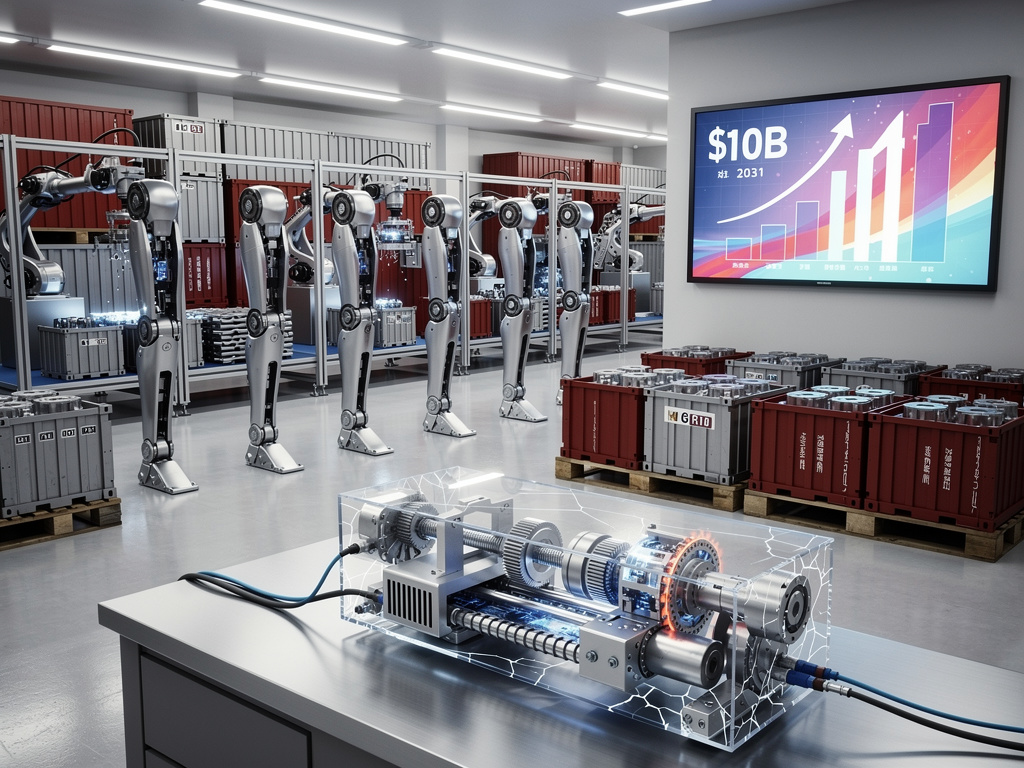
Humanoid robots promise to reshape warehouses and factories. But their joints fail fast. Actuators, the motors and gears powering every bend and stride, crack under the relentless pounding of bipedal steps. A single shift delivers over 40,000 shock loads—each 2 to 3 times the robot’s weight slamming in under a millisecond. Industrial parts shear apart. Engineers scramble for fixes.
Firgelli Automations laid bare the crisis in its engineering guide. Walking demands 5,000 steps an hour for warehouse duty, that’s 84 steps a minute. Heel strikes hit like hammers: 1,400 to 2,100 newtons for a 70-kilogram machine. Back-drivability becomes non-negotiable. Self-locking screws force gearboxes to eat every jolt, leading to failure. Companies like Tesla’s Optimus, Figure, Unitree, Agility’s Digit, and Boston Dynamics’ electric Atlas converge on split designs—rotary for spins, linear for extensions. Firgelli Automations.
Rotary actuators rule hips, knees, ankles, shoulders, elbows. Brushless motors with rare-earth magnets pump 100 to 150 newton-meters peak for hip torque during stairs. Strain wave gearing—think Harmonic Drive—delivers zero backlash in 50:1 to 100:1 ratios. Compact. High density. But efficiency dips to 80-85 percent, and shocks chew the flexspline.
Linear actuators take the brunt at knees and ankles. Inverted planetary roller screws shine here. Frameless motors spin the nut; rollers orbit to push the shaft. Line contacts spread loads 10 to 15 times better than ball screws’ points. Brinelling? Roller screws laugh it off after years; balls quit at 100,000 cycles. Specific force hits 3,500 to 5,000+ newtons per kilogram. Ball screws top out at 800 to 3,500. Lead screws limp at 300 to 800. Only rollers cut it. Boom. Mass penalty spiral.
Add 200 grams to an ankle actuator. Knee balloons by 350 grams. Hip jumps 600 grams. Battery swells 150 grams. Total: 1.3 kilograms extra across the leg. Cost of transport—energy per distance—skyrockets. Bipedals run 0.2 to 0.5, 10 to 50 times worse than wheels at 0.01 to 0.05. Reflected inertia kills rotary gears too. J_output equals J_rotor times gear ratio squared. A 100:1 ratio? 10,000 times heavier feel. Joints turn to bricks under impact.
Quasi-direct drive fights back. Low ratios, 6:1 to 30:1, like Unitree’s H1 and G1 or MIT Cheetah. Bouncy. Back-drivable under 1 newton-meter. Current sensing fakes torque. Downside: sky-high currents for holds, heat buildup. High-reduction setups—30:1 to 50:1 sweet spot—pack strength but demand torque sensors and software compliance. Tesla and Figure lean this way.
Heat sneaks in everywhere. Stall torque for poses sparks Joule heating: power_heat = I squared times resistance. Continuous torque? Just 25 to 30 percent of peak. A 100 newton-meter peak drops to 25 continuous. Temps climb to 40 Celsius? Derate to 18 newton-meters after two minutes. Liquid cooling boosts to 50 to 70 percent, but piles on weight. Aluminum housings. Exposed fins. Ventilation. Survival basics.
Control layers stack high. Forget PWM position loops—they smash obstacles. Torque control via field-oriented control blasts q-axis current 20,000 times a second. Impedance mimics springs: torque = K times position error plus D times velocity error. Stiff for stance, soft for swing. Model predictive control peers 10 to 20 steps ahead at 500 to 1,000 hertz. Full stack: task planner at 10 hertz, MPC mid, impedance 1,000 to 5,000 hertz, FOC 10,000 to 40,000 hertz. Sensors flood data—encoders, IMUs, current, force plates. Latency stays tight.
Compliance saves lives. Or bots. Series elastic actuators slot springs for shock buffering via Hooke’s law: torque = k times deflection. Dual encoders measure it clean. Energy storage too—50 percent work return in runs, Achilles-style. Agility Digit goes physical for passive safety. Tesla picks virtual impedance—tunable, sim-friendly, but no free storage and gearbox risks. Collision? Compliant bots yield.
Market heats up. Valuates Reports pegs humanoid actuators at $150 million in 2024, exploding to $9.9 billion by 2031. Asia-Pacific leads manufacturing; North America pushes research and healthcare. Actuators gobble 40 to 60 percent of bill of materials, 20 to 40 body units plus 50 hands for Optimus Gen 3. AI Business.
Innovators charge. Schaeffler’s planetary gear actuator debuted at CES 2026: 60 to 250 newton-meters torque, two-stage gearbox, motor, encoder, controller in one. Smooth back-driving. High precision. Continuous duty. ‘A highly efficient drive system that enables precise and energy-efficient motion sequences,’ per their release. April 2026, it snagged the Hermes Award at Hannover Messe. Jury head Holger Hanselka: ‘Systemic actuator platforms play a central role in the scaling of service robotics… a key component in humanoid robotics.’ Actuators hit 50 percent of humanoid costs—Schaeffler’s modularity slashes that for volume production. Schaeffler; Schaeffler Hermes.
Korea joins the fray. Hyundai Mobis inks with Boston Dynamics for Atlas actuators, targeting 30,000 units by 2028 on auto-scale manufacturing. LG Electronics’ Axiom brand arms its Cloid robot and eyes outsiders, drawing motor durability know-how. Samsung Electro-Mechanics backs Norway’s Alva Industries for tiny high-performers. Korea JoongAng Daily.
SRI’s Inception Drive twists minds. Ultra-compact infinitely variable transmission via nested pulleys. Constant motor input yields faster, slower, reverse, or neutral output. Safer. Cheaper than harmonics. Vastly efficient for robots. Even hard to picture, admits inventor Alexander Kernbaum. IEEE Spectrum.
China dominates supply chains at 63 percent, per X chatter from insiders. XPeng repurposes EV actuators, magnets, sensors. U.S. owns AI brains. Muscle race heats. Actuators aren’t just parts. They’re the physics bottleneck deciding if humanoids walk factories—or flop.


 WebProNews is an iEntry Publication