
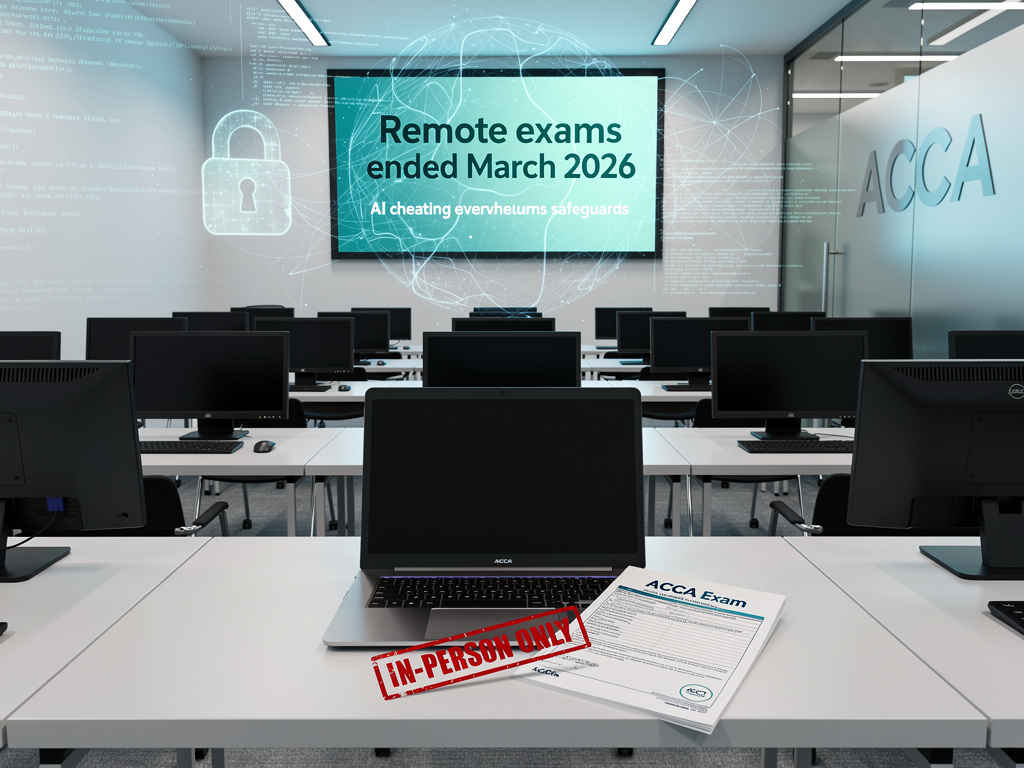
The Association of Chartered Certified Accountants (ACCA), the world’s largest accounting body with nearly 260,000 members and over 500,000 students, is ending remote exams from March 2026, citing an unstoppable surge in AI-powered cheating. Chief Executive Helen Brand told the Financial Times that “we’re seeing the sophistication of [cheating] systems outpacing what can be put in, [in] terms of safeguards.” This move reverts assessments to in-person venues except in exceptional cases, marking a pivotal shift in professional certification amid technology’s double-edged advance.
Remote invigilation debuted during the Covid-19 lockdowns to sustain candidate progress, but ACCA now deems it untenable. Brand emphasized to the Guardian that despite intensive countermeasures, “people who want to do bad things are probably working at a quicker pace.” The decision follows high-profile scandals at major firms, amplifying pressure on bodies like ACCA to restore exam integrity.
Recent web searches reveal widespread coverage, with outlets like Semafor noting cheats are “outpacing” defenses, while The Decoder highlights AI tools enabling real-time question solving. Posts on X from industry observers echo this, pointing to ACCA’s overhaul of its qualification—the first in a decade—to integrate AI, blockchain, and data science training.
Big Four Scandals Fuel Urgency
In 2022, the UK’s Financial Reporting Council (FRC) flagged exam cheating as a “live” issue among top firms, including the Big Four—KPMG, PwC, Deloitte, and EY—plus Mazars, Grant Thornton, and BDO, per the Guardian. EY paid a record $100 million to U.S. regulators after dozens of employees cheated on an ethics exam and misled investigators, as detailed in the FT.
These incidents underscore vulnerabilities in high-stakes testing. One student recounted to the FT photographing exam questions for an AI chatbot, illustrating how tools like advanced large language models bypass proctors. A study cited by The Decoder showed reasoning models passing the rigorous CFA certification, signaling broader risks for finance professions.
ACCA’s pivot aligns with global trends. The Institute of Chartered Accountants in England and Wales (ICAEW) reports rising fraud but retains some online options. Brand noted to the FT, “There are very few high-stakes examinations now that are allowing [remote invigilation],” positioning ACCA ahead of peers.
Pandemic Legacy Meets AI Reality
Online exams proliferated post-2020 to avoid disruptions, but AI’s ascent—exemplified by tools generating instant solutions—has eroded trust. ACCA’s 257,900 members worldwide face a profession demanding unassailable credentials, especially as firms grapple with regulatory scrutiny post-scandals.
Brand described the issue reaching a “tipping point” driven by rapid tech evolution. Web updates confirm no reversal; ACCAGlobal’s X activity reinforces the March timeline. This affects over half a million students, many in remote regions, forcing travel to test centers.
Industry insiders view this as a bellwether. Reddit discussions in legal admissions forums speculate similar fates for bar exams, linking to LSAT shifts toward in-person formats amid parallel concerns.
Overhaul Signals Profession’s Future
ACCA isn’t just closing remote doors; it’s revamping its syllabus for the digital era. The FT reports new emphases on AI ethics, data analytics, and emerging tech to equip accountants against automation threats. This addresses criticisms that curricula lag behind tools now undermining assessments.
Cheating’s toll extends beyond individuals. FRC probes revealed tier-one auditors implicated, eroding public confidence in financial oversight. ACCA’s action aims to safeguard qualification rigor, vital for a sector auditing trillions amid economic volatility.
Peers like ICAEW face mounting reports, per the Guardian, yet hesitate on full bans. ACCA’s decisive step sets a precedent, prompting debates on X about balancing accessibility with integrity.
Global Ripples and Enforcement Challenges
With students spanning continents, implementation poses logistics hurdles. Exceptional circumstances may permit limited remote access, but details remain sparse. Brand’s FT interview stresses proportionality, targeting bad actors without penalizing honest candidates.
AI detection lags creation; proctoring software struggles against subtle aids like earpieces or secondary devices. The Decoder cites ACCA’s admission that fraud scales faster than fixes, echoing Nvidia CEO Jensen Huang’s unrelated Capitol Hill appearance amid AI scrutiny.
Current X sentiment mixes support for integrity with gripes over inconvenience, especially for international students. Accountancy Age warns of ditching the “sofa professional,” predicting firm adjustments in hiring pipelines.
Implications for Firms and Regulators
Big Four recruiters, burned by scandals, welcome bolstered credentials. PwC and Deloitte face ongoing probes, per FT archives, heightening stakes for clean pipelines. ACCA’s 260,000 members staff global enterprises, making exam purity non-negotiable.
Regulators like the FRC may extend oversight to exam processes. U.S. precedents, including EY’s fine, signal escalating penalties. ICAEW’s persistence with partial remotes invites scrutiny if breaches persist.
Web news from Biztoc and Inkl corroborates ACCA’s rationale, framing it as inevitable amid AI proliferation. This reshapes training economics, potentially raising costs but fortifying trust.
Path Forward in Tech-Driven Era
ACCA’s qualification refresh incorporates AI defenses, training members to wield tools ethically. Brand’s vision, per Semafor, positions accountants as tech-fluent guardians of finance. Students must adapt, with in-person mandates spurring center expansions.
Long-term, this combats commoditization of knowledge via AI. Professions like law and medicine eye similar returns to supervised settings. X posts from ACCA underscore commitment: integrity first.
For industry veterans, this underscores vigilance. As AI evolves, so must safeguards—lest credentials crumble under digital ingenuity.


 WebProNews is an iEntry Publication