
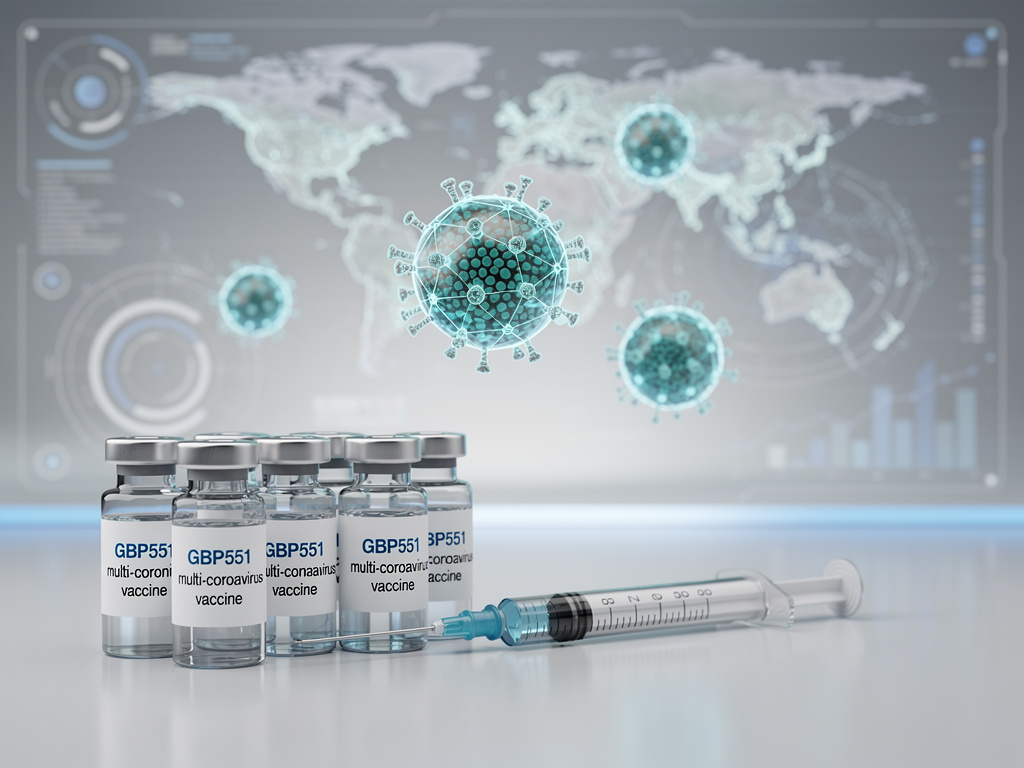
For years, the specter of the next pandemic has loomed over global public health. COVID-19 demonstrated with devastating clarity how quickly a novel coronavirus could upend civilization, killing millions and reshaping economies. Now, a small Seattle-based biotech company and its academic partners are attempting something that was once considered a moonshot: a single vaccine designed to protect against not just one coronavirus, but an entire family of them. The first doses have been administered to human volunteers, marking a pivotal moment in the long quest for a pan-coronavirus vaccine.
On Tuesday, GeekWire reported that SK bioscience, a South Korean vaccine manufacturer, has begun dosing participants in a Phase 1 clinical trial of what is believed to be the first multi-coronavirus vaccine to enter human testing. The vaccine, known as GBP551, is built on nanoparticle technology developed at the University of Washington School of Medicine’s Institute for Protein Design, one of the world’s foremost laboratories for computational protein engineering. The trial represents the culmination of more than half a decade of research that accelerated dramatically during and after the COVID-19 pandemic.
From Protein Design Lab to Clinical Reality
The technology underpinning GBP551 emerged from the lab of Neil King, a biochemist at the University of Washington’s Institute for Protein Design. King and his colleagues have spent years developing self-assembling protein nanoparticles — tiny, soccer-ball-shaped structures that can display fragments of viral proteins on their surfaces. The concept is elegant: by decorating a single nanoparticle with receptor-binding domains from multiple different coronaviruses, the immune system can be trained to recognize shared features across the coronavirus family, rather than just the specific strain circulating at any given moment.
This approach differs fundamentally from the mRNA vaccines produced by Pfizer-BioNTech and Moderna during the COVID-19 pandemic, which targeted the spike protein of a single SARS-CoV-2 variant. While those vaccines proved remarkably effective at reducing severe disease and death, they required frequent updates as the virus mutated. A pan-coronavirus vaccine, by contrast, aims to elicit broadly neutralizing antibodies that could provide durable protection against known coronaviruses — including SARS-CoV-1, MERS, and multiple SARS-CoV-2 variants — as well as novel coronaviruses that have not yet jumped from animals to humans.
The Science of Mosaic Nanoparticles and Broad Immunity
The nanoparticle platform at the heart of GBP551 uses what scientists call a “mosaic” display strategy. Rather than presenting copies of a single antigen, the nanoparticle carries receptor-binding domains from several different coronaviruses simultaneously. According to GeekWire’s reporting, this mosaic approach has shown in preclinical studies the ability to generate immune responses against coronaviruses that were not even included on the nanoparticle — a phenomenon that suggests the immune system is learning to recognize conserved structural features shared across the viral family.
Neil King’s work at the Institute for Protein Design has been supported by significant funding from organizations including the Bill & Melinda Gates Foundation, the National Institutes of Health, and the Coalition for Epidemic Preparedness Innovations (CEPI). The institute, led by David Baker, who won the 2024 Nobel Prize in Chemistry for his contributions to computational protein design, has become a powerhouse in the development of next-generation vaccines. The nanoparticle technology has also been explored for other infectious diseases, but the coronavirus application has attracted the most attention given the ongoing threat of future pandemics.
SK Bioscience Steps Into the Spotlight
SK bioscience, headquartered in Seongnam, South Korea, licensed the nanoparticle technology from the University of Washington and has been developing GBP551 through its own research and manufacturing pipeline. The company is no stranger to vaccine development; it produced a COVID-19 vaccine called SKYCovione, which received emergency use authorization in South Korea in 2022 and was also based on nanoparticle technology from the Institute for Protein Design. That earlier collaboration provided SK bioscience with critical experience in manufacturing protein nanoparticle vaccines at scale, experience that is now being applied to the more ambitious pan-coronavirus candidate.
The Phase 1 trial is designed primarily to assess the safety and immunogenicity of GBP551 in a small group of healthy adult volunteers. As reported by GeekWire, the study will evaluate multiple dose levels to determine the optimal amount of antigen needed to provoke a robust immune response without causing unacceptable side effects. Participants will be monitored for both the breadth and durability of their antibody responses, with particular attention paid to whether the vaccine elicits neutralizing antibodies against coronaviruses not represented in the vaccine construct.
Why a Pan-Coronavirus Vaccine Matters Now
The urgency of developing a broadly protective coronavirus vaccine cannot be overstated. Three times in the past two decades, coronaviruses have caused significant outbreaks in humans: SARS in 2003, MERS beginning in 2012, and COVID-19 starting in late 2019. Scientists have identified hundreds of additional coronaviruses circulating in bat and other animal populations, any one of which could potentially adapt to infect humans. The economic and human toll of COVID-19 alone — more than 7 million confirmed deaths worldwide and trillions of dollars in economic losses — has made the case for proactive pandemic preparedness impossible to ignore.
Current COVID-19 vaccines, while still valuable, face diminishing public uptake. In the United States, fewer than 25% of adults received the most recent updated COVID-19 booster, according to data from the Centers for Disease Control and Prevention. Vaccine fatigue, combined with the perception that COVID-19 has become a manageable endemic illness, has eroded demand. A pan-coronavirus vaccine that could be administered once or infrequently, offering protection against a wide range of threats, could represent a paradigm shift in how societies defend against these pathogens.
The Competitive Field and the Road Ahead
GBP551 is not the only pan-coronavirus vaccine candidate in development, but it appears to be the first to reach human clinical testing with a true multi-coronavirus design. Other efforts are underway at institutions including the Walter Reed Army Institute of Research, which has developed a spike ferritin nanoparticle vaccine, and the California Institute of Technology, where researchers have also explored mosaic nanoparticle approaches. Several mRNA-based candidates from Moderna and other companies are being designed to target multiple variants, though these tend to focus on SARS-CoV-2 lineages rather than the broader coronavirus family.
The path from Phase 1 to a licensed, widely available vaccine is long and uncertain. Even if GBP551 proves safe and immunogenic in early trials, it will need to demonstrate efficacy in larger Phase 2 and Phase 3 studies — a process that could take several years and require hundreds of millions of dollars in additional investment. One of the central challenges is that there is no established correlate of protection for pan-coronavirus immunity, meaning regulators and scientists will need to develop new benchmarks for evaluating whether the vaccine truly works against a broad range of threats.
The University of Washington’s Growing Influence in Vaccine Science
The Institute for Protein Design has emerged as one of the most consequential academic laboratories in modern vaccine science. Beyond the coronavirus nanoparticle work, the institute has contributed to vaccine candidates for respiratory syncytial virus (RSV), influenza, and other pathogens. David Baker’s Nobel Prize-winning research on protein structure prediction and design has provided the foundational tools that make it possible to engineer nanoparticles with atomic-level precision, ensuring that viral antigens are displayed in the exact orientation needed to provoke the strongest possible immune response.
Neil King, who has been the driving force behind the nanoparticle vaccine platform, has emphasized in previous interviews and publications that the goal is not merely to respond to the last pandemic but to get ahead of the next one. The mosaic nanoparticle strategy is specifically designed to anticipate viral evolution, training the immune system to recognize the structural features that coronaviruses are least likely to mutate away from. If the approach works as hoped, it could serve as a template for developing broadly protective vaccines against other viral families, including influenza.
What Success Would Mean for Global Health
Should GBP551 or a similar pan-coronavirus vaccine ultimately prove effective, the implications for global health infrastructure would be profound. Instead of racing to develop, manufacture, and distribute a new vaccine every time a novel coronavirus emerges — a process that took approximately 11 months during the COVID-19 pandemic, an unprecedented speed that is unlikely to be replicated — public health authorities could stockpile a broadly protective vaccine in advance. This would be particularly valuable for low- and middle-income countries, which were largely shut out of early COVID-19 vaccine supplies.
SK bioscience’s manufacturing capabilities add another dimension to this potential. The company has invested heavily in vaccine production infrastructure and has partnerships with global health organizations aimed at ensuring equitable access. If GBP551 advances through clinical development, the combination of cutting-edge American academic science and South Korean manufacturing scale could provide a model for how the world develops and deploys the next generation of pandemic countermeasures.
For now, the first human volunteers in the Phase 1 trial are the ones shouldering the immediate risk and hope. Their participation marks the beginning of what could be a years-long journey from laboratory concept to global public health tool. But the mere fact that a multi-coronavirus vaccine has reached this stage — built on computationally designed proteins, displayed on self-assembling nanoparticles, and targeting a family of viruses rather than a single pathogen — represents a remarkable scientific achievement. Whether it fulfills its promise will depend on the data that emerge in the months and years ahead, but the ambition behind GBP551 is nothing short of an attempt to change the terms of humanity’s relationship with one of its most persistent viral adversaries.


 WebProNews is an iEntry Publication