
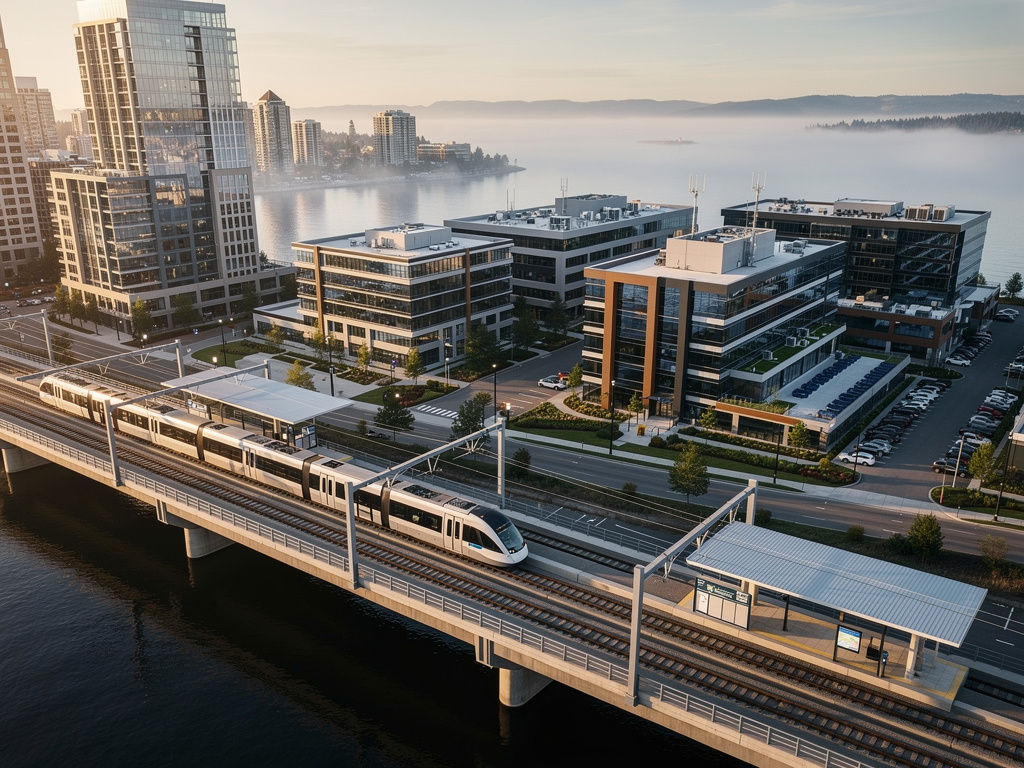
For decades, the commute between Seattle and its booming Eastside suburbs meant sitting in traffic on a floating bridge, watching minutes bleed into hours. That era ended on June 28, 2025, when Sound Transit’s 2 Line light rail carried its first passengers across Lake Washington, linking downtown Seattle to Bellevue and Redmond in roughly 45 minutes.
The opening wasn’t just a transit milestone. It was a vindication of corporate bets placed years ago — and a signal that the economic geography of the Pacific Northwest is being redrawn in real time.
Amazon and Microsoft, the two largest employers on the Eastside, didn’t just cheer from the sidelines. They showed up. As GeekWire reported, executives from both companies celebrated the launch, framing the rail line as a transformative piece of infrastructure that will reshape how tens of thousands of workers move between the region’s two economic poles.
Amazon Web Services CEO Matt Garman rode the inaugural train and called the line “a huge deal” for the region. Microsoft President Brad Smith, whose company’s sprawling Redmond campus sits near the line’s eastern terminus, described it as a generational investment. Both companies contributed financially to the project and pushed for its completion during years of delays and cost overruns.
The Line That Almost Wasn’t
The 2 Line — originally known as East Link — was approved by voters in 2008 as part of Sound Transit’s ST2 ballot measure. It was supposed to open in 2023. Construction challenges, pandemic disruptions, and issues with the tracks near the Interstate 90 floating bridge pushed the timeline back repeatedly. The final price tag swelled past $5.3 billion.
Critics questioned whether the investment made sense in a post-pandemic world where remote work had hollowed out office towers across the Puget Sound region. Ridership projections drawn up before COVID looked optimistic at best. Sound Transit’s own 1 Line, running from the University of Washington to SeaTac Airport and beyond, had seen ridership recover but still hadn’t reached pre-pandemic forecasts by early 2025.
But the Eastside kept growing anyway. Bellevue’s skyline has been transformed by a forest of construction cranes over the past five years. Amazon relocated thousands of employees to a new Bellevue campus, making the city a second headquarters in all but name. Meta, Google, and a constellation of smaller tech firms expanded their Eastside footprints. The residential population surged.
And that changed the calculus. The 2 Line doesn’t just serve commuters heading to downtown Seattle anymore. It connects two major job centers to each other and to the residential neighborhoods in between. A software engineer living in Capitol Hill can now reach Microsoft’s campus without a car. A Bellevue resident can get to Amazon’s South Lake Union offices without merging onto I-405.
Sound Transit CEO Julie Timm said the agency expects weekday ridership on the 2 Line to ramp up to between 45,000 and 50,000 riders per day within the first two years, according to the agency’s projections shared at the opening ceremony. Opening-day crowds were heavy, with trains running at capacity during midday hours — a promising sign, though transit officials cautioned against reading too much into a single day of curiosity-driven ridership.
The line runs from the International District/Chinatown station in Seattle, crosses Lake Washington on the Homer M. Hadley Memorial Bridge, then threads through Mercer Island, the South Bellevue park-and-ride, downtown Bellevue, the Bel-Red corridor, the Overlake area near Meta’s offices, and terminates at Redmond Technology Station adjacent to Microsoft’s campus. Future extensions will push the line further into downtown Redmond.
Corporate Infrastructure as Competitive Advantage
What makes the 2 Line opening unusual among American transit projects is the degree to which private companies shaped its trajectory and are now positioning themselves to benefit from it.
Amazon’s Bellevue expansion was, by the company’s own admission, planned with the light rail timeline in mind. The company’s 43-story Bellevue 600 tower and surrounding office buildings sit within walking distance of the Bellevue Downtown station. When Amazon announced in 2023 that it would require corporate employees to return to the office five days a week, the coming rail link was cited internally as a factor that would ease the transition for employees living in Seattle, according to people familiar with the discussions.
Microsoft has been even more explicit. The company donated land for the Overlake Village station and invested in pedestrian infrastructure connecting the station to its campus. Smith told GeekWire that the rail line would help Microsoft recruit talent that might otherwise resist a Redmond commute. “This connects us to the entire region in a way that a highway never could,” he said.
The investments extend beyond the tech giants. Vulcan Real Estate, the development arm of the late Paul Allen’s estate, and Kemper Development, which owns the Bellevue Collection shopping complex, have poured hundreds of millions into transit-oriented developments near stations along the line. The Spring District, a massive mixed-use development in the Bel-Red corridor anchored by a Facebook (Meta) office and a REI headquarters, was designed explicitly around its light rail station.
Real estate data tells the story in numbers. According to recent analysis from Redfin, median home prices within a half-mile of 2 Line stations in Bellevue rose 14% between January 2024 and June 2025, outpacing the broader Eastside market by roughly six percentage points. Commercial rents near stations have followed a similar trajectory, with Class A office space within walking distance of the Bellevue Downtown station commanding a 20% premium over comparable space a mile away, per CBRE’s Q1 2025 Puget Sound market report.
Not everyone is celebrating. Small business owners along the construction corridor in Bel-Red spent years dealing with reduced foot traffic, road closures, and construction noise. Some didn’t survive. A Vietnamese restaurant owner on 130th Avenue NE told The Seattle Times last year that she’d lost 40% of her revenue during the heaviest construction period and wasn’t sure the promised ridership boom would bring it back.
Transit equity advocates have also raised concerns. The 2 Line’s route connects some of the wealthiest zip codes in Washington state. Its stations are surrounded by expensive new apartment towers, not affordable housing. While Sound Transit has invested in subsidized transit passes for low-income riders, critics argue the line primarily serves high-income tech workers and the developers who build for them.
There’s tension in that critique, and some truth. But it also undersells the line’s potential to connect lower-income communities in Southeast Seattle and the Rainier Valley — served by the 1 Line — to Eastside job centers via a transfer at the International District station. That connection didn’t exist before. Whether it translates into real economic mobility depends on factors well beyond transit infrastructure: housing costs, childcare access, job training programs.
What the Eastside Looks Like in Five Years
The 2 Line is only part of Sound Transit’s buildout. Extensions to Tacoma, Everett, and further into Redmond and Issaquah are in various stages of planning and construction, though several face their own budget pressures and timeline risks. The Federal Way extension on the 1 Line opened earlier this year. A Lynnwood extension is expected soon.
But the cross-lake connection is the linchpin. It turns two separate transit networks — one serving Seattle, one serving the Eastside — into a single integrated system. And it arrives at a moment when the Eastside is asserting itself as more than a bedroom community for Seattle workers.
Bellevue now has more Class A office space than downtown Portland. Its population has grown 25% since 2010. It has a Michelin-starred restaurant scene, a growing arts district, and a downtown that, for the first time, feels genuinely urban. The light rail line both reflects and accelerates that transformation.
Amazon’s Garman put it bluntly during the opening festivities. “This is two cities becoming one metro,” he said, per GeekWire’s reporting. That framing may be slightly ahead of reality — Seattle and Bellevue maintain very different political cultures, tax structures, and development philosophies. But the economic integration is undeniable, and the train makes it physical.
For the tech industry specifically, the implications are practical and immediate. Companies with offices on both sides of the lake can now move employees between campuses without requiring a car or a 90-minute bus ride. Recruiting pools expand. Housing flexibility increases. The argument against locating on the Eastside — that it’s too hard to get to — just got a lot weaker.
So did the argument against living there.
The 2 Line won’t solve the Seattle region’s traffic problems. Interstate 90 and State Route 520 will still be clogged during rush hour. The train runs every eight minutes during peak periods, which is adequate but not exceptional by global standards. And the last mile problem — getting from a station to a final destination that isn’t within walking distance — remains real for many riders.
But as an infrastructure investment, it’s hard to argue with the logic. The Puget Sound region added nearly 800,000 people between 2010 and 2024. It can’t build enough highway lanes to keep up. Rail, for all its costs and delays, offers a path that doesn’t require paving over more of the region’s geography.
And the companies that bet on it — Amazon, Microsoft, Meta, and the developers who followed them — are now sitting on transit-adjacent real estate in one of the fastest-growing corridors in the country. That’s not altruism. It’s strategy. The train just made it real.


 WebProNews is an iEntry Publication