
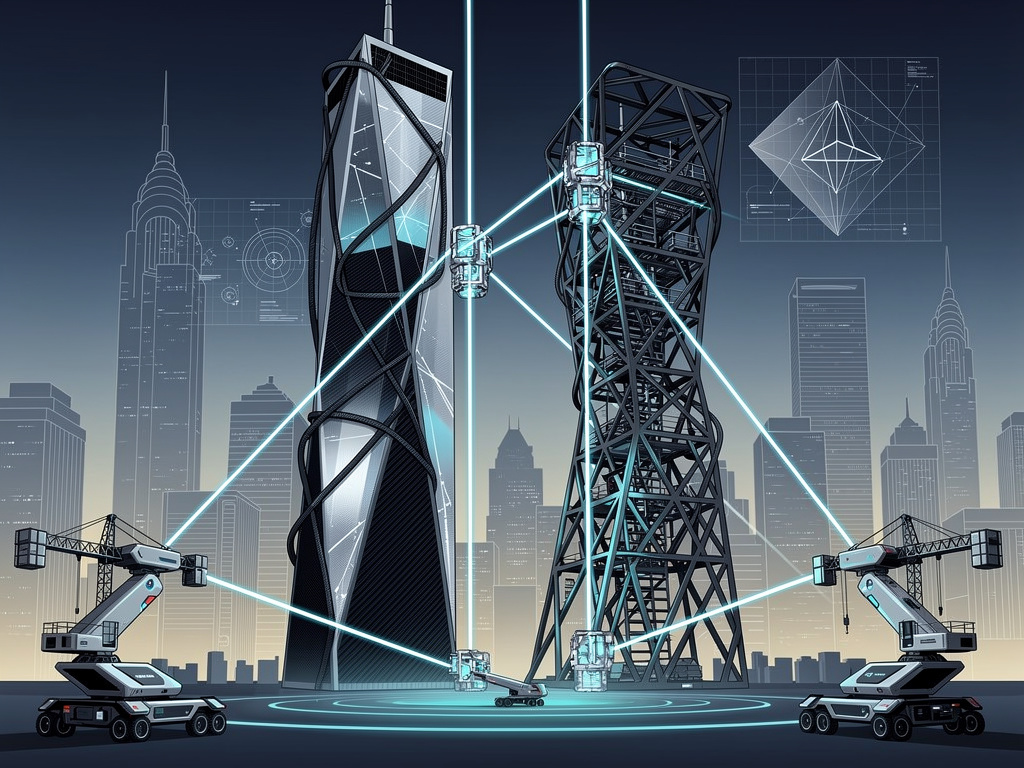
Twenty-four years after the World Trade Center collapsed in the worst terrorist attack on American soil, a structural engineer has put forward a proposal that sounds like it belongs in a science fiction novel: rebuild the Twin Towers, but make them virtually indestructible using laser-based construction and advanced composite materials.
The idea comes from Archibald Neri, a structural engineer who has spent years developing what he describes as a fundamentally different approach to skyscraper construction. His concept replaces traditional steel-and-concrete frameworks with carbon fiber composites assembled and fused using high-powered laser systems. The result, he claims, would be towers that could withstand the kind of catastrophic impact that brought down the originals on September 11, 2001.
Bold? Absolutely. Feasible? That’s where the conversation gets complicated.
As first reported by Futurism, Neri’s proposal envisions structures that would mirror the iconic silhouette of the original 110-story towers designed by Minoru Yamasaki, but with an entirely reimagined structural skeleton. Instead of the steel perimeter columns and floor trusses that defined the 1970s-era engineering of the World Trade Center, Neri’s design calls for a lattice of carbon fiber reinforced polymer (CFRP) components, bonded and shaped on-site using industrial laser systems capable of precise thermal manipulation.
Carbon fiber is not new to engineering. It’s been a staple in aerospace, Formula 1 racing, and high-performance sporting goods for decades. Its tensile strength-to-weight ratio dramatically exceeds that of structural steel. A carbon fiber composite can be five times stronger than steel while weighing roughly a third as much. But deploying it as the primary structural material in a supertall skyscraper? That has never been done. Not even close.
Why Carbon Fiber Changes the Structural Calculus
The original Twin Towers were engineering marvels of their era. Designed with an innovative “tube within a tube” structural system, they used 244 exterior steel columns working in concert with a dense central core to distribute loads. The buildings stood 1,368 and 1,362 feet tall, respectively, and for a brief period held the title of world’s tallest structures.
But their destruction exposed a critical vulnerability. When hijacked aircraft struck the towers, the jet fuel fires — burning at temperatures estimated between 1,500 and 1,800 degrees Fahrenheit — didn’t need to melt the steel columns outright. They only needed to weaken them. Steel begins losing significant structural capacity at around 1,100 degrees Fahrenheit. The fireproofing insulation, dislodged by the impacts, left the steel exposed. The floors sagged. The perimeter columns bowed inward. And then gravity did the rest.
Neri’s argument centers on the thermal properties of carbon fiber composites. CFRP materials maintain their structural integrity at significantly higher temperatures than steel, depending on the resin matrix used. Some advanced carbon fiber systems can operate continuously at temperatures exceeding 2,000 degrees Fahrenheit. This thermal resilience, Neri contends, would have prevented the progressive collapse that killed 2,977 people that morning.
There’s more to the pitch than heat resistance. Carbon fiber’s extraordinary strength-to-weight ratio means the overall mass of the building could be dramatically reduced. A lighter structure imposes less gravitational load on its foundations, less stress on its connections, and — critically — less inertial force during seismic or wind events. For a supertall building in Lower Manhattan, where bedrock sits relatively close to the surface, these advantages compound.
And then there’s the laser component.
Neri proposes using high-powered laser systems to fuse and shape carbon fiber components during construction. Laser-assisted manufacturing of composites is an established industrial process, commonly used in aerospace to create complex geometries with minimal material waste. Scaling it to building construction, however, represents an enormous leap. The precision required to bond structural members in a 110-story tower, exposed to wind, temperature fluctuations, and the inherent chaos of a construction site, presents challenges that no existing laser system has been designed to handle at that scale.
The engineer acknowledges these difficulties but argues that the underlying technology is sound. What’s needed, in his view, is investment in scaling — not fundamental scientific breakthroughs.
Skeptics aren’t hard to find.
The Engineering Community Weighs In
Structural engineers and materials scientists contacted about Neri’s proposal have offered reactions ranging from cautious interest to outright dismissal. The consensus among most professionals is that while carbon fiber composites have extraordinary material properties, the gap between laboratory performance and real-world skyscraper construction remains vast.
One fundamental issue is ductility. Steel is a forgiving material. When overloaded, it bends before it breaks, providing visible warning signs and allowing load redistribution through the structure. Carbon fiber composites, by contrast, tend to fail suddenly and catastrophically — they shatter rather than deform. In structural engineering, this brittleness is a serious concern. Buildings must absorb unexpected loads — from wind gusts, earthquakes, or yes, aircraft impacts — and a material that snaps without warning poses risks that current building codes aren’t designed to accommodate.
Fire behavior presents another complication. While carbon fiber itself resists high temperatures, the polymer resins that bind composite materials together are often far more vulnerable. Epoxy-based resins, the most common matrix material in CFRP, can begin degrading at temperatures as low as 300 to 400 degrees Fahrenheit. Advanced polyimide and ceramic matrix composites offer much higher thermal performance, but they’re exponentially more expensive and difficult to manufacture at scale.
Cost is the elephant in the room. Carbon fiber currently runs between $10 and $25 per pound for standard aerospace-grade material, compared to roughly 30 to 50 cents per pound for structural steel. Even accounting for the reduced material volume needed due to carbon fiber’s superior strength-to-weight ratio, the cost differential is staggering. A project of this magnitude — two 110-story towers in the most expensive real estate market in the Western Hemisphere — would carry a price tag that could easily dwarf the $3.9 billion spent on One World Trade Center.
Then there’s the question of building codes. No major jurisdiction in the world has approved carbon fiber composites as a primary structural material for supertall buildings. The International Building Code, which governs construction in New York City alongside local amendments, is written around the known behavior of steel, concrete, and timber. Introducing an entirely new structural material system would require years of testing, code development, and regulatory approval — a process that typically moves at glacial speed.
But Neri isn’t deterred. He points to the history of structural engineering as evidence that materials once considered exotic eventually become standard. Steel itself was viewed with deep suspicion when it first replaced wrought iron and masonry in the late 19th century. Reinforced concrete faced similar resistance. The Bessemer process made steel economically viable; perhaps advances in carbon fiber manufacturing could do the same for composites.
There’s a parallel worth noting in the aerospace industry. When Boeing designed the 787 Dreamliner, it made the radical decision to construct roughly 50% of the airframe from carbon fiber composites — a first for a commercial aircraft of that size. The program faced massive cost overruns and years of delays, but the aircraft eventually entered service and has proven the viability of large-scale composite structures under extreme loading conditions. Neri has cited the 787 as a conceptual precedent, though the differences between an aircraft fuselage and a 1,300-foot building are obviously profound.
The emotional dimension of this proposal can’t be separated from the engineering. The Twin Towers weren’t just buildings. They were symbols — of American economic ambition, of New York City’s skyline identity, of the nearly 3,000 lives lost when they fell. The 9/11 Memorial and Museum now occupies the footprint where they stood, and One World Trade Center, completed in 2014, rises nearby as a deliberate statement of resilience. Any proposal to rebuild the original towers, regardless of the materials involved, inevitably collides with questions of memory, grief, and civic meaning.
Neri has framed his concept not as a replacement for the memorial but as a complement to it — a demonstration that engineering can overcome the specific failure modes that enabled the towers’ destruction. Whether the public, the Port Authority of New York and New Jersey, or the families of victims would ever support such a project is an entirely separate question from whether it’s technically achievable.
Where the Technology Stands Today
Recent developments in composite construction suggest the field is moving, if slowly, toward the kind of applications Neri envisions. Researchers at institutions including MIT, Delft University of Technology, and the University of Stuttgart have been experimenting with carbon fiber in architectural and structural applications. The BUGA Fibre Pavilion, completed in Stuttgart in 2019, demonstrated that robotic winding of carbon and glass fiber could create load-bearing architectural structures with remarkable efficiency.
In the private sector, companies like Mallinda and Connora Technologies have been developing recyclable thermoset resins that could address one of carbon fiber’s major environmental drawbacks — the difficulty of recycling cured composites. And advances in automated fiber placement, a manufacturing technique borrowed from aerospace, are steadily reducing the labor cost of composite fabrication.
Laser-based processing of composites is also advancing. Laser-assisted tape placement, or LATP, uses focused laser energy to heat and consolidate thermoplastic composite tapes during layup. The technique is already used in production of aircraft components by companies including Airbus and GKN Aerospace. Scaling it to construction-sized components would require significant development, but the foundational physics are well understood.
So is Neri’s proposal a serious engineering blueprint or an elaborate thought experiment? Probably somewhere in between. The materials science is real. The structural advantages of carbon fiber over steel in specific failure scenarios — particularly fire-induced progressive collapse — are well documented. But the practical barriers to building a supertall skyscraper from composites remain formidable: cost, code compliance, manufacturing scale, connection design, long-term durability, and the fundamental challenge of predicting how a novel structural system will behave over decades of service.
What Neri has succeeded in doing is reopening a conversation about whether the structural paradigms established in the 20th century — steel frames, reinforced concrete cores, glass curtain walls — represent the permanent vocabulary of tall building design, or whether something fundamentally different is possible. The answer, almost certainly, is that it is possible. Just not yet. And probably not as a replica of two buildings whose destruction remains one of the defining traumas of modern American history.
The Twin Towers fell because their steel couldn’t survive the heat. Whether carbon fiber and lasers could have saved them is a question that may never be definitively answered. But the fact that a credentialed engineer is asking it — with specific materials, specific processes, and specific structural logic — suggests the conversation about the future of skyscraper construction is far from settled.


 WebProNews is an iEntry Publication