
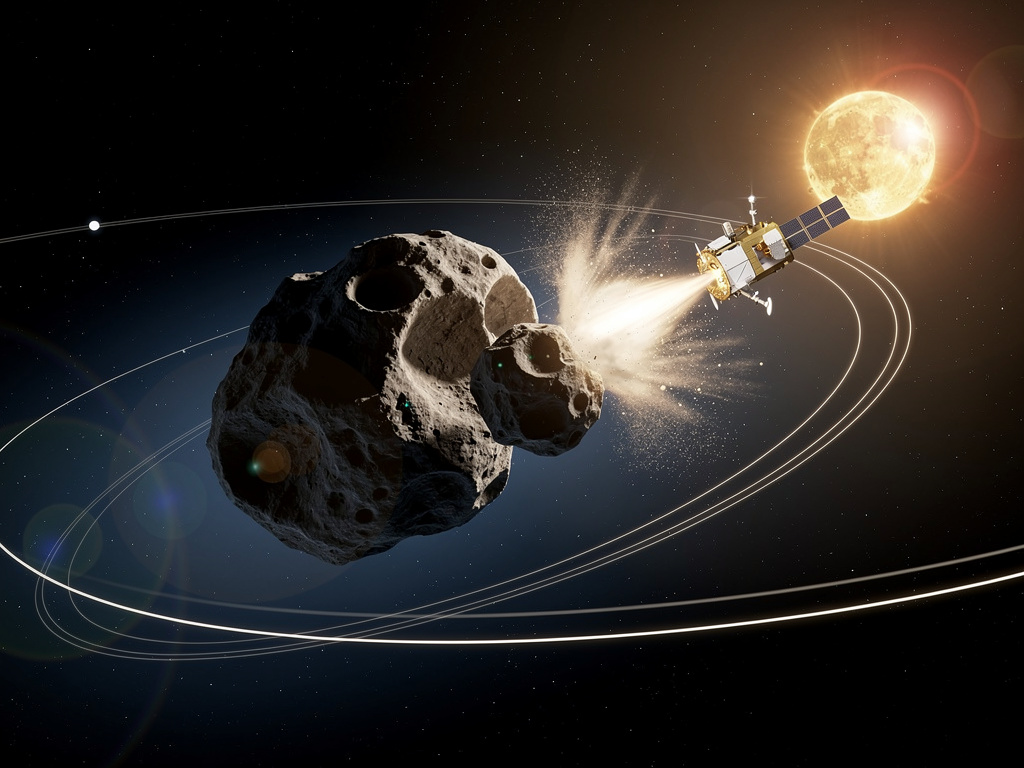
When NASA deliberately slammed a vending-machine-sized spacecraft into a small asteroid moon in September 2022, the agency wanted to prove it could nudge a space rock off course. It worked. What nobody fully anticipated was the cascade of orbital consequences that followed — effects so pronounced they’ve now rewritten our understanding of what a kinetic impactor can actually do.
The Double Asteroid Redirection Test, known as DART, struck Dimorphos, the 525-foot-wide moonlet orbiting the larger asteroid Didymos, at roughly 14,000 miles per hour. The primary goal was straightforward: shorten Dimorphos’s 11-hour-and-55-minute orbit around Didymos. NASA confirmed within weeks that the impact had trimmed that orbit by 33 minutes. A clear success by any measure.
But the story didn’t end there.
New research published in the journal Nature Astronomy reveals that the DART impact didn’t just alter Dimorphos’s path around its parent asteroid. It changed the binary system’s orbit around the Sun itself — a first for any human-made object. As Engadget reported, the Didymos-Dimorphos pair now follows a measurably different heliocentric orbit than it did before DART’s arrival. The change is small in absolute terms — fractions of a meter per second in velocity — but it’s real, detectable, and consequential for planetary defense planning.
The mechanism behind this secondary effect is more subtle than the initial crash. When DART hit Dimorphos, the collision ejected an enormous plume of rocky debris — thousands of tons of material spraying outward into space. That ejecta acted like a rocket exhaust, imparting additional momentum to the system well beyond what the spacecraft’s direct impact delivered. Scientists estimate the ejecta multiplied DART’s momentum transfer by a factor of roughly 3.6, meaning the debris did far more work than the spacecraft itself.
This matters enormously. And here’s why.
If humanity ever needs to deflect a genuinely threatening asteroid, the effectiveness of a kinetic impactor won’t depend solely on the mass and speed of the spacecraft we send. It will depend heavily on the composition and structure of the target — how much material gets blasted free, in what direction, and with what velocity. A rubble-pile asteroid like Dimorphos, loosely bound by gravity rather than solid rock, apparently makes for a highly responsive target. The ejecta effect amplifies the punch.
The new findings come from a team led by Shantanu Naidu at NASA’s Jet Propulsion Laboratory, who used a combination of ground-based radar observations from the Goldstone Deep Space Communications Complex and optical telescopes to track the Didymos system’s position with extraordinary precision in the months following impact. By comparing the system’s actual trajectory against pre-impact predictions, the researchers isolated the heliocentric orbital change. The Nature Astronomy paper details how the binary system’s orbital period around the Sun shifted by approximately 0.3 seconds — a tiny number that nonetheless represents a genuine alteration of a natural solar system body’s path around our star by human intervention.
No one has done this before. Not intentionally, not measurably.
The implications extend well beyond a single proof-of-concept mission. Planetary defense strategists have long debated whether kinetic impactors alone could handle a serious asteroid threat, or whether more exotic approaches — nuclear detonations, gravity tractors, ion beam deflectors — would be necessary. DART’s results tilt the calculus. A single impactor, hitting the right kind of target with sufficient lead time, can produce effects that compound through the physics of ejecta. The heliocentric change demonstrates that these effects propagate through the entire orbital mechanics of a system, not just the local dynamics between two bodies.
There are caveats. Dimorphos is not representative of all asteroids. Its rubble-pile structure made it particularly susceptible to momentum transfer via ejecta. A denser, more monolithic asteroid might absorb more of the impact energy internally, producing less debris and therefore less amplification. Scientists won’t know for certain how Dimorphos’s internal structure influenced the outcome until the European Space Agency’s Hera mission arrives at the asteroid system later this year. Hera launched in October 2024 and is expected to reach Didymos in late 2026, where it will conduct a detailed survey of the impact crater and Dimorphos’s reshaped surface.
What Hera finds could reshape planetary defense doctrine for decades. If Dimorphos turns out to be an unusually cooperative target — loose, porous, easy to excavate — then the DART results may represent something of an upper bound on kinetic impactor effectiveness. If, on the other hand, the ejecta amplification effect proves common across different asteroid compositions, then humanity’s ability to redirect threatening objects is substantially greater than pre-DART models suggested.
The timing of these findings is notable. NASA’s planetary defense program has gained political traction in recent years, with the agency’s Planetary Defense Coordination Office receiving increased funding and attention. The DART mission cost approximately $325 million — a modest sum by space mission standards, and a fraction of what a nuclear deflection mission would require. Demonstrating that a relatively inexpensive kinetic impactor can alter not just a moonlet’s local orbit but an entire binary system’s path around the Sun strengthens the case for continued investment in this approach.
But budget pressures loom. NASA faces significant funding constraints, and planetary defense competes with crewed exploration programs, Earth science missions, and the James Webb Space Telescope’s ongoing operations for limited dollars. The DART results provide ammunition for advocates who argue that asteroid deflection capability is not a luxury — it’s an insurance policy against a low-probability, civilization-ending event.
So where does this leave us? With proof. Concrete, measurable proof that humans can alter the trajectory of a natural object in the solar system. Not in simulation. Not in theory. In reality, tracked by radar and confirmed by peer-reviewed science. The DART mission began as a technology demonstration. It has become something more: the first empirical dataset for a species learning to defend itself against cosmic hazard.
The asteroid Dimorphos, once an unremarkable speck orbiting another unremarkable speck, now traces a slightly different arc around the Sun than nature intended. That difference — tiny, precise, deliberate — may be the most significant thing humanity has ever done in space that wasn’t about exploration or prestige. It was about survival. And the physics worked better than anyone expected.


 WebProNews is an iEntry Publication