
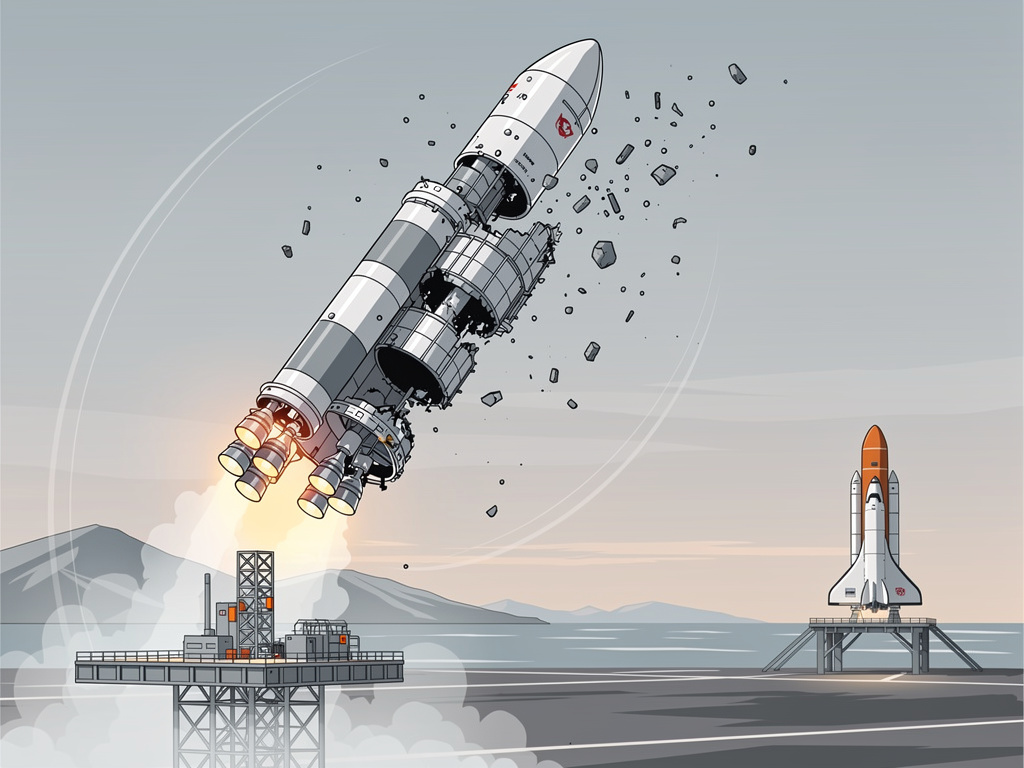
A Chinese rocket startup’s dream of rivaling SpaceX came crashing down — literally — on a recent test flight, underscoring both the fierce ambition and the punishing difficulty of building reusable launch vehicles. Space Pioneer, a Beijing-based private rocket company also known as Tianbing Technology, confirmed that the maiden flight of its Tianlong-3 reusable rocket ended in failure, with the vehicle breaking apart shortly after liftoff.
The failure is a setback not just for one company but for China’s broader push to develop a commercial space sector capable of competing with Elon Musk’s SpaceX and its Falcon 9 workhorse. Beijing has poured policy support and capital into private launch firms over the past several years, hoping to replicate the cost efficiencies and rapid innovation cycles that have made SpaceX the dominant force in global commercial launch. That ambition just got a reality check.
According to Investing.com, Space Pioneer issued a statement acknowledging the failure and said the company is investigating the cause. The Tianlong-3, or Sky Dragon-3, is a medium-lift rocket designed to be partially reusable — its first stage intended to land vertically after launch, much like the Falcon 9 booster. The rocket was carrying no payload on this test flight, a standard precaution for maiden launches of unproven vehicles.
Video footage circulating on Chinese social media showed the rocket ascending briefly before visibly losing stability, tumbling, and disintegrating. Debris fell in what appeared to be a remote area. No casualties have been reported. The images were stark — a pillar of flame twisting sideways against a blue sky, then a fireball.
Space Pioneer had positioned the Tianlong-3 as a direct competitor to the Falcon 9 in terms of payload capacity and cost. The rocket was designed to carry up to 17 metric tons to low Earth orbit in its expendable configuration, with a reduced but still significant capacity in reusable mode. Those specifications, if realized, would have made it one of the most capable rockets produced by China’s private sector. But specifications on paper and a functioning launch vehicle are separated by an enormous engineering chasm.
The company isn’t a newcomer to spaceflight. Space Pioneer successfully launched its smaller Tianlong-2 rocket in April 2023, becoming one of the first Chinese private firms to reach orbit with a liquid-propellant vehicle. That achievement earned the company significant attention and funding. Investors saw a credible path toward reusable rocketry. The leap from Tianlong-2 to Tianlong-3, however, was massive — not incremental. A bigger rocket with reusability features introduces exponentially more complexity in propulsion, guidance, structural loads, and thermal management.
And this is where the SpaceX comparison becomes both instructive and humbling. SpaceX itself failed repeatedly in its early years. The first three launches of the original Falcon 1 rocket ended in failure between 2006 and 2008. The company nearly went bankrupt before the fourth Falcon 1 flight succeeded in September 2008. Even the Falcon 9, now the most reliable and frequently launched rocket in the world, had its share of failures — including a dramatic launchpad explosion in 2016 that destroyed a Facebook satellite. Reusable rocketry is extraordinarily hard. Every company that attempts it learns that lesson the expensive way.
But the competitive pressure on Chinese firms is intense and growing. SpaceX has launched over 300 missions in the past two years alone, deploying thousands of Starlink satellites and dominating the commercial and government launch market. China’s state-owned launch providers — primarily the China Aerospace Science and Technology Corporation (CASC) — have been developing their own reusable rockets, including the Long March 10, but progress has been methodical and slower than Beijing would like. Private firms like Space Pioneer, LandSpace, iSpace, and Galactic Energy were supposed to inject speed and competition into the equation.
LandSpace, another prominent Chinese private rocket company, has had its own mixed record. Its Zhuque-2 became the world’s first methane-fueled rocket to reach orbit in July 2023, after a failed first attempt. The company has since been working on reusability for the Zhuque-3. iSpace, meanwhile, reached orbit with its Hyperbola-1 solid-fuel rocket in 2019 but has struggled with subsequent missions. The pattern across China’s commercial launch sector is clear: ambition is abundant, capital is available, but execution remains brutally difficult.
The Chinese government’s interest in this sector is strategic, not merely commercial. A robust domestic launch capability supports military satellite constellations, Earth observation networks, and China’s own planned mega-constellation of broadband internet satellites — sometimes described as China’s answer to Starlink. The State Council and the Central Military Commission have both signaled that space launch is a priority area for private-sector participation. Local governments in cities like Wuhan, Xi’an, and Beijing have established space industry zones with tax incentives and infrastructure support for rocket startups.
So the stakes for Space Pioneer extend beyond one failed test. The company has reportedly raised billions of yuan in funding from investors including state-backed venture capital funds. A maiden flight failure, while not uncommon in the history of rocketry, will inevitably raise questions about timelines, burn rate, and technical readiness. Investors in China’s space sector have generally shown patience — the government’s strategic backing provides a cushion that pure commercial ventures in the West might not enjoy — but patience has limits.
The technical investigation into the Tianlong-3 failure will be closely watched. Rocket failures typically stem from a handful of categories: engine malfunction, guidance and control system errors, structural failure, or staging anomalies. Given that the vehicle appeared to lose control early in flight, propulsion or guidance issues seem like probable areas of focus. Space Pioneer has not yet disclosed preliminary findings.
One factor that distinguishes the Chinese commercial space sector from its American counterpart is the regulatory and information environment. Failure investigations in the United States, overseen by the FAA and often involving NASA expertise, tend to produce detailed public reports. In China, the process is less transparent. Companies may share findings with investors and government regulators without making them broadly public. This opacity can slow the kind of cross-industry learning that benefits the sector as a whole.
Still, failure in rocketry is not the end. It’s often the beginning. SpaceX’s trajectory from repeated Falcon 1 failures to the world’s most prolific launcher took about a decade of relentless iteration. Blue Origin spent even longer in development before achieving orbital flight. The question for Space Pioneer is whether it can diagnose the problem, fix it, and return to flight quickly enough to maintain investor confidence and competitive positioning.
The broader Chinese commercial space industry will be watching closely, too. Every private launch attempt in China generates data and experience that benefits the entire sector — engineers move between companies, suppliers learn from integration challenges, and the regulatory framework evolves in response to real-world operations. A failure, painful as it is, contributes to the collective knowledge base.
For now, the wreckage of the Tianlong-3’s maiden flight is a reminder of a simple truth that applies equally in Houston, Hawthorne, and Beijing. Rockets are unforgiving machines. The physics doesn’t care about your funding round, your national strategy, or your competitive ambitions. You either solve the engineering or you don’t. Space Pioneer will get another chance. Whether it can convert that chance into a working reusable rocket will say a great deal about the maturity and resilience of China’s private space sector.


 WebProNews is an iEntry Publication