
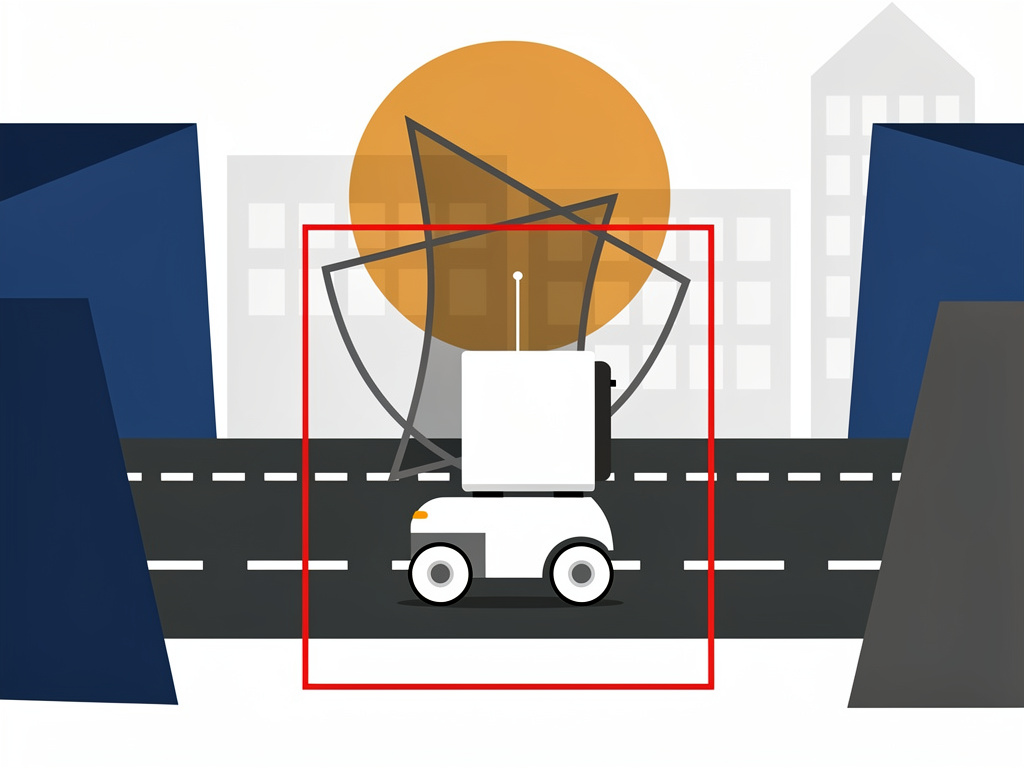
A hulking autonomous robot recently rolled through the streets of a U.K. town, flanked by police officers who had been called in to help it cross a busy road. Not because the robot was malfunctioning. Not because it posed a danger. Because it simply couldn’t handle a crosswalk.
The scene, captured on video and shared widely on social media, is almost too on-the-nose as a metaphor: a machine built to operate independently, yet so incapable of basic urban navigation that it required the very human infrastructure — uniformed officers stopping traffic — it was ostensibly designed to replace or supplement. The footage, first reported by Futurism, shows the Starship Technologies delivery robot waiting helplessly at a road crossing while police officers stepped in to halt vehicles and shepherd it across.
Funny? Sure. But the incident raises questions that the autonomous robotics industry would rather not answer right now — questions about readiness, public space allocation, and who bears the cost when machines can’t do what their makers promise.
The Starship Problem: Delivery Robots Meet the Real World
Starship Technologies, the San Francisco-headquartered company co-founded by Skype veterans Ahti Heinla and Janus Friis, has been deploying its small, six-wheeled delivery robots since 2014. The company has completed millions of deliveries across multiple countries, operating primarily on college campuses and in suburban neighborhoods where traffic is lighter and sidewalks are wide. The robots travel at pedestrian speed — roughly 4 mph — and use a combination of cameras, sensors, and GPS to find their way.
On paper, the model works. In practice, it frequently doesn’t.
The U.K. police escort incident isn’t the first time Starship’s robots have struggled with real-world conditions. Reports from university campuses in the United States have documented the bots getting stuck in snow, blocking wheelchair ramps, and congregating in confused clusters at intersections. In Milton Keynes, the English town where Starship has run one of its largest deployments, residents have posted videos of robots stopped dead by minor curb changes or confused by temporary construction barriers.
The core issue is deceptively simple. These robots were designed for controlled environments with predictable variables. Sidewalks. Low-speed zones. Mapped routes with minimal deviation. But cities and towns aren’t controlled environments. They’re chaotic, unpredictable, and full of edge cases — a parked car on a curb, a child darting across a path, a road with no pedestrian crossing signal. Every one of these scenarios requires judgment that current autonomous systems handle poorly, if at all.
And when the robot can’t cope, someone else has to step in. In this case, it was police officers — public servants funded by taxpayers, redirected from their duties to babysit a private company’s delivery machine.
That’s not a minor detail. It’s the whole story.
Who Pays When Robots Can’t Do Their Jobs?
The delivery robot sector has attracted billions in venture capital over the past decade. Starship alone has raised over $200 million. Competitors like Serve Robotics, Kiwibot, and Nuro have collectively pulled in hundreds of millions more. The pitch to investors has been consistent: autonomous last-mile delivery will reduce costs, cut emissions, and eliminate the need for human couriers.
But the economics look different when you factor in externalities — the costs that don’t show up on a company’s balance sheet but are very real for everyone else. Police time. Blocked sidewalks. Pedestrians forced to step into traffic to get around a stalled bot. Maintenance of public infrastructure that robots damage or wear down. The cognitive load on city planners who must now account for machines that share space with humans but don’t follow human social norms.
There’s a term for this in economics: cost externalization. The company captures the revenue from each delivery while the public absorbs the friction. So far, most municipalities have been slow to push back. Some have embraced delivery robots as symbols of innovation, offering permits and pilot programs with minimal regulatory requirements. Others have started asking harder questions.
San Francisco temporarily banned delivery robots from most sidewalks in 2017 before later loosening restrictions. Pittsburgh has imposed weight limits and speed caps. In the U.K., the Law Commission has been working on a regulatory framework for autonomous vehicles and robots that would clarify liability — but that framework remains incomplete.
The police escort incident puts a sharp point on the liability question. If a robot causes a traffic disruption that leads to an accident, who’s responsible? The company that deployed it? The municipality that permitted it? The officer who waved traffic through? These aren’t hypothetical concerns. As autonomous machines proliferate in public spaces, they’re becoming urgent ones.
Meanwhile, the broader autonomous vehicle industry is watching closely. Waymo, Cruise, and other self-driving car companies face analogous challenges at a much larger scale — and with far higher stakes. Cruise pulled its robotaxis from San Francisco streets in late 2023 after one of its vehicles dragged a pedestrian, an incident that led to the company’s CEO resigning and its operations being suspended. The parallel isn’t exact, but the underlying dynamic is the same: autonomous systems encountering situations they weren’t built to handle, with real consequences for real people.
Delivery robots operate at lower speeds and lower risk profiles than robotaxis. Nobody’s going to die because a Starship bot couldn’t cross a road. But the pattern matters. Deploying autonomous machines into public spaces before they can reliably handle those spaces creates a kind of technological debt — problems deferred, not solved, that compound over time as deployments scale.
Starship Technologies has generally responded to these incidents by emphasizing its safety record and the volume of successful deliveries. The company points out, correctly, that its robots have traveled millions of miles without causing serious injury. And that’s true. But “hasn’t hurt anyone yet” is a low bar for a technology that claims to be ready for widespread deployment in populated areas.
The Bigger Question: Are We Building Public Spaces for People or Machines?
Zoom out from the police escort video and a more fundamental tension comes into focus. Sidewalks, crosswalks, and public roads were built for people. They were designed around human capabilities — our walking speed, our field of vision, our ability to make eye contact with a driver and negotiate right-of-way in real time. Robots don’t do any of that.
When a delivery robot enters a crosswalk, it doesn’t make eye contact with the driver waiting at the light. It doesn’t speed up or slow down based on social cues. It doesn’t wave a thank-you. These seem like trivial things until you realize how much of urban mobility depends on them. Traffic flow in dense areas is a negotiation, not a set of fixed rules. And robots are terrible negotiators.
This is why the police had to intervene. Not because the road was especially dangerous or the robot was broken. Because the machine lacked the social intelligence to participate in a basic human interaction: crossing the street.
Some robotics researchers argue this is a temporary problem — that better sensors, improved AI, and vehicle-to-infrastructure communication will eventually close the gap. Maybe. But “eventually” does a lot of heavy lifting in that sentence. The gap between current capability and the marketing claims of autonomous delivery companies remains wide, and closing it will require not just better technology but better regulation, better urban planning, and an honest public conversation about trade-offs.
Because here’s the trade-off nobody in the industry wants to talk about: every square foot of sidewalk occupied by a delivery robot is a square foot not available to a pedestrian, a wheelchair user, a parent with a stroller. Every police officer escorting a robot across the street is an officer not responding to a call. Every city dollar spent accommodating autonomous machines is a dollar not spent on transit, housing, or schools.
None of this means delivery robots are inherently bad or that autonomous technology should be abandoned. It means the current deployment model — move fast, externalize costs, and let municipalities figure out the rest — isn’t sustainable. And a robot needing a police escort to cross the street is about as clear a signal as you’ll get that the technology isn’t where its backers say it is.
The video is funny. The implications aren’t.


 WebProNews is an iEntry Publication