
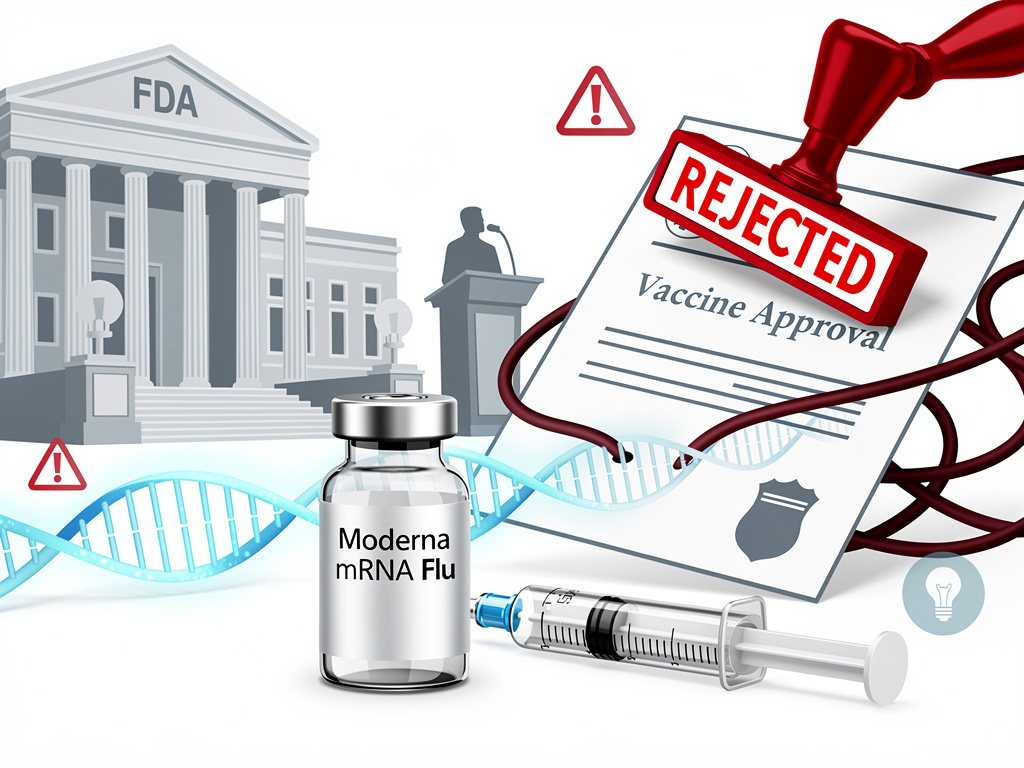
In a move that has alarmed public health experts and sent shockwaves through the pharmaceutical industry, a senior Trump administration official personally intervened to reject Moderna’s application for a new mRNA-based influenza vaccine, overruling the Food and Drug Administration’s own career scientists who had recommended approval. The decision, which surfaced in recent days through reporting by multiple outlets, represents one of the most striking examples of political interference in the FDA’s drug-approval process in modern history — and raises urgent questions about the future of vaccine development in the United States.
According to a detailed account published by Ars Technica, the rejection was not driven by safety or efficacy concerns identified during the FDA’s rigorous scientific review process. Instead, it was orchestrated by a political appointee within the Department of Health and Human Services who harbored ideological objections to mRNA vaccine technology — the same platform that powered the COVID-19 vaccines developed by Moderna and Pfizer-BioNTech during the pandemic.
The Science Said Yes — But Politics Said No
FDA career scientists had conducted a thorough evaluation of Moderna’s mRNA-based seasonal influenza vaccine, known internally as mRNA-1010. The vaccine had undergone extensive clinical trials involving tens of thousands of participants and had demonstrated both safety and efficacy that met the agency’s established benchmarks for approval. Reviewers within the FDA’s Center for Biologics Evaluation and Research (CBER) had prepared documentation supporting the vaccine’s authorization, a process that typically represents the culmination of years of scientific scrutiny.
Yet before that recommendation could be formally acted upon, a Trump administration official at HHS stepped in and directed that the application be denied. The intervention bypassed the normal chain of scientific decision-making at the FDA, effectively substituting a political judgment for a scientific one. As Ars Technica reported, the official in question had ties to vaccine-skeptic circles and had previously expressed reservations about mRNA technology, despite the overwhelming scientific consensus supporting its safety.
Inside the Decision: How the Override Unfolded
The mechanics of the rejection are particularly troubling to former FDA officials and regulatory experts. Historically, the FDA’s drug and vaccine approval decisions have been insulated from direct political interference. While political appointees have always held nominal authority over the agency, a longstanding norm — reinforced by decades of bipartisan practice — has kept the scientific review process at arm’s length from ideological pressures. That norm, experts say, has been shattered.
Sources familiar with the matter told reporters that FDA scientists were blindsided by the decision. Several senior reviewers had signed off on the application, and the expectation within the agency was that approval was imminent. When word came down that the application had been rejected at the direction of an HHS political appointee, morale within the agency plummeted. Some career staff reportedly considered the move a direct affront to their professional integrity and the agency’s mission to protect public health through evidence-based regulation.
Moderna’s Flu Vaccine: What the Data Showed
Moderna’s mRNA flu vaccine represented a significant advance in influenza prevention. Traditional flu vaccines, which are manufactured using egg-based or cell-based methods, require months of lead time and are often imperfectly matched to circulating strains by the time they reach patients. The mRNA platform, by contrast, allows for much faster production and more precise targeting of specific influenza strains, potentially delivering higher efficacy rates than conventional alternatives.
Clinical trial data submitted by Moderna showed that mRNA-1010 elicited robust immune responses across multiple age groups, including older adults who are most vulnerable to severe influenza complications. The vaccine’s safety profile was consistent with that of other approved mRNA vaccines, with side effects that were generally mild and transient — sore arms, fatigue, and low-grade fevers that resolved within days. No serious safety signals were identified during the trials or in the FDA’s independent analysis of the data.
The Broader War on mRNA Technology
The rejection of Moderna’s flu shot does not exist in isolation. It is part of a broader pattern of skepticism toward mRNA vaccine technology that has gained traction within certain political circles since the COVID-19 pandemic. Despite the fact that mRNA COVID vaccines were developed under the Trump administration’s own Operation Warp Speed initiative, a vocal faction within the current administration and its allied advocacy groups has sought to distance itself from the technology, driven in part by the anti-vaccine sentiments that have gained political currency in recent years.
Robert F. Kennedy Jr., who was confirmed as Secretary of Health and Human Services, has long been one of the most prominent critics of vaccines in the United States. His appointment sent a clear signal about the administration’s posture toward vaccine policy, and the Moderna rejection appears to be a direct manifestation of that posture. Kennedy has repeatedly questioned the safety of mRNA vaccines, despite extensive real-world evidence — drawn from billions of doses administered globally — demonstrating their safety and effectiveness.
Industry Reaction: A Chilling Effect on Innovation
The pharmaceutical industry’s response has been swift and deeply concerned. Moderna’s stock price dropped sharply on news of the rejection, and analysts warned that the decision could have far-reaching consequences for biotech investment in the United States. If the FDA’s scientific judgments can be overridden by political appointees on ideological grounds, companies may think twice before investing billions of dollars in developing new vaccines and therapeutics that require FDA approval.
“This is not just about one vaccine,” said one senior pharmaceutical executive who spoke on condition of anonymity. “This is about whether the United States is still a place where science-based regulation can be trusted. If the answer is no, capital and talent will go elsewhere.” Industry groups, including the Biotechnology Innovation Organization (BIO), have expressed concern about the precedent being set, warning that political interference in the approval process undermines the credibility that has made the FDA the gold standard for drug regulation worldwide.
Public Health Consequences: What’s at Stake
The implications for public health are equally alarming. Seasonal influenza kills tens of thousands of Americans every year, and current flu vaccines offer only moderate protection. An mRNA-based flu vaccine could have represented a meaningful improvement in the nation’s ability to prevent influenza-related illness, hospitalization, and death — particularly among the elderly and immunocompromised populations who bear the heaviest burden of the disease.
By blocking the vaccine’s approval, the administration has effectively denied the American public access to a potentially superior tool for fighting one of the most persistent infectious disease threats in the country. Public health officials have warned that the decision could also undermine confidence in the broader flu vaccination program, as the politicization of vaccine approvals makes it harder for physicians and public health agencies to communicate clear, science-based recommendations to patients.
Legal and Congressional Scrutiny Intensifies
The rejection has already attracted the attention of lawmakers on Capitol Hill. Democratic members of the Senate Health, Education, Labor, and Pensions (HELP) Committee have called for hearings into the decision, demanding that HHS and the FDA provide a detailed accounting of how and why the scientific recommendation was overruled. Several senators have described the move as an unprecedented breach of the FDA’s independence and have called for legislative safeguards to prevent similar interference in the future.
Legal experts say Moderna may have grounds to challenge the rejection, though the path forward is uncertain. The FDA has broad discretion in its approval decisions, and courts have historically been reluctant to second-guess the agency’s regulatory judgments. However, if Moderna can demonstrate that the rejection was motivated by political considerations rather than legitimate scientific concerns, it could potentially mount a successful legal challenge under the Administrative Procedure Act, which prohibits arbitrary and capricious government action.
A Defining Moment for the FDA’s Future
For the FDA, the stakes could not be higher. The agency’s credibility rests on the perception — and the reality — that its decisions are driven by science, not politics. That credibility is what gives FDA approval its weight in the eyes of physicians, patients, and regulators around the world. If that credibility is eroded, the consequences will extend far beyond a single vaccine, affecting the agency’s ability to regulate everything from cancer drugs to medical devices to the food supply.
Former FDA Commissioner Scott Gottlieb, who served in the first Trump administration, has publicly expressed concern about the direction of the current administration’s health policy. Other former commissioners from both parties have echoed those concerns, warning that the politicization of the FDA threatens to undo decades of institutional credibility that took generations to build. As the debate over Moderna’s flu vaccine continues, the broader question looms: whether the FDA can remain a science-driven institution in an era of intensifying political pressure on public health.


 WebProNews is an iEntry Publication