
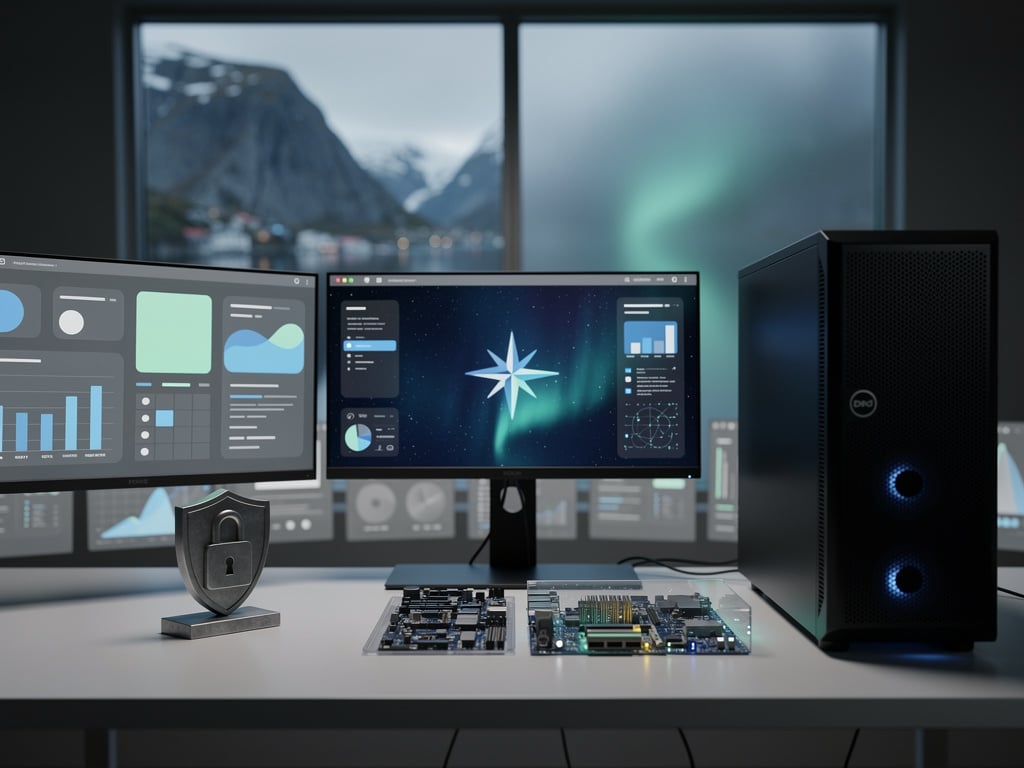
Andreas Røsdal just shipped something remarkable. On June 5, 2026, the Norwegian developer released version 1.0.0 of Nordstjernen. This independent web browser, written entirely from scratch in C, marks the first stable edition of a project that rejects the massive codebases and complex dependencies defining today’s dominant browsers.
The numbers tell part of the story. Nordstjernen’s core engine spans roughly 88,000 lines of hand-written C code spread across 93 files in its source directory. That count excludes the vendored libraries for parsing, JavaScript execution and image decoding. One person can read and audit the entire thing end to end. Compare that to Chromium’s tens of millions of lines. The contrast feels deliberate.
Røsdal built the browser with clear priorities. Security comes first. Stability follows close behind. Independence matters. He named it after the North Star, a fitting choice for software that aims to offer direction in an industry dominated by a handful of players. The project lives at nordstjernen.org, where its minimalist website echoes the philosophy behind the code.
Technical decisions reflect that philosophy. Nordstjernen employs a zero-JIT approach to JavaScript. It integrates quickjs-ng version 0.14.0 as a bytecode interpreter rather than relying on just-in-time compilation common in other engines. The absence of JIT reduces attack surface significantly. Write XOR Execute protections hold process-wide. Such choices sacrifice some raw speed. They deliver measurable gains in predictability and safety.
Other components follow similar logic. HTML and CSS parsing uses lexbor 3.0.0, chosen for its standards focus. Image handling relies on Google’s Wuffs library version 0.4, known for its memory safety in decoding PNG, GIF, BMP and JPEG files. Networking comes via libcurl with support for HTTP/2 and modern compression algorithms including brotli and zstd. The user interface builds on GTK 4. Each page opens in its own window. No tab strip exists by default. The design favors simplicity over convention.
Security hardening runs deep. Landlock and seccomp provide sandboxing on Linux. Position-independent executables, full RELRO protections and Intel Control-flow Enforcement Technology add layers against common exploits. Partitioned cookies prevent cross-site tracking. HSTS, CSP and mixed-content blocking activate by default. No telemetry ships with the browser. None at all.
This focus on fundamentals sets Nordstjernen apart. Standards compliance gets measured against the specification text itself, section by section. Documentation on GitHub tracks progress in detail. The approach differs from many projects that test primarily against existing browser behavior. Røsdal wants fidelity to the written rules.
The license reflects similar independence. The Nordstjernen Source License 1.0 permits free use, modification and redistribution with one restriction. Users cannot employ the code to create a competing browser product. After ten years, each release converts automatically to MIT terms. Commercial licenses remain available by agreement. The structure protects the project’s intent while encouraging long-term openness.
News of the 1.0 release spread quickly through niche communities. Discussions appeared on Hacker News, where posters welcomed an independent effort free of Blink, Gecko or WebKit foundations. One thread highlighted the value of browsers not built on those shared foundations. Another noted the audacity of attempting a from-scratch browser in 2026. The project had been iterating rapidly. Versions 0.7.0, 0.8.0 and 0.8.1 arrived in late May before the stable milestone.
Yet Nordstjernen does not aim for universal replacement. Its creator positions it as an alternative for users who value auditability and reduced complexity over the broadest feature set. WebGL support remains opt-in. Media playback hands off to external players in some cases. The browser targets those willing to accept tradeoffs for stronger security guarantees and smaller footprint.
Industry watchers have followed similar experiments before. Many independent browser projects launch with promise then fade under the weight of web platform demands. Maintaining compatibility with the modern web requires constant effort. JavaScript frameworks, intricate CSS features and evolving standards test any new engine. Nordstjernen’s compatibility table on GitHub shows steady progress but also acknowledges gaps.
Røsdal’s background adds context. The copyright lists 2026 for the Nordstjernen project, with contact available at [email protected]. Development appears to be largely solo, though the repository welcomes contributions within its licensing bounds. An Android port is underway. Nightly builds provide the latest code for testing across Windows, macOS and various Linux distributions including Debian, Ubuntu, openSUSE and Alpine with musl.
Downloads for the 1.0.0 release come packaged for each platform. Source code ships as a tarball with checksums for verification. The project provides a Java API jar for integration experiments, complete with Javadoc. Such attention to accessibility suggests Røsdal wants the work examined and built upon responsibly.
Broader questions emerge from this effort. Browser engine diversity has narrowed dramatically over two decades. Three major rendering engines power nearly all web experiences. Security vulnerabilities in one can affect billions of users. monoculture risks grow as complexity increases. Projects like Nordstjernen, however small, represent counterforces. They demonstrate that simpler, auditable alternatives remain possible even now.
Performance claims stay measured. The site notes that avoiding JIT makes the browser much more secure while remaining fast enough for typical use. No specific benchmarks appear in the announcement materials. Real-world testing will determine how the bytecode interpreter holds up against demanding sites. Early feedback from communities like the Pale Moon forum suggests users appreciate the focus on security, leanness and privacy even if feature breadth trails the leaders.
The release timing feels intentional. Major browsers continue adding features, telemetry options and AI integrations. User frustration with resource usage and privacy practices simmers in forums and social channels. Nordstjernen offers a different path. Its small size means lower memory demands. The lack of telemetry respects user data. Hardened defaults reduce configuration burden.
Of course challenges remain. Web standards grow more intricate each year. Video codecs, advanced graphics APIs, WebAssembly performance needs and countless site-specific quirks test any new implementation. Nordstjernen may render many pages cleanly today. Full compatibility with every major site will take sustained work. The project’s documentation acknowledges this reality through its detailed compatibility matrix.
Still, the achievement stands. In an era when most new browsers fork Chromium, one developer produced a functional, standards-oriented alternative in clean C. The code stays compact enough for individual audit. Security choices prioritize defense over speed at every turn. Minimalism guides the interface and feature decisions.
Whether Nordstjernen gains significant adoption matters less than what it represents. Independent browser development has not died. Small teams or determined individuals can still produce viable engines when they accept different priorities than the market leaders. The North Star may not guide every ship. For those seeking a different course through the modern web, it now offers a literal alternative worth watching.
Further discussion continues on Hacker News, where the 1.0 announcement drew comments on the feasibility and value of such projects in 2026. Similar conversations appear in browser enthusiast forums. The project’s GitHub repository at github.com/nordstjernen-web/nordstjernen provides the complete source and release artifacts for those wanting to examine the work directly.


 WebProNews is an iEntry Publication