
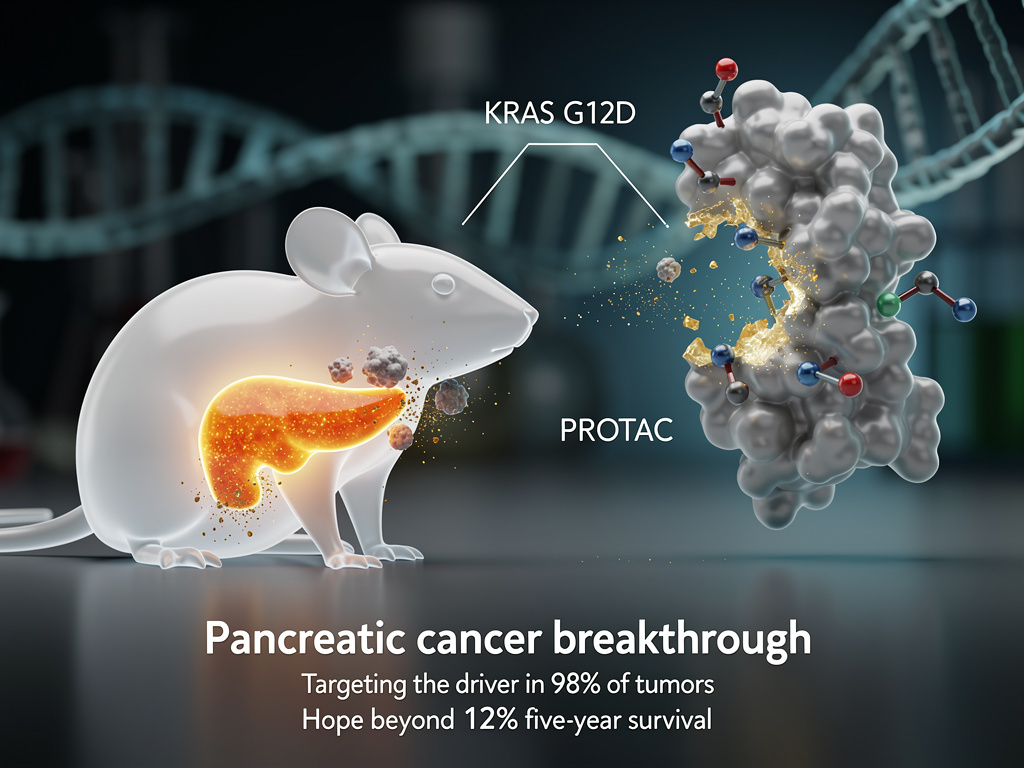
In a development that could fundamentally reshape oncology’s approach to one of medicine’s most lethal malignancies, researchers have achieved something previously thought impossible: the complete elimination of pancreatic cancer tumors in laboratory mice. The breakthrough, centered on a novel molecular approach that targets a protein long considered “undruggable,” represents a paradigm shift in how scientists think about treating pancreatic cancer, a disease that claims more than 50,000 American lives annually and offers patients a grim five-year survival rate of just 12 percent.
According to research published by a team at Cold Spring Harbor Laboratory and detailed by the New York Post, the experimental treatment employs a sophisticated mechanism called proteolysis-targeting chimera, or PROTAC technology, to degrade a protein known as KRAS G12D. This particular mutation drives approximately 98 percent of pancreatic cancers and has frustrated drug developers for decades due to its molecular structure, which lacks the binding pockets that traditional pharmaceuticals require to work effectively. The research team’s success in not merely inhibiting but actually destroying this protein marks a fundamental departure from conventional drug development strategies.
The implications extend far beyond the laboratory. Pancreatic cancer’s reputation as a swift and merciless killer stems partly from its late detection—symptoms often don’t appear until the disease has metastasized—and partly from its resistance to existing therapies. Chemotherapy, radiation, and even newer immunotherapies have shown limited efficacy against pancreatic tumors, leaving surgical resection as the only potentially curative option for the minority of patients diagnosed early enough to qualify. The new approach targets the cancer’s molecular foundation rather than attempting to poison rapidly dividing cells or stimulate immune responses, offering a precision that previous generations of treatment could not achieve.
The Science Behind Protein Degradation
PROTAC technology functions as a molecular matchmaker, creating a bridge between a disease-causing protein and the cell’s own waste disposal system. The engineered molecule has two ends: one binds to the target protein—in this case, the mutant KRAS—while the other attaches to an E3 ubiquitin ligase, an enzyme that tags proteins for destruction. Once connected, the cell’s proteasome, essentially its recycling center, recognizes the tagged protein and breaks it down into harmless components. Unlike traditional drugs that must continuously occupy their target to maintain effectiveness, PROTACs work catalytically; a single molecule can tag multiple proteins before being cleared from the system, potentially allowing for lower doses and reduced side effects.
The KRAS protein family has haunted cancer researchers since its discovery as an oncogene in the 1980s. Mutations in KRAS genes occur in roughly 25 percent of all cancers, including significant portions of lung and colorectal malignancies. The G12D variant, specifically prevalent in pancreatic cancer, changes a single amino acid in the protein’s structure, causing it to remain permanently “on” and continuously signal cells to divide. Traditional drug development efforts stumbled because the mutant protein’s smooth surface offered nowhere for small molecules to grip effectively. Recent years have seen limited success with KRAS G12C inhibitors in lung cancer, but the G12D variant, with its different structural characteristics, remained stubbornly resistant.
From Bench to Bedside: The Translation Challenge
The mouse study’s dramatic results—complete tumor regression in treated animals—naturally raises questions about human application timelines. Pharmaceutical development typically requires extensive preclinical testing in multiple animal models, followed by three phases of human trials examining safety, efficacy, and optimal dosing. Even with expedited review processes for breakthrough therapies, the journey from laboratory success to FDA approval typically spans seven to ten years. However, the urgency surrounding pancreatic cancer, combined with PROTAC technology’s growing track record in other applications, could potentially accelerate this timeline.
Several biotechnology companies have already begun exploring PROTAC-based therapies for various cancers and other diseases. Arvinas, a Connecticut-based firm, has advanced protein degraders into clinical trials for breast and prostate cancers, demonstrating that the technology can work safely in humans. Kymera Therapeutics has focused on degrading proteins involved in inflammatory and immune system diseases. These early-stage efforts provide a foundation of safety and pharmacological data that could smooth the path for pancreatic cancer applications, though each specific PROTAC molecule must still prove its own safety and effectiveness profile.
The manufacturing and delivery challenges inherent in PROTAC technology also demand attention. These molecules are significantly larger than traditional small-molecule drugs, which can affect their ability to penetrate tissues and reach tumor sites effectively. The pancreas’s location deep in the abdomen, surrounded by dense connective tissue and often characterized by a challenging tumor microenvironment, presents additional obstacles. Researchers must optimize not only the PROTAC molecule itself but also the formulation and delivery method to ensure adequate concentrations reach cancer cells while minimizing exposure to healthy tissue.
Economic and Competitive Implications
The potential market for an effective pancreatic cancer treatment dwarfs most oncology indications. Despite its relatively modest incidence compared to breast or lung cancer, pancreatic cancer’s high mortality rate and lack of effective therapies create enormous unmet medical need. Industry analysts estimate that a truly effective pancreatic cancer drug could generate annual revenues exceeding $10 billion, attracting intense interest from major pharmaceutical companies and venture capital investors alike. The PROTAC platform’s applicability to other KRAS-driven cancers multiplies this potential exponentially.
This commercial promise has already triggered a competitive race. Multiple research institutions and biotechnology firms are pursuing various approaches to targeting KRAS mutations, including direct inhibitors, immunotherapies designed to recognize KRAS-mutant cells, and combination strategies that attack the cancer on multiple fronts simultaneously. The protein degradation approach represents one strategy among several, each with distinct advantages and limitations. Success will likely come not from a single breakthrough but from a portfolio of complementary approaches tailored to individual patients’ tumor characteristics and genetic profiles.
Patient Perspectives and Clinical Realities
For the approximately 66,000 Americans diagnosed with pancreatic cancer each year, news of scientific progress brings both hope and frustration. The gap between laboratory success and accessible treatment can feel unbridgeable when facing a disease that often allows mere months of survival. Patient advocacy groups have increasingly pushed for expanded access programs and accelerated approval pathways, arguing that traditional clinical trial timelines impose unacceptable delays for diseases with such poor prognoses. The FDA’s breakthrough therapy designation and accelerated approval mechanisms offer potential shortcuts, though they require substantial evidence of meaningful clinical benefit.
The current standard of care for pancreatic cancer—typically involving some combination of surgery when possible, chemotherapy with drugs like gemcitabine or FOLFIRINOX, and radiation therapy—extends survival but rarely achieves cure. Median survival for metastatic pancreatic cancer remains under one year despite incremental improvements in recent decades. Even patients who undergo successful surgical resection face high recurrence rates, with cancer returning in the majority of cases within two years. This grim reality underscores why the mouse study’s complete tumor elimination has generated such excitement; it suggests the possibility of outcomes that current therapies simply cannot deliver.
Broader Implications for Oncology
The successful targeting of KRAS G12D through protein degradation validates a broader shift in cancer drug development philosophy. Rather than searching for ways to block proteins with drugs designed to fit into binding pockets—an approach limited by protein structure—degradation strategies co-opt the cell’s existing machinery to eliminate problematic proteins entirely. This conceptual framework applies to numerous disease-causing proteins beyond KRAS, potentially opening new therapeutic avenues for cancers and other conditions currently lacking effective treatments.
Researchers are already exploring protein degradation approaches for transcription factors, scaffolding proteins, and other molecular targets that have resisted conventional drug development. The technology’s versatility extends to non-cancer applications as well, including neurodegenerative diseases where toxic protein accumulation drives pathology. Each successful application builds the knowledge base around optimal PROTAC design, delivery methods, and patient selection criteria, creating a virtuous cycle of innovation and refinement.
The pancreatic cancer breakthrough also highlights the value of sustained investment in basic cancer biology research. Understanding the molecular mechanisms that drive tumor growth and survival has enabled researchers to design increasingly sophisticated interventions. The decades spent characterizing KRAS mutations, mapping cellular protein degradation pathways, and developing chemical synthesis techniques have converged to make this advance possible. It serves as a reminder that transformative medical progress often requires patient, sustained scientific inquiry rather than quick fixes or shortcuts.
Regulatory Pathways and Development Timelines
Moving from successful mouse studies to human clinical trials requires navigating complex regulatory requirements designed to protect patient safety while facilitating medical innovation. The FDA’s investigational new drug application process demands extensive preclinical data on pharmacology, toxicology, and manufacturing before human testing can begin. For pancreatic cancer applications, developers must demonstrate that their PROTAC molecule effectively degrades the target protein in relevant models, achieves adequate exposure at tumor sites, and maintains acceptable safety margins.
The regulatory pathway may benefit from the FDA’s increasing familiarity with protein degradation as a therapeutic modality. As more PROTAC-based drugs enter clinical development and advance through trials, regulatory agencies develop institutional knowledge about appropriate testing frameworks, relevant biomarkers, and meaningful clinical endpoints. This accumulated experience could streamline review processes for subsequent applications, potentially accelerating development timelines for pancreatic cancer therapies. However, each new molecule still faces rigorous scrutiny, and the unique challenges of pancreatic cancer—including its aggressive biology and limited treatment options—demand particularly careful evaluation of risk-benefit tradeoffs.
Looking ahead, the field faces critical questions about patient selection, treatment sequencing, and combination strategies. Will PROTAC-based therapies work best as first-line treatments, or should they be reserved for patients who have exhausted other options? Should they be combined with chemotherapy, immunotherapy, or other targeted agents to maximize effectiveness? How can clinicians identify which patients are most likely to respond? Answering these questions will require carefully designed clinical trials that balance the urgency of addressing a lethal disease against the need for rigorous scientific evidence. The coming years will reveal whether this promising laboratory advance can fulfill its potential to transform outcomes for pancreatic cancer patients, finally offering hope against one of oncology’s most formidable adversaries.


 WebProNews is an iEntry Publication