
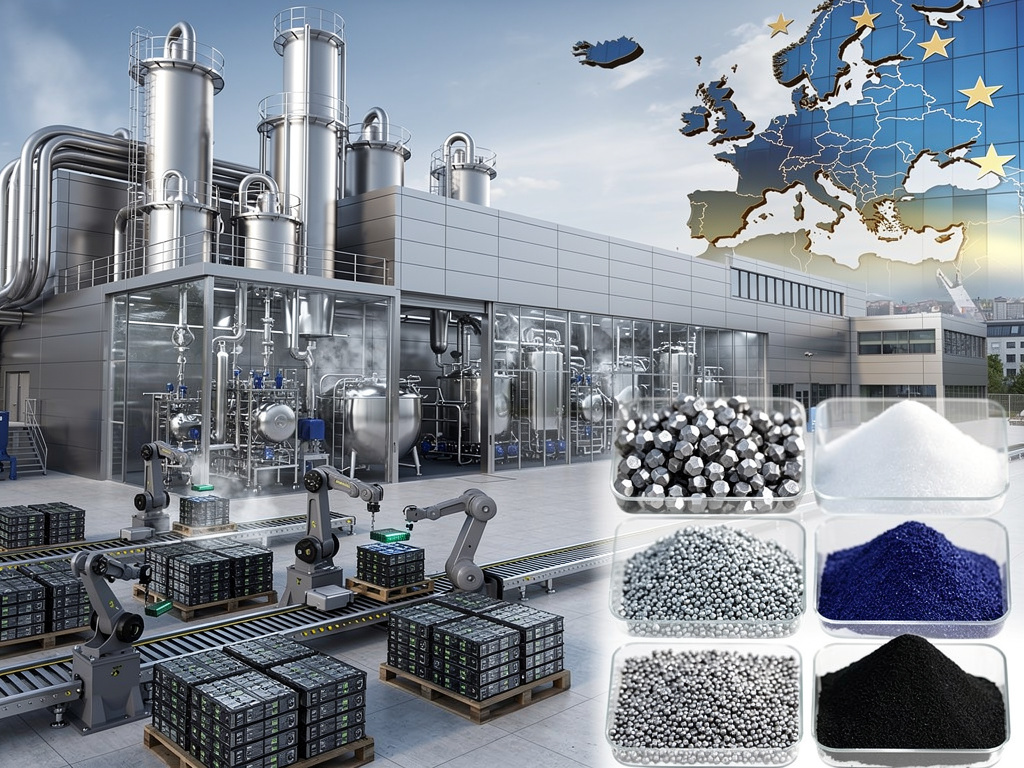
In a former industrial district of Munich, a startup called Tozero is doing something that most of Europe’s battery supply chain has only talked about. It’s actually recycling lithium-ion batteries at scale — and recovering lithium in the process, a feat that the vast majority of existing recyclers still can’t pull off.
The company announced in late June 2025 that it has opened what it calls Europe’s first industrial-scale hydrometallurgical battery recycling plant. The facility can process 10,000 metric tons of lithium-ion battery waste per year, extracting critical minerals like lithium, nickel, cobalt, and graphite and returning them to the supply chain as battery-grade materials. According to The Next Web, the plant represents a significant step toward closing the loop on Europe’s battery material dependency.
That dependency is staggering. Europe currently imports more than 95% of the critical raw materials it needs for battery production, primarily from China, the Democratic Republic of Congo, and Australia. The geopolitical implications are obvious. Less obvious — but equally pressing — is the sheer volume of battery waste heading toward the continent’s doorstep. As electric vehicle adoption accelerates and first-generation EV batteries reach end of life, Europe faces a recycling bottleneck it hasn’t built the infrastructure to handle.
Tozero thinks it has the answer.
Founded in 2022 by Sarah Fleischer and Dr. Ksenija Milicevic Neumann, the company has moved from lab-stage research to commercial operations in roughly three years. That’s fast by any measure, but especially so for a deep-tech materials company operating in a heavily regulated European market. The founding team met at the Technical University of Munich, where their research focused on hydrometallurgical recovery processes — essentially using water-based chemical solutions rather than extreme heat to extract metals from battery waste.
The distinction matters. Most existing battery recyclers in Europe rely on pyrometallurgy, which involves smelting battery materials at temperatures exceeding 1,500 degrees Celsius. The process recovers cobalt and nickel reasonably well but typically destroys the lithium content, which ends up in slag. It also burns away graphite entirely. Tozero’s hydrometallurgical approach, by contrast, operates at much lower temperatures and can recover lithium at battery-grade purity — along with graphite, which the company brands as “HydroGraphite.”
This isn’t a marginal technical improvement. It’s a fundamentally different recovery profile. As The Next Web reported, Tozero’s process recovers over 95% of critical materials from black mass — the shredded, powdered remains of spent batteries that serve as the feedstock for chemical recovery. That figure, if it holds at industrial scale, would put Tozero ahead of most competitors on recovery rates and well within the targets set by the European Union’s new Battery Regulation.
The EU Battery Regulation, which entered into force in 2023 and will phase in requirements through 2031, is the policy engine behind much of the investment flowing into European battery recycling. Among its key mandates: by 2027, recyclers must recover at least 50% of lithium from battery waste, rising to 80% by 2031. For cobalt, copper, and nickel, the thresholds are 90% by 2027 and 95% by 2031. And starting in 2030, new batteries sold in Europe must contain minimum percentages of recycled content — 12% cobalt, 4% lithium, 4% nickel, and 85% lead.
These aren’t aspirational targets. They’re binding law.
The regulation has created a structural demand signal for companies like Tozero. Battery manufacturers and automakers operating in Europe will need verified sources of recycled materials to remain compliant. And they’ll need those sources to be domestic, or at least within the EU, to satisfy the regulation’s traceability and chain-of-custody requirements. That gives European recyclers a built-in market advantage — if they can deliver the volumes and purity levels required.
Tozero’s 10,000-ton-per-year facility is a bet that it can. The plant is located in Munich and represents the company’s transition from pilot to production. According to the company, it is already processing commercial volumes of black mass and producing battery-grade lithium hydroxide, nickel sulfate, cobalt sulfate, and manganese sulfate, as well as its proprietary recovered graphite product.
The financing behind this push has been substantial. Tozero raised a €23 million Series A round in early 2025, led by venture firm World Fund with participation from several strategic and institutional investors. That followed earlier seed funding and grant support from German and EU innovation programs. The company has also received backing from EIT InnoEnergy, the European investment engine focused on sustainable energy, which has supported a number of battery value chain startups across the continent.
But Tozero isn’t operating in a vacuum. The European battery recycling sector has attracted a wave of competitors, each pursuing slightly different technical and commercial strategies. Redwood Materials, founded by former Tesla CTO JB Straubel, has been scaling aggressively in the United States and has signaled interest in European operations. Li-Cycle, a Canadian company, opened a spoke facility in Germany before running into financial difficulties that forced a restructuring. Hydrovolt, a joint venture between Northvolt and Hydro, operates a mechanical processing facility in Norway. And several Chinese firms, including Brunp Recycling (a CATL subsidiary) and GEM Co., dominate global recycling volumes, particularly in hydrometallurgical processing.
The competitive dynamics are complex. Chinese recyclers benefit from massive scale, lower labor costs, and proximity to the world’s largest battery manufacturing base. American companies like Redwood Materials have access to Inflation Reduction Act subsidies that can offset capital costs. European startups, by contrast, must contend with higher energy prices, stricter environmental permitting, and a fragmented collection infrastructure for end-of-life batteries.
What European companies do have is regulatory tailwind and geographic necessity. The EU’s Critical Raw Materials Act, adopted in 2024 alongside the Battery Regulation, sets explicit targets for domestic processing and recycling capacity. By 2030, the bloc aims to process at least 40% of its annual consumption of strategic raw materials domestically and recycle at least 25% of those materials from waste streams. Lithium, cobalt, nickel, and natural graphite all appear on the strategic materials list.
So the policy architecture is in place. The question is whether companies like Tozero can build the physical infrastructure fast enough to meet the demand curve.
There are reasons for optimism. The European Investment Bank has been increasing its lending to battery recycling and materials processing projects. National governments, particularly Germany and France, have earmarked billions in subsidies for battery value chain development. And automakers including BMW, Volkswagen, and Stellantis have all signaled willingness to sign offtake agreements with domestic recyclers — provided they can guarantee supply quality and consistency.
There are also reasons for caution. Hydrometallurgical recycling, while more selective than pyrometallurgy, generates significant volumes of chemical waste — acids, solvents, and process water that must be treated and disposed of in compliance with environmental regulations. Scaling these processes from pilot to industrial volumes introduces engineering challenges that don’t always resolve linearly. And the economics of battery recycling remain tightly linked to volatile commodity prices: when lithium or cobalt prices drop, as they have at various points over the past two years, the margin between processing cost and recovered material value can shrink uncomfortably.
Tozero’s leadership has acknowledged these challenges. In previous interviews, CEO Sarah Fleischer has emphasized the importance of maintaining flexibility across battery chemistries — the company’s process is designed to handle NMC (nickel-manganese-cobalt), NCA (nickel-cobalt-aluminum), and LFP (lithium iron phosphate) cathode types, which is critical as the market shifts increasingly toward lower-cost LFP batteries that contain no cobalt or nickel. Recovering lithium and graphite from LFP cells is technically demanding, and many pyrometallurgical recyclers simply can’t do it economically. If Tozero can, it opens a large and growing market segment that most European competitors haven’t yet addressed.
The graphite angle is particularly interesting. Natural graphite is overwhelmingly sourced from China, which controls roughly 65% of global mine production and an even larger share of processed graphite suitable for battery anodes. Synthetic graphite production is energy-intensive and concentrated in the same geography. Recovering high-purity graphite from spent batteries could provide a meaningful alternative supply source — and one that carries a significantly lower carbon footprint than virgin production.
Tozero’s HydroGraphite product is aimed squarely at this opportunity. The company claims its recovered graphite meets the purity specifications required for direct reuse in battery anodes, though independent verification of these claims at commercial scale remains to be fully published. If validated, it would make Tozero one of a very small number of companies globally capable of closing the graphite loop.
The timing of Tozero’s plant opening also intersects with a broader rethinking of supply chain strategy across European industry. The trade tensions between the United States and China, the disruptions caused by the war in Ukraine, and the growing awareness of concentration risk in critical mineral supply chains have all pushed European policymakers and corporate strategists toward a more aggressive stance on domestic sourcing. Battery materials sit at the center of this shift.
And the numbers are only going to get bigger. The International Energy Agency estimates that global demand for lithium will grow roughly 20-fold by 2040 under its stated policies scenario. Cobalt and nickel demand for batteries is expected to multiply several times over. Even with aggressive mining expansion, recycled materials will need to fill a significant share of that demand — particularly in regions like Europe that lack major domestic mining operations for these commodities.
Tozero’s 10,000-ton annual capacity is, in the context of Europe’s total battery waste generation, still modest. But it’s a proof point. The company has demonstrated that a European startup can move from university research to industrial production in three years, attract serious venture capital, and begin delivering recycled battery materials at commercial volumes. Whether it can scale to 50,000 or 100,000 tons — the kind of capacity that would make a real dent in Europe’s import dependency — is the next test.
For now, the Munich plant is operational. The chemistry works. The regulation is on the books. And the market, for once, is pulling in the same direction as the policy. That’s a rare alignment in European industrial strategy, and Tozero appears positioned to capitalize on it — if it can execute.
The rest of the continent is watching.


 WebProNews is an iEntry Publication