
Amanda Hyslop’s teenage son snapped a photo of his math homework. He fed it into an AI tool. One word prompt followed: Solve. The answer appeared. Homework done.
But something felt off. Hyslop, a parent in the Reed Union School District north of San Francisco, didn’t panic. She acted. Last fall she joined the district’s new AI task force. By November she helped draft its first vision statement, safety guidelines, and student-use framework. Business Insider published her account June 21, 2026.
Her experience captures a shift happening in homes and classrooms across the country. Teens turn to AI daily. Schools scramble to set rules. Parents stand caught between fear and necessity. Short sentences. Long silences. Then questions that linger.
Data confirms the scale. A June 2026 Education Week report revealed nearly one-quarter of 9- to 17-year-olds would ask a chatbot for homework help before turning to a teacher, counselor or parent. Among adolescents who use AI, 85% apply it to schoolwork. Half do so weekly. One in five uses it every day. The pattern holds even when schools issue guidance. Teens still reach for the tool first.
Hyslop saw this firsthand. Her son took the easy route. Many peers did too. Some chased grades without consequence. Others avoided AI entirely out of fear of punishment or peer judgment. “Use AI, maybe get an A, or use AI and risk getting judged by your friends, or punished by teachers,” she wrote. The gray zone left everyone uneasy.
From parental worry to policy drafting
Hyslop entered the task force protective. She worried about creativity, attachment, critical thinking and problem-solving. Conversations with other parents revealed shared anxiety. AI literacy mattered. Its side effects raised alarms. Yet the district, located near OpenAI, Anthropic and Google, refused to ban the technology. Leaders focused on responsible integration from the start.
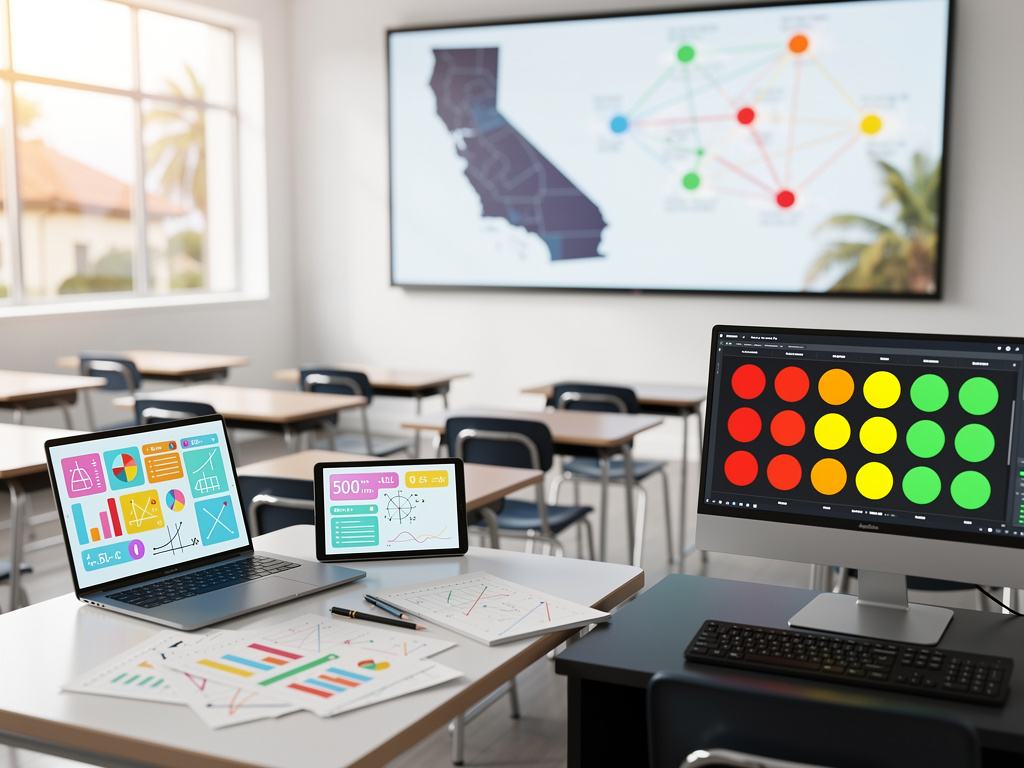
Three meetings produced concrete output. A vision statement. Ethics review process. Clear policy on literacy and use. The group settled on a traffic-light model. For K-5 students, red meant no AI, yellow allowed tutor support, green treated AI as partner. Middle school adopted a 0-to-4 scale with color bands. Zero barred involvement. Four required students to critique and fact-check AI-generated work. Assignment headers, posters and family notes would display the signals. Clarity replaced confusion.
This approach mirrors broader trends. A February 2026 Pew Research Center study found over half of teens used chatbots for schoolwork. Twelve percent sought emotional support from them. More teens viewed AI positively than negatively. Yet schools often lag. A March 2026 RAND report noted most students who used AI for homework in 2025 worried about damage to critical thinking. RAND urged districts to distinguish cognitive offloading from augmentation and to communicate rules explicitly. RAND Corporation.
Hyslop’s district chose augmentation. The traffic-light system signals intent. Students learn when AI supports thinking rather than replaces it. Teachers gain consistency. Parents receive transparency. Hyslop wants her son curious, questioning outputs, pushing back when answers ring false. She rejects copy-and-paste outsourcing. “I don’t want him to sit down, hit copy and paste, and walk away,” she explained. The distinction feels vital.
Recent surveys show parents often remain unaware. A 2026 Understanding America Study cited in LinkedIn analysis by Morgan Polikoff found two-thirds of teens use AI for schoolwork. Usage barely differs between schools with bans and those without. Only one in five teachers works in a district with a formal policy. Parents underestimate their children’s activity. LinkedIn post by Morgan Polikoff.
Legislatures respond. Ohio’s House Bill 96, passed earlier in 2026, requires K-12 and higher education institutions to adopt AI policies by July 1. States introduced 134 AI education bills in 2026 across 31 jurisdictions, many targeting data privacy and human oversight. California strengthened student data protections. Illinois granted families opt-out rights on AI grading. The pace quickens. MultiState.
Yet policy alone falls short. Common Sense Media’s Generation AI report, released in 2026, captured a stark divide. Fifty-two percent of kids and teens believe using AI for assignments should be encouraged as innovative. An equal share of parents call it unethical and demand consequences. Both sides agree schools must teach responsible use. Sixty-eight percent of youth and 52% of parents assign that duty to educators. Common Sense Media.
Hyslop bridges that divide. She entered the process skeptical. Exposure to teachers and administrators shifted her view. AI carries promise when guided. Risks remain real. The middle path requires effort from everyone. Her son’s shortcuts forced the conversation. The resulting framework gives students structure instead of secrecy.
But challenges persist. A March 2026 School AI guide for parents noted half of parents don’t know their school’s AI policy. Pew data from early 2025 already showed usage doubling in one year. Teens in higher grades lead the trend. Eleventh and twelfth graders report highest adoption. Younger students follow. Britannica’s May 2026 pro-con analysis highlighted acceptance rates: 54% of teens find AI acceptable for research, 29% for math problems, only 18% for full essays. Britannica.
Districts experiment. New York City Public Schools issued detailed AI guidance emphasizing research, exploration and critical evaluation while developing assessment policies for an AI-enabled environment. NYCPS stresses family notification. Other systems adopt similar transparency. The pattern repeats: acknowledge reality, set boundaries, teach evaluation.
Hyslop still figures it out. She reinforces the traffic-light rules at home. She encourages questions over blind acceptance. Her experience offers a template. One family’s discovery sparked district action. That action now informs thousands of students. The technology won’t retreat. Schools and parents must advance together.
So the photo of math homework led to policy posters on classroom walls. A single prompt produced more than answers. It produced a framework. Clarity. Signals. Partnership instead of shortcut. And a reminder that sometimes the most powerful prompt isn’t “Solve.” It’s “How do we prepare our children to think alongside these tools?”


 WebProNews is an iEntry Publication