
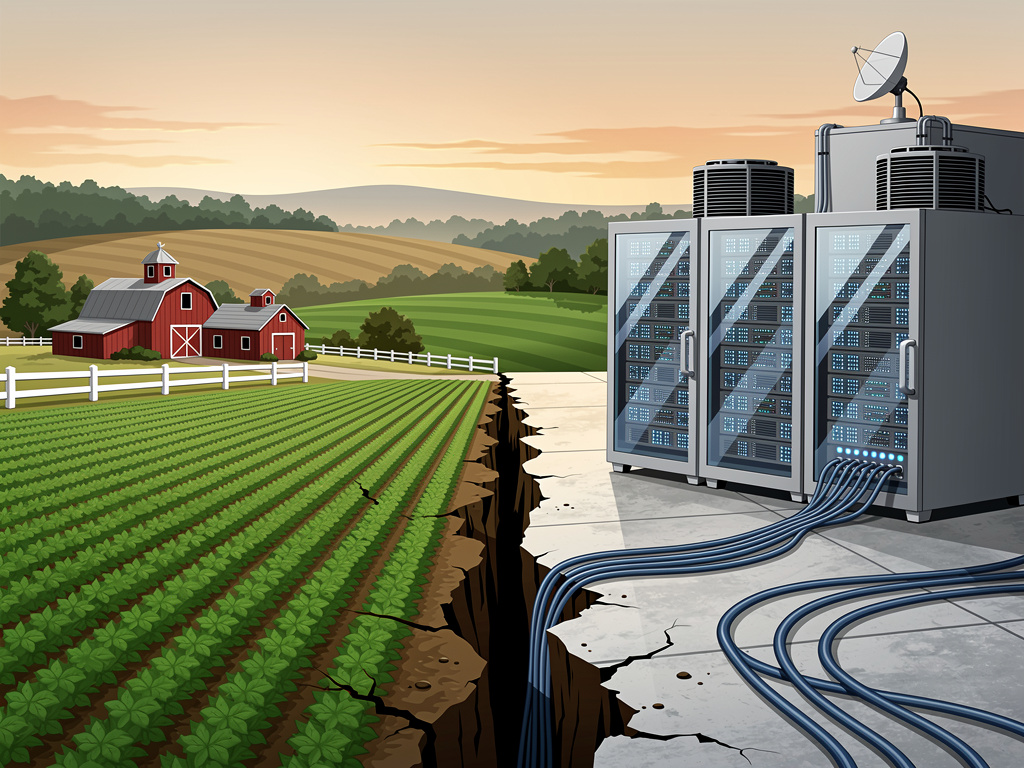
Tiffany Burns doesn’t want to sell her farm. Not for $26 million. Not for any price.
The 58-year-old Kentucky woman has become an unlikely symbol of resistance in a national conflict that is accelerating faster than most Americans realize — the collision between Big Tech’s insatiable demand for data center land and the rural communities sitting on top of the acreage they need. As first reported by TechCrunch, Burns rejected a staggering eight-figure offer from a developer seeking to convert her multi-generational family property in rural Kentucky into a hyperscale data center facility. The offer represented a premium of roughly ten times the land’s appraised agricultural value.
She turned it down flat.
“This land has been in my family for four generations,” Burns told TechCrunch. “You can’t put a price on that.” Her stance has resonated far beyond her county line, sparking debate on social media and drawing attention from agricultural advocacy groups, tech industry analysts, and local politicians who see her case as a bellwether for fights playing out across the American heartland.
But Burns’s decision, however personally meaningful, sits at the center of a much larger story — one about power grids buckling under new demand, about communities divided over tax revenue versus quality of life, and about an industry that has spent the last two years on a building spree of historic proportions.
The Math Behind the Mania
The numbers driving the data center land grab are staggering. U.S. data center capacity is projected to more than double by 2030, driven primarily by the explosive growth of artificial intelligence workloads. According to a recent report from JLL, North American data center absorption hit record levels in 2025, with over 2,700 megawatts of new capacity leased across primary markets. And that appetite is pushing developers into secondary and tertiary markets — places like rural Kentucky, central Ohio, and the outskirts of small towns in Georgia and Mississippi — where land is cheap, electricity is available, and local governments are often desperate for economic development.
Kentucky, in particular, has become a magnet. The state offers competitive electricity rates thanks to its legacy coal infrastructure and growing renewable portfolio. The Kentucky Cabinet for Economic Development has actively courted data center investment, offering tax incentives that can run into the hundreds of millions of dollars over the life of a project. Several major facilities are already under construction or in the permitting phase across the state.
So when a developer came knocking on Tiffany Burns’s door with $26 million, it wasn’t random. It was the logical extension of a strategy playing out across dozens of rural counties nationwide.
The developer, whose identity has not been publicly confirmed, reportedly identified Burns’s property — approximately 400 acres of farmland with access to major transmission lines and a nearby water source — as an ideal location for a facility that could eventually draw upwards of 100 megawatts of power. Properties with that combination of attributes have become extraordinarily scarce in markets closer to major population centers, where land costs and permitting timelines have ballooned.
Burns’s neighbors have had mixed reactions. Some view her refusal as noble. Others think she’s leaving life-changing money on the table — money that could benefit not just her family but the broader community through construction jobs, property tax revenue, and downstream economic activity. That tension is real, and it’s not going away.
“You’re talking about a region where the median household income is under $40,000,” one local official told reporters. “Twenty-six million dollars is an abstraction. But the jobs and tax base a data center brings? That’s concrete.”
The counterargument is equally concrete. Data centers employ relatively few permanent workers — a facility drawing 100 megawatts might have a full-time staff of 50 to 100 people. The construction phase creates temporary employment, but once the servers are humming, the economic footprint is modest relative to the infrastructure demands. Water consumption for cooling systems can strain local supplies. Noise from backup generators and HVAC systems can be relentless. And the sheer scale of these facilities — some covering 50 acres or more under roof — permanently transforms the character of the land.
For Burns, those tradeoffs aren’t abstract. They’re personal.
When Heritage Meets Hyperscale
Her farm produces cattle and hay. It has a creek running through it where her grandchildren play. The family cemetery is on the property. These are the kinds of details that don’t show up in a site selection spreadsheet, but they’re the ones that make someone say no to a number that most people would find impossible to refuse.
And she’s not alone. Across the country, similar standoffs are playing out with increasing frequency. In Virginia’s Loudoun County — long the epicenter of American data center development, housing roughly 70% of the world’s internet traffic at one point — residents have pushed back hard against further expansion into residential and agricultural areas. Prince William County, Virginia, saw a proposed 2,100-acre data center campus from QTS become a flashpoint for community opposition in recent years, with residents citing concerns about noise, water use, and the industrialization of formerly rural land.
In Chesterton, Indiana, a proposed Meta data center drew fierce local opposition over water usage. In Mount Pleasant, Wisconsin, the ghost of the Foxconn debacle — where massive public subsidies yielded a fraction of the promised jobs — continues to haunt conversations about large-scale tech facility development. The pattern is remarkably consistent: a developer identifies a site, local officials see dollar signs, and residents organize in opposition, often too late to stop the project but early enough to extract concessions or, occasionally, kill it outright.
What makes Burns’s case unusual is the size of the offer she rejected and the clarity of her refusal. There was no counteroffer. No negotiation. Just no.
That kind of resolve is becoming a variable that data center developers and their real estate brokers have to factor into their models. Site selection has always been a complex calculus involving power availability, fiber connectivity, water access, natural disaster risk, tax incentives, and labor markets. Now add community sentiment — and the possibility that a single landowner can upend a deal worth hundreds of millions in eventual investment.
Some developers are adapting. Microsoft, Google, and Amazon — the three largest hyperscale data center operators — have all invested in community engagement programs designed to build local support before projects are announced. Microsoft has pledged investments in local infrastructure, schools, and broadband access in communities where it builds. Google has funded workforce development programs. Amazon has touted the property tax contributions its facilities make.
But the fundamental tension remains. These companies need land, power, and water on a scale that is difficult to reconcile with the character of small rural communities. A single hyperscale campus can consume as much electricity as a small city. The water demands for evaporative cooling systems can run into the millions of gallons per day. And the visual impact of a 500,000-square-foot windowless building surrounded by security fencing is, to put it mildly, not what most people picture when they think of the pastoral countryside.
Burns’s rejection also highlights a legal and political dimension that is only beginning to receive serious attention. In some states, eminent domain statutes could theoretically be invoked to acquire land for data center projects deemed to serve a public purpose — particularly if the facility is tied to government contracts or critical infrastructure designations. While no such action has been taken against a private landowner for a data center to date, legal scholars have flagged it as a possibility, especially as AI infrastructure becomes increasingly intertwined with national security priorities.
Kentucky law provides some protection for agricultural land through its right-to-farm statutes, but those protections weren’t designed with data centers in mind. State legislators have begun discussing whether new guardrails are needed — both to protect landowners who don’t want to sell and to streamline the process for those who do.
The politics are thorny. Rural Republican lawmakers, who might instinctively side with property rights and agricultural preservation, also tend to be pro-business and eager for economic development in their districts. Democrats in urban areas, who might champion environmental and community concerns, are often aligned with the tech companies driving the demand. The issue doesn’t break cleanly along partisan lines, which makes legislative action unpredictable.
Meanwhile, the money keeps flowing. Capital investment in U.S. data centers exceeded $300 billion in commitments announced during 2025 alone, according to industry tracking by Synergy Research Group. That figure is expected to grow substantially in 2026 as AI model training and inference workloads continue to scale. Every one of those dollars eventually needs a physical home — a piece of land, a power connection, a water source.
Tiffany Burns’s 400 acres represent a tiny fraction of the land that will be needed. But her decision carries weight precisely because it’s so easy to understand. In a debate often dominated by megawatts, latency figures, and tax abatement schedules, she’s offered something simpler.
This is my home. No.
Whether that sentiment can hold against the combined force of corporate capital, local economic need, and national technology ambitions is the question that will define the next chapter of America’s data center expansion. For now, Burns is tending her cattle, her grandchildren are playing by the creek, and the developer is, presumably, looking at the next parcel on the list.
There are always more parcels. But there aren’t always more Tiffany Burnses willing to say no — and that scarcity, paradoxically, may be the most valuable thing of all.


 WebProNews is an iEntry Publication