
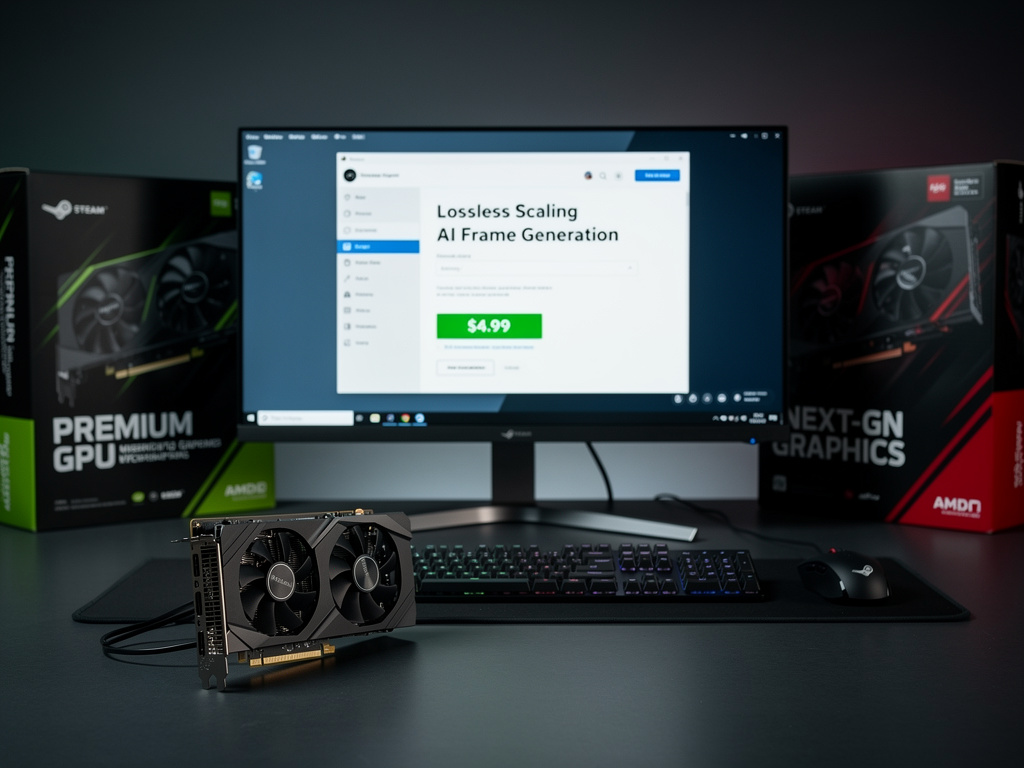
For years, the upgrade treadmill in PC gaming has been relentless: new games demand more frames, more frames demand newer hardware, and newer hardware demands ever-deeper wallets. Nvidia’s latest flagship cards now routinely breach the $1,000 mark, and even midrange options hover around $400 to $500. But a small, scrappy software tool called Lossless Scaling is quietly undermining that entire economic logic — delivering modern frame generation technology to graphics cards that are half a decade old, all for less than the price of a fast-food combo meal.
The application, available on Steam for just $4.99, has surged in popularity among PC gamers who refuse to shell out for new GPUs. It works by inserting AI-generated intermediate frames between the frames your graphics card actually renders, effectively doubling or even tripling your perceived frame rate without requiring any additional horsepower from your existing hardware. As TechRadar reported, the software can transform an outdated GPU into a “frame gen machine for less than the price of a 6-piece chicken nugget meal.”
How Frame Generation Went From Exclusive Feature to Five-Dollar Commodity
Frame generation as a concept is not new. Nvidia introduced its proprietary version, DLSS 3 Frame Generation, alongside the RTX 40-series GPUs in late 2022. The technology was marketed as a tentpole feature of the Ada Lovelace architecture, one that could only run on RTX 4000-series cards and above due to a dedicated hardware component called the Optical Flow Accelerator. AMD followed with its own implementation, Fluid Motion Frames (AFMF), which worked across a broader range of Radeon GPUs but still required relatively recent hardware and game-specific driver support.
Lossless Scaling sidesteps all of those restrictions. Because it operates as an overlay at the operating system level rather than hooking into individual game engines, it is hardware-agnostic. It works on Nvidia cards, AMD cards, and even Intel Arc GPUs. It works on games that have no built-in frame generation support. And critically, it works on older cards — the GTX 1060s and RX 580s of the world that millions of gamers still rely on daily, according to Steam’s own hardware survey data.
The Technical Mechanics: What Lossless Scaling Actually Does Under the Hood
The software, developed by a small independent team, uses frame interpolation algorithms — including an option branded as “LSFG 2” (Lossless Scaling Frame Generation 2) — to analyze two consecutive rendered frames and generate a synthetic intermediate frame that approximates what the scene would look like between them. The result is a smoother visual experience, particularly in games that would otherwise run at 30 or 40 frames per second on aging hardware.
According to TechRadar’s analysis, the tool is particularly effective for single-player and less twitchy titles where the slight additional input latency introduced by frame interpolation is less noticeable. In fast-paced competitive shooters, the added latency can be a dealbreaker — but for the vast majority of gaming scenarios, the trade-off is more than acceptable. The publication noted that the software essentially democratizes a technology that GPU manufacturers have been using as a premium selling point.
Why GPU Makers Have Reason to Pay Attention
The implications for Nvidia and AMD are significant. Both companies have spent considerable marketing dollars positioning frame generation as a reason to upgrade. Nvidia’s messaging around the RTX 50-series, which launched earlier this year, has leaned heavily on “DLSS 4” and its Multi Frame Generation capability, which can generate up to three intermediate frames at once. AMD has similarly promoted AFMF 2 as a key differentiator for its latest Radeon lineup.
But if a $5 application can deliver 80% of the perceived benefit on hardware that is already paid for, the value proposition of a $500-plus GPU upgrade becomes harder to justify for budget-conscious consumers. Steam’s hardware surveys consistently show that the most popular graphics cards among its user base are not the latest flagships but rather midrange cards from one or two generations back. The GTX 1650, RTX 3060, and RX 6600 XT remain among the most widely used GPUs on the platform. For those users, Lossless Scaling represents an extraordinarily cost-effective performance boost.
The Caveats: Frame Generation Is Not a Free Lunch
It is worth being clear-eyed about the limitations. Frame generation — whether from Nvidia, AMD, or Lossless Scaling — does not actually increase the number of frames your GPU renders. Your game is still running at whatever native frame rate your hardware can manage. The interpolated frames are synthetic approximations, and they can introduce visual artifacts, particularly in scenes with rapid camera movement or complex particle effects. Ghosting, where objects leave faint trails, is a common complaint.
Input latency is the other major concern. Because the software must wait for at least two real frames before it can generate an intermediate one, there is an inherent delay between a player’s input and the corresponding visual response on screen. For competitive multiplayer titles — think Counter-Strike 2 or Valorant — this is a non-trivial disadvantage. Lossless Scaling’s developers acknowledge this and recommend the tool primarily for single-player experiences and games where visual smoothness matters more than raw responsiveness.
The Broader Trend: Software Eating Hardware’s Lunch
Lossless Scaling is part of a broader pattern in the PC hardware space where software solutions are increasingly encroaching on territory that was once the exclusive domain of hardware upgrades. Nvidia’s own DLSS upscaling technology — which renders games at lower resolutions and uses AI to reconstruct a higher-resolution image — was itself a concession that raw brute-force rendering was becoming unsustainable. AMD’s FSR (FidelityFX Super Resolution) took that concept further by making it open-source and hardware-agnostic.
Frame generation is simply the next frontier in this trend. And the fact that a small independent developer can offer a competitive implementation for under $5 suggests that the technology itself is not as proprietary or hardware-dependent as GPU manufacturers have implied. The Optical Flow Accelerator that Nvidia touts as essential for DLSS 3 Frame Generation may offer superior quality and lower latency, but the gap between that premium implementation and a software-only alternative is narrowing with each update Lossless Scaling ships.
What This Means for the Next GPU Upgrade Cycle
The timing of Lossless Scaling’s rise in popularity is particularly interesting given the current state of the GPU market. Nvidia’s RTX 50-series cards have faced criticism for high pricing, with the RTX 5080 launching at $999 and the RTX 5070 Ti at $749. AMD’s next-generation RDNA 4 cards have been positioned more aggressively on price but are still not cheap by historical standards. Intel’s Battlemage Arc GPUs have offered compelling budget options, but availability has been inconsistent.
In this environment, tools like Lossless Scaling give consumers a reason to wait. If a $5 software purchase can extend the useful life of a current GPU by another year or two, the urgency to upgrade diminishes considerably. That is a problem for companies whose business models depend on regular upgrade cycles. Nvidia in particular derives a significant portion of its gaming revenue from the assumption that consumers will replace their GPUs every two to three generations.
The Chicken Nugget Benchmark and What Comes Next
The comparison to a fast-food meal is not just clickbait — it captures something real about the absurd economics of modern PC gaming. A technology that major corporations have spent billions developing and marketing as a premium feature can now be approximated by software that costs less than lunch. That does not mean the premium versions are worthless; Nvidia’s and AMD’s implementations remain superior in quality and latency. But for the millions of gamers running older hardware, “good enough” at $5 beats “best in class” at $500 every single time.
Lossless Scaling has already accumulated tens of thousands of reviews on Steam, the overwhelming majority of them positive. Its developer continues to push updates that improve interpolation quality and reduce artifacts. If the trajectory holds, the gap between software-based and hardware-based frame generation will only continue to shrink. GPU makers may eventually need to find new reasons to convince consumers that the next $500 graphics card is worth the price — because frame generation alone is no longer going to cut it.


 WebProNews is an iEntry Publication