
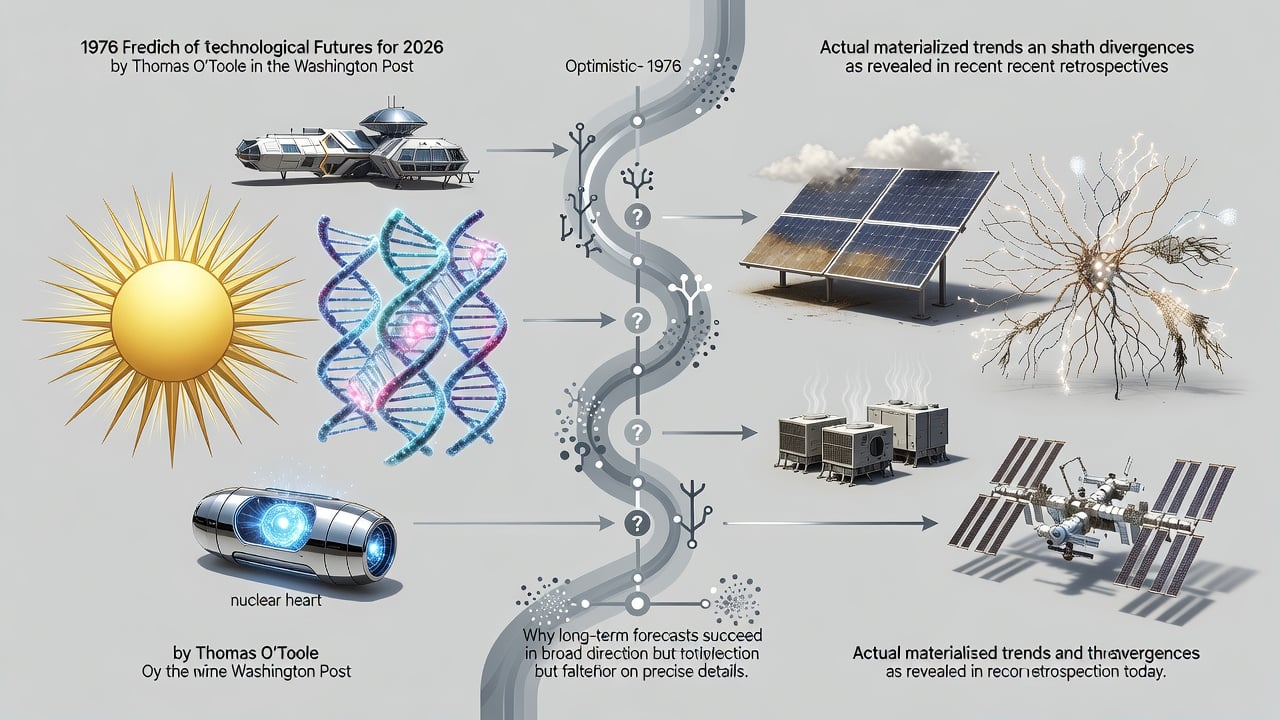
Thomas O’Toole sat down in 1976 to sketch life in 2026. The Washington Post science editor laid out bold expectations for energy, medicine, communications and space. Half a century later the scorecard looks mixed. Some forecasts landed close to reality. Others missed by a mile. And the exercise itself reveals something valuable about how experts imagine tomorrow.
O’Toole wrote his piece for America’s bicentennial. He wanted to mark the 200th anniversary by peering ahead to the 250th. The result, titled “Inventing the Future,” appeared on July 4, 1976. It captured the postwar optimism that science could solve almost any problem. Solar power would dominate. Fusion remained decades distant. Phones would travel through optical fiber. Genetic engineering would reshape health care. Americans would live longer. Nuclear-powered artificial hearts would become ordinary. Deep-sea mining would boom. Permanent settlements would exist beyond Earth.
Fast-forward to today. Many of those ideas feel familiar. But the details diverge in telling ways. The Washington Post revisited the article this week. Average life expectancy for Americans hit a record 79 years in 2024. O’Toole had predicted gains. He got that one right.
Solar energy supplies a meaningful share of electricity in 2026. Not the majority O’Toole envisioned, yet far more than skeptics expected in the 1970s. Fusion power still sits decades away despite billions poured into research. The prediction holds. So does the caution that commercial fusion would take time.
Mobile communications exploded beyond recognition. Smartphones let people talk, text and stream from almost anywhere. Optical fiber carries vast data traffic. The spirit of the forecast proved accurate even if the exact form looked nothing like O’Toole imagined. No one in 1976 described a device that fits in a pocket and connects to satellites.
Genetic engineering offers a partial success. CRISPR tools edit genes with precision. They treat certain diseases and spark ethical debates. Health care feels transformed. Yet routine designer babies or wholesale rewriting of human biology remain distant. The promise arrived. The scale did not.
Other forecasts fell flat. Nuclear-powered artificial hearts never became commonplace. Medical teams pursued transplants, mechanical pumps and stem-cell therapies instead. The nuclear option raised safety questions that proved hard to overcome. Deep-sea mining exists in prototype form. Environmental concerns and regulatory hurdles slowed adoption. Companies test the waters. They do not yet harvest minerals at the pace O’Toole expected.
Human settlements beyond Earth stay elusive. NASA, private firms and international partners plan lunar bases and Mars missions. No one lives off-planet full time in 2026. The dream persists. The timeline stretched. And that gap between vision and delivery tells a larger story.
Predictions rarely nail specific inventions. They capture broader directions. O’Toole foresaw a connected world, longer lives and new energy sources. He did not anticipate the internet, social media or the smartphone. Those omissions matter less than the underlying trends he sensed. Digital Trends noted the humbling success rate. The piece highlighted how forecasts succeed on direction but stumble on form and timing.
Experts quoted in recent coverage echo that view. Forecasting demands humility. Technological change depends on policy, investment, public acceptance and sheer luck. A breakthrough in one lab can accelerate progress. Regulatory pushback or public fear can stall it. O’Toole operated in an era of Apollo triumphs and oil crises. His optimism reflected the times.
But look at the new piece published days ago. The Washington Post asked what America might look like in 2076. Futurists spoke of moon bases, life spans reaching 100 and flying cars. Ray Kurzweil described exponential growth in computing power. Stewart Brand likened the whole world to a computer. The language feels familiar. So do the caveats. History shows such visions often arrive late, transformed or not at all.
Consider artificial intelligence. None of the 1976 predictions mentioned it. Yet AI now dominates technology discussions. Recent analyses test older forecasts against current reality. A MIT Media Lab review of 1990s predictions found similar patterns. Some hits. Many misses. The MIT Media Lab summary, drawing on Quartz reporting, underscored how quickly assumptions age.
Business leaders and policymakers still crave foresight. PwC released its 2026 AI predictions this month. The firm stressed agentic workflows and responsible innovation. Success hinges on measurable outcomes rather than hype. That focus on results would have surprised O’Toole. His era trusted science to deliver progress almost automatically.
Yet the 1976 article retains value. It shows how experts balance hope with realism. Solar and genetics advanced. Space colonization lagged. Hearts took different paths. The discrepancies highlight constraints that forecasts often ignore: cost, ethics, unintended consequences.
So what does this teach technology executives and investors? Treat long-range predictions as directional signals. Not blueprints. Track underlying drivers such as computing power, materials science and regulatory environments. Those forces shape outcomes more than any single invention.
O’Toole died in 2003. He never saw how his list performed. His successors at The Post continue the tradition. The 2026 retrospective and the fresh look toward 2076 form a chain. Each adds perspective. Each admits uncertainty.
And uncertainty defines the game. Short-term forecasts prove difficult enough. Fifty-year horizons invite error. But they also spark conversation. They force readers to question assumptions. They remind leaders that technology unfolds within society, not apart from it.
Perhaps the most useful takeaway is modesty. O’Toole got the big picture partly right. Life expectancy rose. Renewable energy grew. Communications transformed daily existence. He overstated some specifics and missed others entirely. That mixed record feels honest.
Today’s forecasters face the same test. They predict AI agents, quantum computing and climate solutions. Some will land. Others will not. The value lies in the discussion they provoke and the preparation they encourage. Fifty years from now another retrospective will judge them. The score will likely look familiar. Partial credit. Surprises. And a reminder that the future refuses to follow a script.
Still, the impulse endures. Humans want to know what comes next. They write articles. They commission studies. They debate timelines. The 1976 effort stands as one example among many. Humbling. Illuminating. Worth remembering.


 WebProNews is an iEntry Publication