
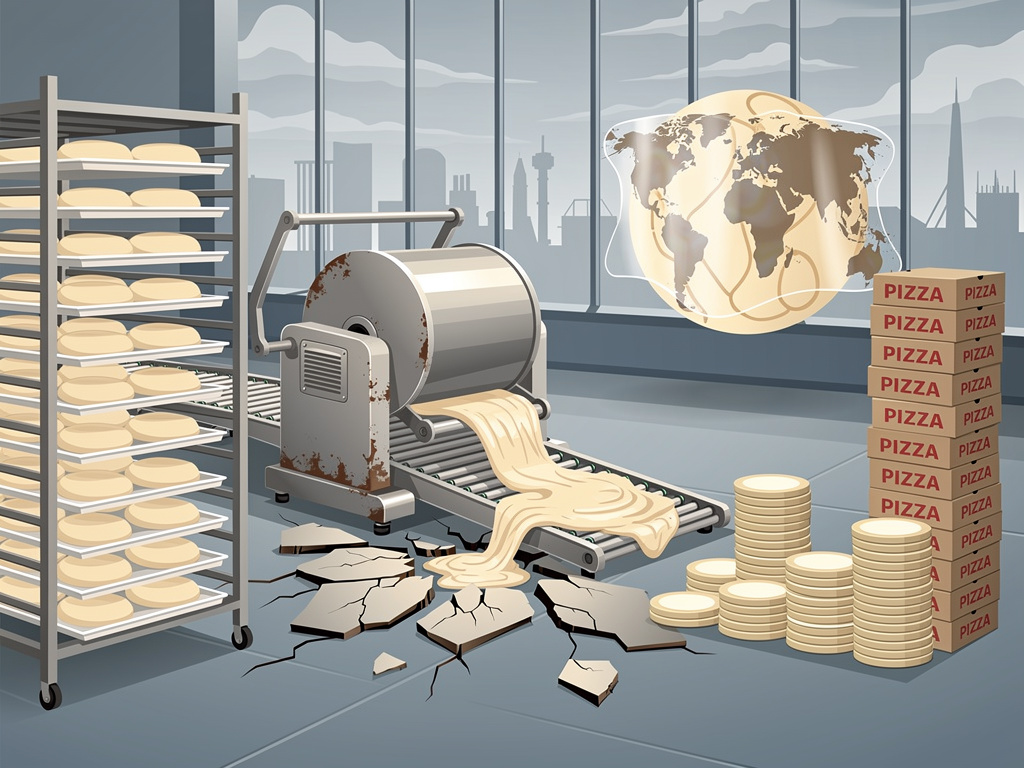
Millennium Dough Company lasted 34 years. It supplied frozen artisan pizza bases to major U.K. chains, hotels and wholesalers from a base in Greenford, West London. Then the numbers stopped adding up. On June 8, 2026, the company entered administration. Debt had more than doubled in under three years. Rising ingredient and energy bills outran sales. Cash flow tightened. Administrators stepped in.
The Supplier Behind the Crust
Founded in 1992 as Millennium Food Services Limited, the firm rebranded in 2022 to highlight its specialty. Long-fermentation dough. Craft flavor profiles. Industrial scale. It produced frozen bases designed for restaurants that wanted better-than-average pizza without mixing their own. The company claimed expertise in authentic, artisan-style product for volume buyers. In 2023 Aquilla Food Group bought it. Terms stayed private. For a time the acquisition looked smart. The year ending October 2024 delivered £1.7 million in profit.
Yet the balance sheet told another story. Debt stood at £751,052 in 2023. By early 2026 it reached £1.5 million. The jump proved too much. Nicholas Charles Simmonds and Chris Newell of Quantuma Advisory Limited took joint control. In a statement the firm said rising costs and cash flow problems pushed Millennium into administration. The company itself issued no comment on restructuring plans or possible rescue. Operations now sit with the administrators. Creditors wait.
But here’s the larger picture. The global pizza market keeps expanding. Projections show growth from roughly $280 billion in 2025 toward more than $340 billion by 2034. Demand exists. Individual suppliers and operators still stumble. Inflation in flour, cheese, labor and utilities hit hard. Energy prices in the U.K. swung sharply after the pandemic and the war in Ukraine. Many hospitality businesses passed costs along unevenly. Some chains absorbed them to protect margins. Others raised menu prices and watched traffic slip.
Millennium felt the squeeze from both sides. Its restaurant and hotel customers faced their own pressures. Several major U.K. pizza brands trimmed locations or renegotiated supplier contracts. Volume orders softened. At the same time raw-material costs climbed faster than the company could adjust pricing. Long-term contracts may have locked in earlier, lower rates. When those expired, reality arrived.
And the timing mattered. The firm had invested in craft positioning after the rebrand. That required higher-quality ingredients and slower processes. Those choices added expense even as competitors offered cheaper, faster alternatives. Customers who once valued the fermentation edge now hunted bargains. The result? Profit on paper, but mounting liabilities.
This case echoes wider distress across the sector. In the United States, multiple Pizza Hut franchisees filed Chapter 11 in recent years. Restaurant Dive reported in July 2024 that EYM Pizza, operator of 140 units, sought protection amid lawsuits with its franchisor and store closures. By early 2025 those locations went to auction. New owners paid roughly $180,000 per store on average, according to court records. Pizza Hut itself bought 18 of them for far less. The episode showed how quickly franchise economics can sour when same-store sales lag and debt piles up.
Similar forces operate on the supply side. Dough makers, cheese processors and packaging firms share the same input inflation. When restaurants cut orders or switch to lower-cost providers, suppliers lose scale. Fixed costs remain. Debt service grows heavier. Millennium’s experience fits this pattern exactly. It reported solid profit one year, then collapsed the next.
Quantuma’s appointment signals standard U.K. procedure. Administration hands day-to-day control to licensed professionals who seek either a sale of the business as a going concern or orderly wind-down. No immediate store closures apply here. The company has no retail outlets. Its factory and customer contracts represent the main assets. Potential buyers could include rival dough producers or larger food groups seeking capacity. Yet high debt and current market conditions may limit interest. Insolvency remains a real possibility.
Industry watchers point to structural change. Quick-service restaurants push harder for off-premise sales. Delivery apps change ordering habits. Consumers split between premium experiences and rock-bottom value. The middle ground narrows. Suppliers caught in that squeeze face tough choices: cut quality, raise prices faster, or absorb losses until cash runs out. Millennium appears to have run out of runway.
Recent coverage reinforces the trend. TheStreet detailed the debt escalation and noted parallel Chapter 11 filings by small U.S. pizza chains Smoking Monkey Pizza and North County Pizza Inc. earlier in 2026. Both cited the same combination of flagging sales and legacy location counts that no longer paid. Papa John’s and Yum! Brands also announced closures of underperforming sites to protect margins. The message repeats. Growth in the overall category does not guarantee survival for every participant.
So what happens next for Millennium? Administrators will solicit offers and speak with major creditors. The £1.5 million debt figure includes trade suppliers, possibly utilities and tax authorities. Any rescue buyer would need to address those claims while preserving the specialized production know-how. Staff at the Greenford facility face uncertainty. The company once promoted itself as a craft producer at industrial scale. That positioning may still hold appeal if a strategic acquirer steps forward.
Broader lessons emerge for food manufacturers. Cost volatility no longer represents a temporary spike. It defines the operating environment. Companies that grew during low-interest, lower-inflation years now carry debt loads calibrated to different assumptions. When sales volume dips even modestly, interest and input costs can overwhelm. Hedging programs, tighter working-capital management and faster menu-price adjustments at the customer level all matter. Many suppliers learned those realities the hard way since 2022.
Millennium Dough Company’s fall after 34 years illustrates the point with clarity. Profit one year. Administration the next. The global pizza business expands, yet the individual businesses that make it possible operate on thinner ice than headlines suggest. Rising costs do not forgive. Cash flow problems compound quickly. And when they do, even established names with loyal industrial customers can disappear almost overnight.
Further details on the administration appeared in local reporting. The Gazette published the formal notice. Regional outlets such as Border Telegraph and the Express covered the family-run origins and wholesale focus. Each account repeats the core facts: 1992 founding, craft frozen dough, sudden debt surge, Quantuma appointment. No new rescue plan has surfaced as of mid-June 2026. The process continues.


 WebProNews is an iEntry Publication