
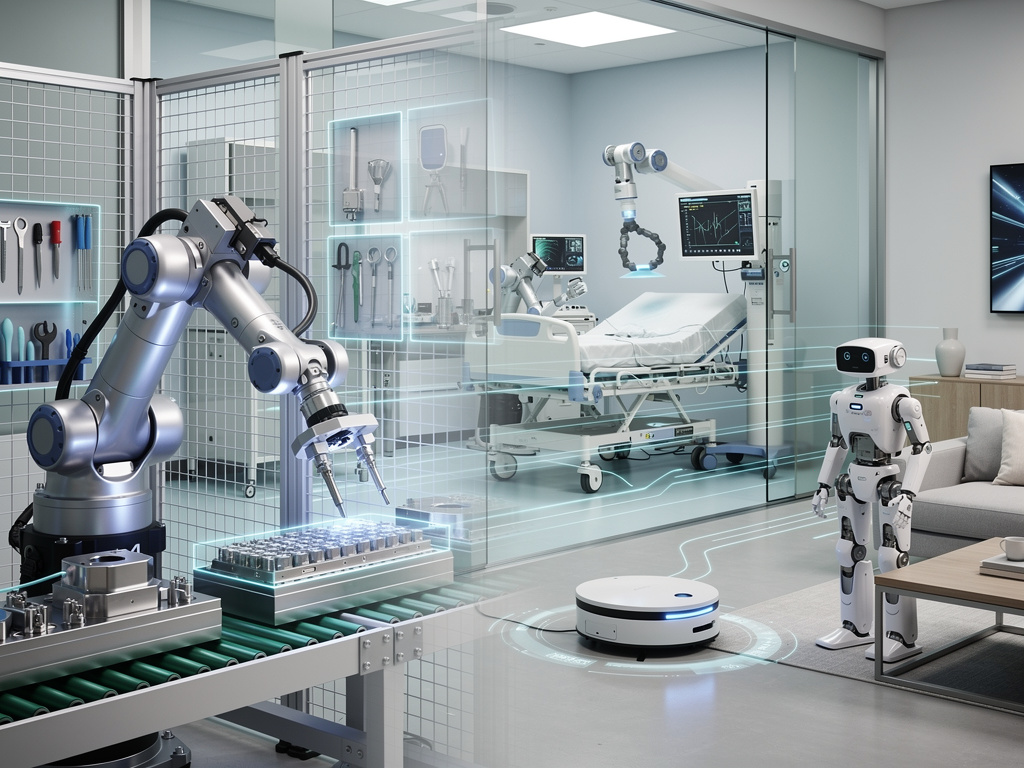
2026: Robotics Revolution Without the Apocalypse
As we approach 2026, the world of robotics is poised for significant advancements, but don’t expect a scene straight out of “The Terminator.” Industry experts and recent developments suggest a more grounded evolution, focusing on practical applications rather than dystopian takeovers. Companies like Tesla and Boston Dynamics are pushing boundaries, yet the reality is far from science fiction. Humanoid robots are making strides in factories and homes, but their integration into daily life will be incremental, driven by AI improvements and hardware refinements.
Recent reports highlight that while humanoid robots like Tesla’s Optimus are generating buzz, much of the progress relies on teleoperation rather than full autonomy. A video circulating on social media showed an Optimus robot collapsing after its operator removed a VR headset, underscoring the current limitations. This incident, as detailed in a piece from TechRadar, illustrates that 2026 won’t mark the year of fully independent androids roaming freely. Instead, expect enhancements in AI-driven tasks, where robots assist in controlled environments.
Beyond the hype, analysts predict a surge in specialized robots for industries like manufacturing and healthcare. Deloitte’s insights point to AI enabling robots to adapt to complex settings, improving safety and precision. This convergence of AI and robotics is expected to unlock new efficiencies, but challenges remain in scaling production and ensuring reliability.
Advancements in AI Integration
The fusion of artificial intelligence with robotic hardware is accelerating, with predictions from sources like Wired suggesting potential shifts in the AI sector, including layoffs as automation takes hold. However, the focus for 2026 is on collaborative systems where humans and machines work in tandem. McKinsey’s research emphasizes skill partnerships, where AI agents and robots complement human capabilities rather than replace them entirely.
Humanoid designs are evolving rapidly. A list from Humanoid Robotics Technology outlines the top 12 models of 2025, many of which will see updates in 2026, incorporating better AI for human-robot interaction. These robots are designed for tasks like elderly care and warehouse operations, prioritizing utility over omnipotence.
Mashable forecasts that AI robots and foldable tech will dominate headlines in 2026, but the reality is a measured rollout. Posts on X from industry observers, such as those discussing Elon Musk’s predictions, indicate that humanoid robots might outnumber humans eventually, but 2026 is more about prototypes entering limited production.
Industry Applications and Challenges
In manufacturing, robots like EngineAI’s T800—evoking but distinct from cinematic terminators—are slated for mass production. New Atlas reports on this acrobatic machine aimed at industrial use, highlighting its potential to handle repetitive tasks with precision. Yet, experts caution that widespread adoption hinges on cost reductions and regulatory approvals.
Healthcare is another frontier. Tiny autonomous robots, smaller than a grain of salt, are being developed for medical applications, as noted in Tom’s Hardware. These micron-scale bots could revolutionize microscale manufacturing and treatments, costing mere pennies to produce.
Transportation and logistics will see AI robots optimizing supply chains. IEEE Spectrum’s top stories of 2025 recap humanoid challenges and innovations like robots for agricultural uses, setting the stage for 2026 expansions.
Economic Impacts and Market Trends
The economic ripple effects are profound. ABC News discusses how AI powered economies to record highs in 2025, yet raises concerns about job displacements, with robots seemingly the only ones “smiling” amid uneven benefits. Investors are watching closely; Investing.com’s analysis of the Humanoid 100 index shows a 25% rise since early 2025, outperforming benchmarks.
Foldables and smart glasses may share the spotlight, but robotics’ growth is tied to AI advancements. Tomorrow’s World Today lists top tech progressions for 2026, with AI at the forefront, influencing everything from energy to automation.
On X, sentiments from users like those predicting millions of robots by 2027 reflect optimism, but also underscore the need for realistic timelines. David Shapiro’s posts suggest hundreds of thousands of units in 2026, each with high effective IQs, acting as universal polymaths.
Humanoid Innovations on the Horizon
LG’s CLOiD robot, with human-like arms for household chores, is set to debut at CES 2026, according to The Times of India. This two-armed assistant represents a step toward home integration, handling tasks like cleaning and organizing with AI guidance.
Broader trends include the “opening of the Robotics AI Era,” as Medium articles describe, building on ChatGPT’s legacy to create adaptive machines. Robotics & AI insights predict 2025-2026 as pivotal, with explosions in business paradigms driven by large language models.
However, not all predictions are rosy. TechRadar’s in-depth look warns that while 2026 will be big for robotics in homes and factories, it won’t be transformative overnight. The article debunks Terminator fears, emphasizing that current demos often rely on human oversight.
Global Perspectives and Ethical Considerations
Internationally, China’s role in AI and robotics is under scrutiny. Wired’s scary predictions for 2026 include potential propaganda efforts to hinder US data-center growth, which could impact global robotics supply chains.
Ethical debates are heating up. As robots become more capable, questions arise about their societal roles. McKinsey’s report on agents, robots, and humans stresses the importance of skill partnerships to mitigate disruptions.
Posts on X from figures like Dr. Singularity forecast that by end-2026, humanoids will perform most human tasks, thanks to AI learning in real and simulated worlds. This rapid progress demands careful oversight to ensure benefits outweigh risks.
Investment Opportunities and Risks
For industry insiders, investment in robotics presents both opportunities and pitfalls. Morgan Stanley analysts, via Investing.com, urge seeing the bigger picture amid soaring excitement, recommending diversified approaches.
The rise of physical AI, as discussed in Deloitte’s trends, involves navigating convergence challenges. Adaptive machines promise gains, but require robust data ecosystems.
X discussions, such as Andrew Kang’s on the AlphaGo moment for PhysicalAI, indicate that intelligent robots are proliferating, with edge computing and physics engines accelerating development.
Technological Breakthroughs Driving Change
Key breakthroughs include world foundation models replacing traditional training, as noted in X posts about physical AI being mispriced bets. Jensen Huang and Elon Musk’s endorsements highlight the sector’s potential for exponential growth in 2026.
Non-autoregressive architectures and continuously learning models are expected to push AI boundaries, driving robotics forward. Matt McDonagh’s X insights predict intelligence becoming “too cheap to meter,” fueling a robotics boom.
In micro-robotics, Tom’s Hardware details programmable bots for medicine, showcasing how scale reductions open new applications.
Societal Integration and Future Outlook
Integrating robots into society will require addressing public perceptions. While sci-fi like Terminator looms large, real-world implementations, as per TechRadar, are collaborative and benign.
Education and reskilling will be crucial. McKinsey emphasizes human-AI collaborations to foster inclusive growth.
Looking ahead, 2026 could see fleets of AI robots in various sectors, but the path is evolutionary. As Mashable anticipates, headlines will buzz, yet true impact builds gradually.
Strategic Imperatives for Businesses
Businesses must strategize for this shift. Adopting AI robots for efficiency, as Deloitte suggests, involves investing in adaptive technologies.
Global competition, potentially influenced by geopolitical factors from Wired’s predictions, adds complexity.
Ultimately, the robotics surge in 2026 promises innovation without apocalypse, grounded in practical AI advancements.
Emerging Players and Collaborations
New players like OpenMind AGI are breaking down progress, with X posts highlighting moves from simulation to real-life applications.
Collaborations between tech giants and startups will accelerate. For instance, Tesla’s Optimus, referenced in X predictions, could price at $20,000-$30,000, making it accessible.
IEEE Spectrum’s stories underscore humanoid difficulties but also successes, like iRobot’s evolution.
Innovation in Specialized Robotics
Specialized robots, such as those for cows in agriculture, show niche innovations scaling up.
Micron-scale robots from Tom’s Hardware exemplify how affordability drives adoption.
Overall, 2026’s robotics scene is vibrant, focused on enhancement rather than domination.
Reflections on Progress and Potential
Reflecting on 2025’s milestones, from IEEE Spectrum, sets a foundation for 2026’s leaps.
With AI at the helm, as per Tomorrow’s World Today, the future is collaborative.
Industry insiders should monitor these developments closely, leveraging insights from diverse sources to navigate the evolving field.


 WebProNews is an iEntry Publication