
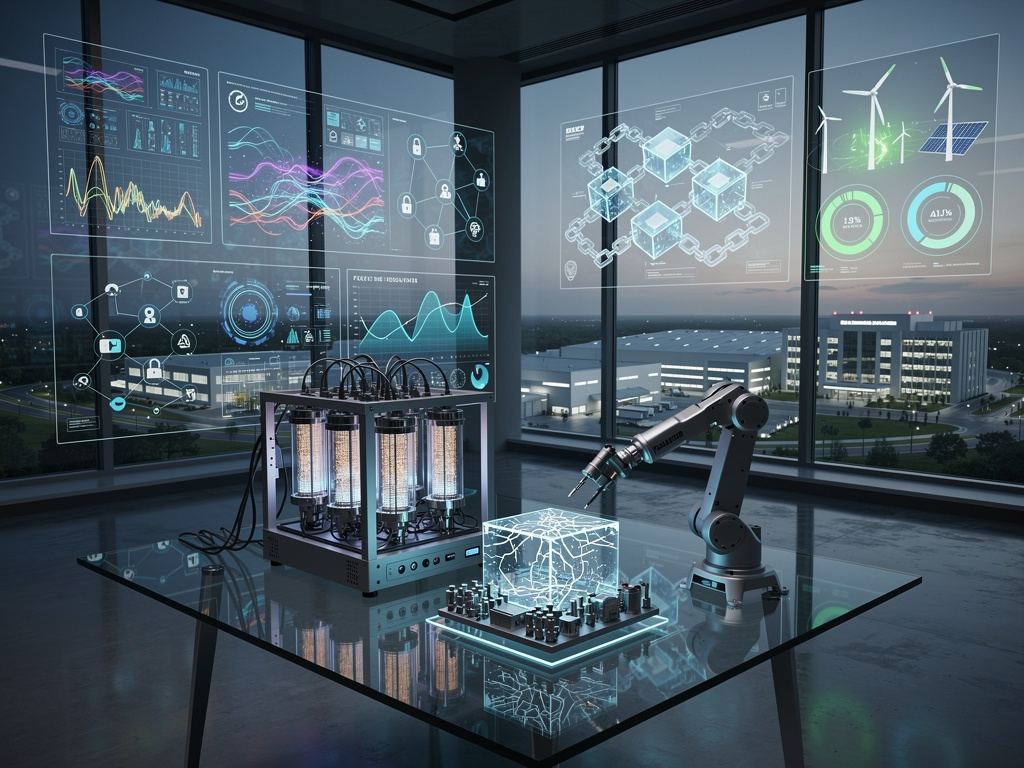
Decoding Tomorrow: The Tech Revolutions Reshaping Industries in 2026
In the fast-evolving world of technology, 2026 promises to be a pivotal year where artificial intelligence moves beyond hype into tangible, enterprise-level impact. Industry leaders are shifting from pilot projects to full-scale deployments, driven by advancements in AI infrastructure and multimodal models. According to insights from Deloitte Insights, successful organizations are leveraging these tools to transition from experimentation to measurable outcomes, emphasizing the integration of AI with existing systems for strategic advantages.
This shift is not just about adopting new tools but rethinking business models entirely. For instance, AI-powered decision-making is combining with Internet of Things (IoT) and blockchain to enable real-time analytics and secure data sharing. Posts on X highlight how these integrations are expanding AI’s role from operational support to core strategic planning, with examples like multilingual generative AI enhancing global operations.
Meanwhile, the push for sustainability is intertwining with tech innovations, as companies invest in green technologies to meet regulatory demands and consumer expectations. Reports indicate that bio-based materials and decentralized renewable energy sources are gaining traction, positioning them as key growth areas in the post-2025 era.
AI’s Expanding Dominion in Enterprise Strategy
The rise of agentic AI, where systems autonomously perform tasks and make decisions, is set to redefine workflows across sectors. Simplilearn outlines how emerging technologies like this are shaping job markets and innovation pipelines, predicting a surge in demand for skills in AI governance and ethical implementation.
In parallel, multimodal AI models that process text, images, and audio simultaneously are enabling more sophisticated applications, from advanced healthcare diagnostics to personalized consumer experiences. This convergence is particularly evident in telemedicine platforms and mental health apps, which are leveraging AI for proactive interventions.
Challenges remain, however, including the need for robust data privacy measures and addressing biases in AI systems. Industry insiders note that as AI integrates deeper into critical sectors like healthcare and finance, regulatory frameworks will evolve to ensure accountability without stifling progress.
Quantum Leaps and Neuromorphic Computing on the Horizon
Quantum computing is another frontier gaining momentum, with potential to solve complex problems in drug discovery and financial modeling at unprecedented speeds. The World Economic Forum lists it among the top emerging technologies for 2025, extending into 2026, highlighting its role in accelerating scientific breakthroughs.
Neuromorphic computing, mimicking the human brain’s efficiency, is emerging as a solution to the energy demands of traditional AI hardware. Juniper Research identifies this as a trend to watch, noting its potential to enable physical AI—robots and devices that learn and adapt in real-world environments.
This technology is particularly promising for edge computing, where low-power, high-efficiency processing is crucial. Innovations in this area could revolutionize industries like manufacturing, with AI-driven diagnostics and 3D printing for on-demand production reducing waste and costs.
Sustainability Drives Tech Innovation Waves
The intersection of technology and environmental responsibility is creating new opportunities in renewable energy and circular economies. Decentralized systems powered by blockchain are facilitating peer-to-peer energy trading, as seen in emerging agri-tech solutions that optimize resource use.
McKinsey ranks sustainability-focused tech among the top trends, emphasizing how companies are using AI to monitor and reduce carbon footprints in supply chains. This includes predictive analytics for energy consumption in data centers, which are exploding in number due to AI demands.
Posts on X underscore the investment potential in AI infrastructure, with cloud giants like Microsoft and Amazon ramping up monetization efforts. These developments are not without hurdles, as the energy requirements of massive data centers raise concerns about grid stability and environmental impact.
Blockchain’s Role in Secure Digital Ecosystems
Beyond cryptocurrencies, blockchain is evolving into a foundational technology for secure, transparent transactions across industries. Its integration with AI and 5G is enabling innovations in supply chain management and digital identities, reducing fraud and enhancing traceability.
In healthcare, blockchain-secured data sharing is improving patient outcomes by allowing seamless, privacy-protected access to records. SciTechDaily reports on breakthroughs in biotechnology that leverage these secure frameworks for collaborative research.
The automotive sector is also benefiting, with concepts in electric vehicles (EVs) incorporating blockchain for battery lifecycle management and smart contracts for autonomous vehicle interactions. As the industry navigates hybrid and battery-electric transitions, these technologies ensure efficiency and compliance.
The Surge of Physical AI and Robotics
Physical AI, where intelligent systems interact with the physical world, is poised for significant advancements. Robots equipped with neuromorphic chips are becoming more autonomous, capable of learning from environments without constant human oversight.
TechTarget discusses trends like this in machine learning, predicting widespread adoption in logistics and healthcare by 2026. For example, AI-driven robotics in surgery could enhance precision and reduce recovery times.
Challenges in scalability and ethical deployment are prompting discussions on governance. Industry experts on X emphasize the need for open-source AI to foster competition and innovation, especially in geopolitical contexts like U.S.-China tech rivalries.
Navigating Geopolitical Influences on Tech Progress
Global tensions are influencing tech development, with calls for open-source initiatives to counter proprietary dominance. Elon Musk’s ventures, often highlighted in media, exemplify how individual leaders can shape federal policies on AI and space tech.
WIRED reflects on 2025’s key stories, including AI data center expansions and political takeovers, projecting similar dynamics into 2026. This includes debates over post-quantum cryptography to secure communications against future threats.
Investment themes on X point to digital banks and AI infrastructure as high-growth areas, with cloud providers leading the charge. These trends suggest a maturing market where profitability drives innovation rather than speculation.
Innovations in XR and Foldable Devices
Extended reality (XR) technologies are blending virtual and augmented realities for immersive experiences in education and training. The mobile tech sector is seeing revolutions with tri-fold devices and ultra-thin designs, as noted in recent analyses.
Android Central details how 2025’s foldables and AI integrations are fundamentally changing user interactions, with 2026 expected to build on this by incorporating more seamless AI assistants.
In consumer electronics, these innovations are driving competition, with companies like Samsung and Apple pushing boundaries in hardware that supports advanced software ecosystems. The result is a more connected, intuitive user experience that blurs lines between devices.
Healthcare Transformations Through Tech Integration
AI’s role in healthcare is expanding rapidly, from predictive diagnostics to personalized medicine. Multimodal models are analyzing vast datasets to identify patterns in diseases, accelerating drug development.
Jagran Josh lists breakthroughs like autonomous agents in medical research, which are set to define 2026’s advancements. Telemedicine platforms enhanced by AI are making healthcare more accessible, especially in remote areas.
Ethical considerations, such as data sovereignty and bias mitigation, are critical. Regulatory bodies are stepping in to ensure these technologies benefit society equitably, balancing innovation with public trust.
The Future of Work in an AI-Driven World
As AI automates routine tasks, the workforce is shifting toward roles requiring creativity and strategic thinking. Remote work norms, amplified by digital tools, are becoming standard, as per startup trends discussed on X.
Capgemini explores how these changes are driving industry transformation, with a focus on upskilling programs to prepare employees for an AI-first environment.
Investments in synthetic biology and longevity research are opening new frontiers, potentially extending human capabilities and creating markets in bio-based innovations. This holistic approach ensures technology enhances human potential rather than replacing it.
Strategic Investments and Market Dynamics
Venture capital is flowing into AI infrastructure, with hyperscalers projecting massive capital expenditures. Posts on X from investors highlight profitable growth in cloud revenues, underscoring the economic viability of these technologies.
Firstpost recaps 2025’s defining innovations, noting AI’s dominance alongside breakthroughs in EVs and biotechnology, setting the stage for 2026’s expansions.
Companies like Tesla and Amazon exemplify how innovation leads to market leadership, with revenue growth tied to tech adoption. As 2026 unfolds, the focus will be on scalable, impactful solutions that address real-world challenges.
Emerging Sectors and Long-Term Visions
New sectors like advanced waste management and micro-factories are emerging, driven by 3D printing and AI optimization. These areas promise sustainable growth, reducing environmental footprints while creating jobs.
Popular Science celebrates 2025’s greatest innovations, including automotive shifts toward hybrids and EVs, which will influence 2026’s transportation tech.
Ultimately, the tech environment in 2026 will be defined by interconnected innovations that prioritize impact over novelty. Industry insiders must navigate these trends with foresight, investing in technologies that align with broader societal goals for enduring success.


 WebProNews is an iEntry Publication