
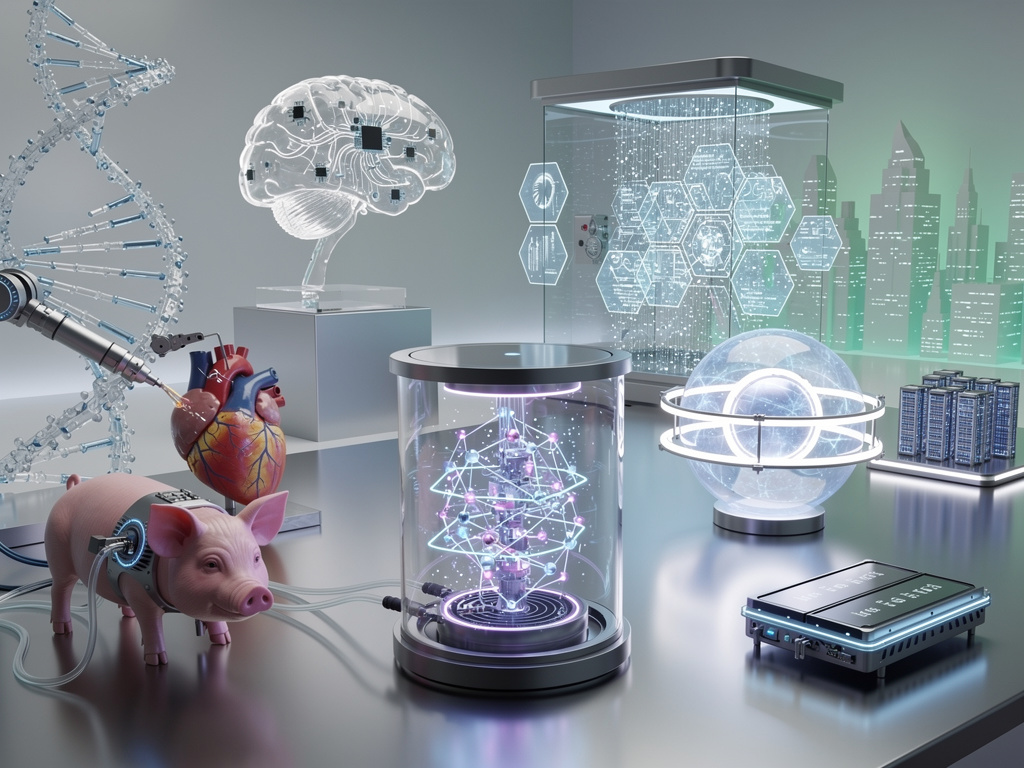
Quantum Horizons: Unveiling 2025’s Tech Breakthroughs That Redefine Innovation
In the fast-paced world of technological progress, 2025 has emerged as a pivotal year marked by groundbreaking developments that promise to reshape industries and daily life. Drawing from recent reports, including a key release from ScienceDaily, researchers have unveiled advancements in quantum computing that could revolutionize data processing speeds and security protocols. This comes amid a broader surge in innovations spanning artificial intelligence, biotechnology, and sustainable energy solutions, as highlighted in various publications. Industry insiders are closely watching how these developments integrate into existing systems, potentially accelerating everything from medical diagnostics to climate modeling.
The ScienceDaily release details a study where scientists achieved a milestone in stabilizing qubits, the fundamental units of quantum information, allowing for longer computation times without errors. This breakthrough, conducted by a team at a leading university, addresses one of the most persistent challenges in quantum tech: decoherence, where environmental interference disrupts calculations. By employing novel materials and error-correction algorithms, the researchers extended qubit coherence by a factor of ten, paving the way for practical applications in fields like cryptography and drug discovery. Such progress aligns with predictions from earlier in the year, echoing sentiments from tech leaders who foresaw quantum supremacy within reach.
Complementing this, reports from SciTechDaily emphasize how time variations across the solar system influence quantum systems, adding layers of complexity to interstellar computing ambitions. As companies race to commercialize these technologies, the implications for global markets are profound, with potential disruptions in sectors reliant on classical computing. Investors and policymakers alike are recalibrating strategies to accommodate this shift, recognizing that quantum advancements could unlock unprecedented computational power.
Stabilizing the Quantum Realm: From Theory to Tangible Progress
Beyond quantum realms, artificial intelligence continues to dominate discussions, with ScienceDaily’s AI section chronicling the rise of more efficient models that mimic human learning processes. In 2025, AI systems have evolved to incorporate ethical frameworks inherently, reducing biases in decision-making algorithms. This evolution is crucial for applications in healthcare, where AI-driven diagnostics are becoming standard, as noted in recent analyses. The integration of AI with quantum computing further amplifies capabilities, enabling simulations of molecular interactions that were previously infeasible.
Biotechnology has also seen remarkable strides, with gene-editing tools like CRISPR advancing to new heights. Posts on X from industry figures, such as those discussing Alphafold-3 and CAR-T cell therapies, reflect a collective excitement about personalized medicine. These tools are not just theoretical; clinical trials reported in World Economic Forum’s emerging technologies list show promise in treating rare genetic disorders, potentially extending lifespans and improving quality of life. The convergence of biotech with AI allows for predictive modeling of treatment outcomes, minimizing risks and optimizing therapies.
Sustainable technologies are gaining traction as well, with innovations in green energy addressing climate challenges. ScienceDaily’s technology news highlights prototypes for advanced batteries that store renewable energy more efficiently, crucial for transitioning away from fossil fuels. These developments are supported by global initiatives, as seen in forums discussing fusion power and next-generation electric vehicle components, indicating a shift toward eco-friendly infrastructures.
AI’s Ethical Evolution: Balancing Power and Responsibility
Delving deeper into AI’s role, 2025 has witnessed the deployment of agentic AI systems that operate autonomously, making decisions in real-time environments. This is evident in transportation, where self-driving technologies have matured, reducing accidents and optimizing traffic flow. Industry reports, including those from Simplilearn, forecast that such AI will create new job categories while transforming existing ones, emphasizing the need for upskilling in tech-savvy workforces. The economic ripple effects are significant, with projections estimating trillions in added value to global GDP.
In parallel, cybersecurity has become a focal point, as quantum advancements threaten current encryption methods. Experts warn that quantum computers could crack codes that protect sensitive data, prompting a rush to develop quantum-resistant algorithms. This urgency is captured in discussions on X, where posts about decentralized AI and blockchain integrations suggest a fortified digital future. Companies are investing heavily in these areas, aiming to safeguard everything from financial transactions to personal privacy.
Moreover, the intersection of AI and neuroscience has led to breakthroughs in brain-computer interfaces. Live Science reports on devices that enable direct neural communication, offering hope for patients with neurological disorders. These interfaces, enhanced by AI’s pattern recognition, could restore mobility or even augment human cognition, blurring lines between biology and technology.
Biotech Frontiers: Gene Editing’s Leap Forward
Turning to biotechnology’s specifics, 2025 has been a banner year for CRISPR applications, with prime editing techniques allowing precise genetic modifications without unintended mutations. As detailed in X posts referencing Yuval Noah Harari’s talks, these tools raise philosophical questions about human evolution and ethics. Clinical successes, such as curing inherited blood disorders, underscore the potential, though regulatory hurdles remain to ensure safe widespread adoption.
Xenotransplantation, the use of animal organs for human transplants, has advanced with genetic tweaks to prevent rejection. This innovation, covered in Science Friday, addresses organ shortages, potentially saving countless lives. Coupled with 3D bioprinting, which fabricates tissues on demand, the field is poised to revolutionize transplant medicine.
Environmental biotechnology is also progressing, with microbiome engineering enhancing soil health and crop yields. These methods, as explored in ScienceDaily’s top science stories, contribute to food security amid climate change, demonstrating tech’s role in sustainable agriculture.
Sustainable Energy Shifts: Powering a Greener Tomorrow
Energy innovations in 2025 include strides in nuclear fusion, with prototypes achieving net energy gain, as predicted in older X posts from figures like Sam Altman. Tech Startups highlights how these reactors could provide limitless clean power, reducing reliance on intermittent renewables. The scalability of such systems is under scrutiny, with pilot projects testing commercial viability.
Advanced materials for solar and wind energy have improved efficiency, capturing more power with less environmental impact. Reports indicate that these enhancements, combined with AI-optimized grids, could stabilize energy supplies globally. This is particularly vital for data centers, whose booming demand—fueled by AI—has sparked debates over resource consumption, as noted in recent analyses.
Transportation tech has evolved with electric and hydrogen vehicles incorporating smart systems for longer ranges and faster charging. These vehicles, integrated with AI for predictive maintenance, promise to cut emissions significantly, aligning with international climate goals.
Cybersecurity in the Quantum Age: Fortifying Digital Defenses
As quantum tech advances, cybersecurity strategies are evolving rapidly. The development of post-quantum cryptography is essential, with standards being set by international bodies to protect against future threats. Industry insiders point to collaborative efforts between governments and tech firms to implement these safeguards swiftly.
In the realm of information technology, ScienceDaily’s IT news covers how blockchain and decentralized networks enhance data integrity. These systems are resilient against attacks, making them ideal for critical infrastructures like healthcare and finance.
Furthermore, the rise of edge computing distributes processing power, reducing latency and vulnerability. This approach, gaining popularity in 2025, supports IoT devices in smart cities, where real-time data analysis drives efficiency.
Neuroscience Meets Tech: Interfaces Redefining Human Potential
Brain-computer interfaces have progressed to enable thought-controlled prosthetics, transforming lives for those with disabilities. Ongoing research, as shared in scientific communities, explores applications in education and entertainment, where neural links could enhance learning or immersive experiences.
Ethical considerations are paramount, with debates on privacy and consent shaping regulations. As these technologies mature, they challenge notions of identity and augmentation, prompting interdisciplinary dialogues.
Looking ahead, the fusion of neuroscience with AI could lead to advanced cognitive assistants, boosting productivity across professions.
Global Impacts: Tech’s Role in Societal Transformation
The global reach of these technologies is evident in initiatives like the Genome India Project, aiming to map diverse genetic profiles for tailored healthcare. Such projects, mentioned in X discussions on science topics, foster inclusivity in medical advancements.
Space exploration benefits too, with AI aiding missions like those from ISRO, enhancing data analysis from satellites. These efforts contribute to understanding climate patterns and resource management on Earth.
Ultimately, 2025’s tech breakthroughs underscore a era of interconnected innovations, driving progress while necessitating thoughtful governance to harness benefits equitably. As these developments unfold, they hold the promise of solving longstanding challenges, from disease to environmental sustainability, charting a course for a more advanced future.


 WebProNews is an iEntry Publication