
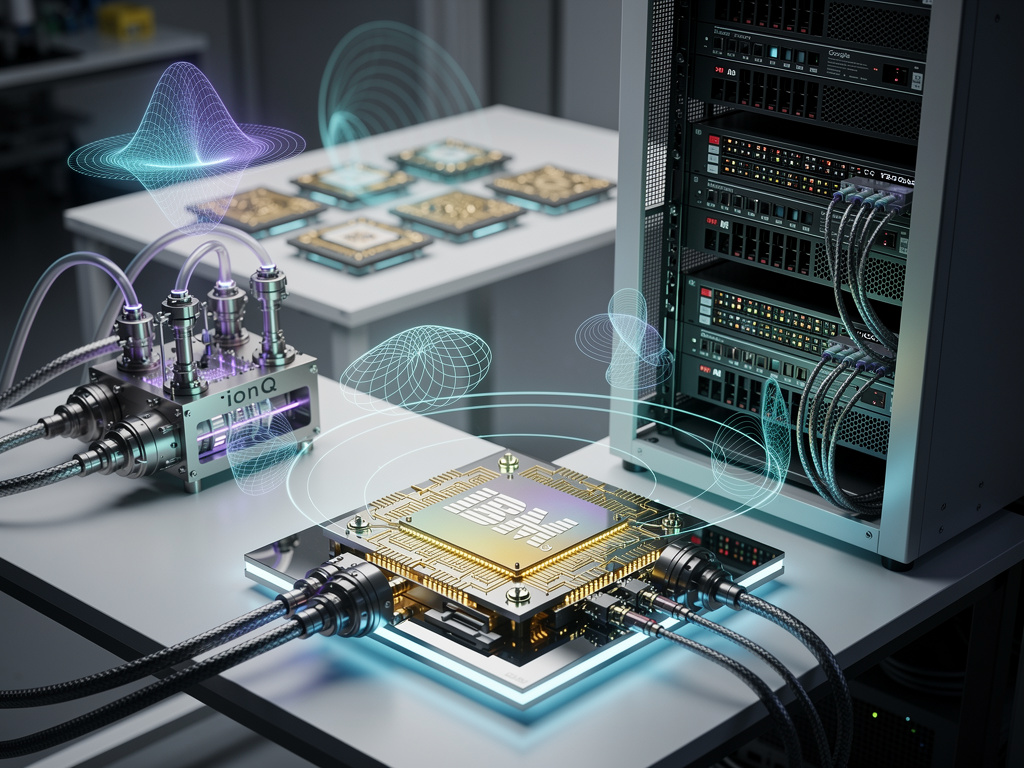
Quantum Vault: Hardware Innovations Catapulting 2025 Toward Everyday Quantum Power
In the rapidly evolving realm of quantum technology, 2025 has emerged as a pivotal year marked by groundbreaking advancements in hardware that promise to bridge the gap between theoretical promise and real-world application. Researchers and companies worldwide are pushing the boundaries, developing systems that could revolutionize fields from drug discovery to cryptography. Drawing from recent developments, this deep dive explores the key hardware breakthroughs driving this transformation, highlighting how they address longstanding challenges like error rates and scalability.
One standout innovation comes from IBM, which unveiled new quantum processors and software enhancements aimed at achieving quantum advantage by 2026. According to IBM’s newsroom, these advancements include processors with improved qubit stability, setting the stage for fault-tolerant computing by 2029. This progress is not isolated; it’s part of a broader wave where investment and government support are fueling a robust ecosystem for commercial quantum applications.
Another critical development is the creation of a microchip-sized device that controls laser frequencies with unprecedented precision, using significantly less power than traditional systems. As reported in ScienceDaily, this chip, manufactured using standard techniques, paves the way for mass-produced quantum machines that are vastly more powerful and accessible. Such innovations are crucial for scaling quantum systems beyond laboratory prototypes.
Scaling Up Qubit Architectures
The push toward practical quantum systems is also evident in efforts to link multiple quantum processors. Posts on X from experts like Dr. Singularity highlight a device enabling direct communication among processors, accelerating progress in modular quantum computing. This interconnect technology, developed by MIT researchers, allows for remote entanglement, addressing the limitations of single-chip systems.
Meanwhile, IonQ’s study, as covered in The Quantum Insider, demonstrates that networked quantum computers can outperform larger standalone ones. By linking smaller chips, researchers at UC Riverside have shown that scalability doesn’t demand flawless hardware, with simulations revealing robust performance even with imperfections.
These modular approaches are transforming how quantum hardware is conceptualized. Instead of monolithic supercomputers, the future lies in distributed networks, much like classical cloud computing. This shift is supported by findings from the DARPA Quantum Benchmarking Initiative, which, according to X posts from QubitValue, concludes that success in quantum computing is now more likely than not, despite remaining obstacles.
Error Correction Takes Center Stage
Error correction remains a cornerstone challenge in quantum hardware, and 2025 has seen remarkable strides. Scientists have built what they claim is the most accurate quantum computing chip to date, achieving 99.99% fidelity through a new silicon-based architecture. Live Science details how this scalable atomic quantum processor breaks records, offering a pathway to reliable computations that outperform classical methods.
Google’s Quantum Echoes algorithm, as described in their blog, introduces a breakthrough in verifiable quantum advantage, enabling unprecedented scientific analysis. This software-hardware synergy is vital, as it compensates for hardware limitations through innovative algorithms that echo quantum states more efficiently.
China’s Zuchongzhi 3.2 quantum computer has also hit the fault-tolerance threshold using an efficient microwave-based approach, as noted in X posts by Salim Elhila. This achievement marks the first outside the U.S., underscoring global competition and the diverse paths to error-corrected quantum systems.
Room-Temperature Operations and Entanglement
A game-changer in accessibility is the development of room-temperature quantum chips. Stanford scientists have created a tiny optical device that entangles photons with electrons without cryogenic cooling, utilizing “twisted light” in molybdenum diselenide. X user Ernesto Lana’s post emphasizes this breakthrough, which eliminates the need for expensive cooling infrastructure, making quantum tech more practical for widespread adoption.
Cisco’s prototype entanglement source chip, in collaboration with UC Santa Barbara, could accelerate practical quantum computing by nearly a decade. As shared on X by Dr. Singularity, this chip excels in generating entangled photons efficiently, a fundamental requirement for quantum networks and secure communications.
These advancements are converging with industry trends, as outlined in SpinQ’s analysis. The focus has shifted from whether quantum systems will be useful to when and in which applications, with drug discovery and materials science leading the charge.
Investment and Ecosystem Growth
The influx of capital is accelerating these hardware breakthroughs. Network World lists top quantum achievements of 2025, including record-breaking computers and skyrocketing investments that are building a supportive ecosystem. Government initiatives and workforce development are key, ensuring a skilled talent pool to tackle scaling challenges.
An updated list of quantum computing companies from The Quantum Insider showcases 76 major players driving innovation. This competitive environment fosters rapid progress, with companies like IonQ and IBM leading in hardware bets, as per recent data on trends showing a narrowing focus on specific architectures.
Posts on X reflect this optimism, with 19keys noting Google’s Willow chip’s error reduction as a game-changer, stabilizing fragile qubits and heralding the quantum age. Such sentiment underscores the transition from speculation to tangible progress.
Applications on the Horizon
Practical applications are beginning to materialize. In optimization and cryptography, these hardware leaps promise solutions to problems intractable for classical computers. For instance, the convergence of hardware and software innovations, as per SpinQ’s report, suggests meaningful commercial uses within five to ten years.
Healthcare stands to benefit immensely. Quantum simulations could speed up drug discovery by modeling molecular interactions at unprecedented scales. Materials science, too, will see advancements in designing new alloys or batteries, leveraging the high-fidelity processors now emerging.
Transportation and logistics could optimize routes and supply chains with quantum algorithms running on these advanced systems. The key is the maturation of hardware, where qubit counts rise alongside falling error rates, as highlighted in Interesting Engineering‘s top stories of 2025.
Challenges and Future Trajectories
Despite these strides, hurdles remain. Scaling to thousands of qubits while maintaining coherence is no small feat. Researchers must continue refining error correction and integration with classical systems to create hybrid setups that maximize strengths.
Global policy and standards, including post-quantum cryptography, are evolving to keep pace. The Quantum Benchmarking Initiative’s positive outlook, echoed on X, suggests that while challenges persist, none are insurmountable.
Looking ahead, 2026 predictions from experts in The Quantum Insider foresee further advances, potentially in linked systems and cloud-based quantum access. This momentum could democratize quantum power, making it a staple in industry toolkits.
Industry Implications and Strategic Shifts
For businesses, these hardware breakthroughs necessitate strategic reevaluation. Companies are investing in quantum-ready infrastructure, anticipating disruptions in sectors like finance, where quantum algorithms could revolutionize risk assessment and fraud detection.
The role of startups is pivotal, with many of the 76 players listed innovating in niche areas like photonic or trapped-ion qubits. Collaborations, such as Cisco’s with UC Santa Barbara, exemplify how academia and industry synergy accelerates progress.
Ultimately, 2025’s hardware revolutions are laying the groundwork for a quantum-empowered future. As systems become more practical, the focus will intensify on ethical deployment and equitable access, ensuring these technologies benefit society broadly.
Global Competition Heats Up
International rivalry is intensifying, with China’s achievements in fault-tolerant computing challenging U.S. dominance. This competition drives innovation, as seen in microwave-based error correction methods that offer efficiency gains.
European efforts, including those in silicon-based architectures, contribute to a diverse array of solutions. The global nature of quantum research fosters knowledge sharing, even amid geopolitical tensions.
X posts from Shanaka Anslem Perera highlight ultra-efficient processors with neural accuracy, pointing to interdisciplinary breakthroughs blending quantum with AI.
Technological Convergence and Innovation
The integration of quantum with other technologies, like AI and machine learning, is amplifying impacts. Quantum Echoes, for instance, enables discoveries that classical systems can’t match.
Miniaturization trends, such as the hair-thin optical phase modulators noted on X, could unlock larger quantum computers by enabling dense packing of components.
As 2025 draws to a close, these hardware milestones signal that practical quantum systems are no longer distant dreams but imminent realities, poised to reshape computational paradigms.


 WebProNews is an iEntry Publication