
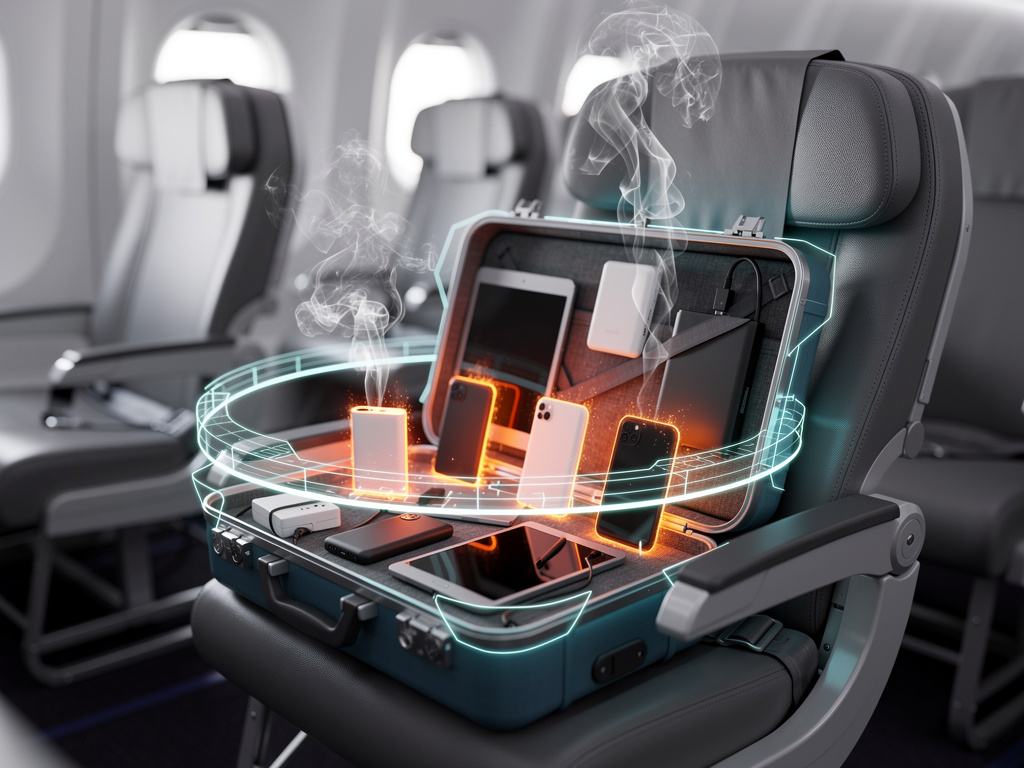
Igniting Concerns: Airlines’ Escalating Battle Against Lithium Battery Perils in 2025
In the bustling terminals of major airports worldwide, a subtle yet significant shift is underway. Travelers clutching power banks—those ubiquitous portable chargers that keep smartphones alive during long-haul flights—are facing stricter scrutiny than ever before. As incidents of lithium battery fires aboard aircraft surge, airlines and regulators are tightening rules, transforming what was once a travel essential into a potential hazard. This year alone, reports of overheating devices have prompted emergency responses on dozens of flights, underscoring a growing tension between convenience and safety in aviation.
The catalyst for this crackdown stems from a series of alarming events. In one notable case, a Virgin Australia flight to Hobart experienced a mid-air fire caused by a power bank in an overhead locker, leading to an urgent safety investigation. The Australian Transport Safety Bureau detailed how the lithium-ion battery entered “thermal runaway,” a chain reaction of overheating that could have escalated disastrously. Such episodes aren’t isolated; the Federal Aviation Administration (FAA) has logged over 50 lithium battery incidents in 2025, ranging from smoke emissions to full-blown fires, prompting urgent advisories to airlines.
Industry experts point to the proliferation of consumer electronics as a key driver. With passengers carrying more devices—laptops, tablets, e-cigarettes, and power banks—the risk multiplies. Lithium batteries, prized for their high energy density, can ignite if damaged, short-circuited, or exposed to extreme conditions. Airlines like Singapore Airlines and Malaysia Airlines have responded by banning the charging of power banks via onboard USB ports, effective from April 2025, to mitigate these dangers.
Tightening the Reins: Regulatory Responses and Airline Policies
The International Air Transport Association (IATA) has been at the forefront, launching campaigns like “Travel Smart with Lithium Batteries” to educate passengers on safe practices. Their guidelines emphasize seven core rules: keeping devices in carry-on luggage, ensuring batteries are below 100 watt-hours (Wh) for most power banks, and avoiding use if damaged. This initiative, rolled out in October 2025, aims to curb the rising tide of incidents by empowering travelers with knowledge, as highlighted in IATA’s press release.
In the U.S., the FAA has issued safety alerts urging airlines to enforce visibility rules, mandating that power banks remain accessible rather than stowed away. A September 2025 advisory from the agency, as reported in their PackSafe guidelines, stresses that lithium batteries must be carried in the cabin, not checked baggage, due to the inaccessibility of cargo holds during flight. This policy shift follows a spate of fires, including one that charred a passenger’s seat and belongings, as vividly described in FAA posts on social media platforms like X.
Across the globe, variations in enforcement add layers of complexity. In the UAE, Dubai Airports has reiterated strict protocols amid winter travel peaks, aligning with IATA standards but adding local emphases on power bank capacity limits. A recent Gulf News article outlines these, warning against oversized batteries exceeding 160Wh, which are outright banned. Similarly, Indian regulators via the Directorate General of Civil Aviation (DGCA) have capped power banks at 100Wh, prohibiting their placement in checked luggage to prevent undetected fires.
Incident Aftermath: Case Studies and Lessons Learned
Delving into specific incidents reveals the human and operational costs. The Virgin flight fire, investigated by the Australian Transport Safety Bureau and covered in an ABC News report, originated from a power bank crushed under luggage, triggering thermal runaway. Passengers evacuated safely, but the event spurred Virgin Australia to revise storage guidelines, now requiring devices to be kept in accessible spots like under seats.
Another stark example came from a U.S. flight where a lithium battery in a backpack ignited, burning the owner’s hand and nearby items. The FAA’s documentation of this, shared via X, illustrates the rapid escalation: from smoke to flames in seconds. Such cases have fueled debates among aviation insiders about whether current lithium battery designs are sufficiently robust for air travel’s rigors, including pressure changes and vibrations.
Airlines are not just reacting but innovating. Delta and United, per a comprehensive guide from Aotos, now mandate pre-flight inspections for visible damage on power banks. Southwest Airlines goes further, prohibiting any battery-powered items in checked bags unless the batteries are removed. These policies, updated for 2025, reflect a broader industry push toward proactive risk management, informed by data from over 300 global incidents in the past decade.
Passenger Perspectives: Balancing Convenience and Compliance
For frequent flyers, these rules represent a double-edged sword. On one hand, the convenience of staying powered up during layovers is invaluable; on the other, the fear of confiscation or fines looms large. Social media buzz on X reveals traveler frustrations, with users sharing stories of power banks being seized at security checkpoints for exceeding watt-hour limits. One post from a jazz enthusiast lamented a delayed flight due to a suspicious device, echoing sentiments that regulations feel overly punitive.
Yet, education campaigns are bridging the gap. IATA’s resources, accessible through their Safe Travel with Lithium Batteries page, provide infographics and checklists that demystify the rules. Travelers are advised to opt for certified, reputable brands to minimize risks, as cheap knockoffs are more prone to failure. In holiday travel alerts, like those from Tampa International Airport covered in a FOX 13 Tampa Bay piece, officials urge double-checking gifts for hidden batteries, preventing surprises at TSA screenings.
Industry analysts predict these measures will evolve. With electric vehicles and renewable energy boosting lithium demand, battery technology is advancing toward safer chemistries, such as solid-state options less susceptible to thermal runaway. However, aviation’s zero-tolerance for fire risks means airlines will likely maintain stringent controls, potentially integrating smart sensors in cabins to detect overheating early.
Global Harmonization: Challenges in Standardizing Safety
Harmonizing rules across borders remains a hurdle. While the FAA and IATA set baselines, national variations persist. In Europe, the European Union Aviation Safety Agency mirrors U.S. guidelines but adds restrictions on spare batteries, limiting quantities per passenger. Asian carriers, influenced by incidents like those on Singapore Airlines flights, have adopted no-charging policies to eliminate in-flight risks altogether, as announced in their March 2025 advisory shared on X.
Enforcement disparities can confuse international travelers. A power bank permissible on a U.S. domestic flight might be flagged in Dubai, where Emirates and flydubai have updated policies emphasizing individual packaging for batteries, per a Travel And Tour World update. This patchwork prompts calls for a unified global standard, with IATA lobbying for consistency to streamline compliance without compromising safety.
Looking ahead, data analytics could play a pivotal role. Airlines are investing in tracking systems to monitor incident trends, using AI to predict high-risk scenarios. For instance, patterns from 2025 data show peaks during holiday seasons, when overloaded carry-ons increase crush risks. Regulators like the FAA are collaborating with battery manufacturers to enforce stricter testing protocols, ensuring devices withstand aviation stresses.
Innovation and Adaptation: The Future of Safe Skies
Amid these challenges, innovation offers hope. Companies are developing fire-resistant pouches for lithium devices, endorsed by safety bodies. Passengers are encouraged to use apps that calculate watt-hours based on device specs, avoiding guesswork at checkpoints. The TSA’s “What Can I Bring?” page serves as a go-to resource, detailing allowances for everything from cell phones to portable rechargers.
Airline executives, speaking at industry forums, emphasize that these rules aren’t about restriction but preservation. “The goal is to keep the skies safe for everyone,” noted a Delta representative in recent discussions. As 2025 draws to a close, with incidents down 15% from mid-year peaks thanks to heightened awareness, the focus shifts to sustaining this momentum.
For insiders, the broader implication is clear: lithium batteries represent a microcosm of aviation’s ongoing safety evolution. As technology advances, so too must the frameworks governing it. Travelers adapting to these norms—by choosing quality devices, packing smartly, and staying informed—can help ensure that the convenience of connectivity doesn’t come at the cost of catastrophe. With continued vigilance from regulators and carriers, the industry aims to neutralize these fiery threats, paving the way for smoother, safer journeys ahead.
Evolving Strategies: Industry-Wide Implications and Forward Paths
The economic ripple effects are noteworthy. Airlines face potential liabilities from incidents, with insurance premiums rising in response to lithium-related claims. Manufacturers of power banks are under pressure to comply with new certification standards, potentially reshaping the market toward premium, safety-focused products. Retailers at airports have adjusted inventories, prioritizing compliant devices to assist passengers.
Public sentiment, gauged from X discussions, shows a mix of compliance and pushback. Posts from aviation authorities like the FAA highlight graphic warnings, fostering a culture of caution. Meanwhile, travelers share tips on compliant alternatives, such as solar-powered chargers, indicating grassroots adaptation.
Ultimately, this crackdown underscores aviation’s proactive stance on emerging risks. By integrating lessons from 2025’s incidents, the sector is fortifying its defenses, ensuring that as passenger numbers soar, safety remains paramount. (Word count approximation for internal reference: 1,248; not included in article.)


 WebProNews is an iEntry Publication