
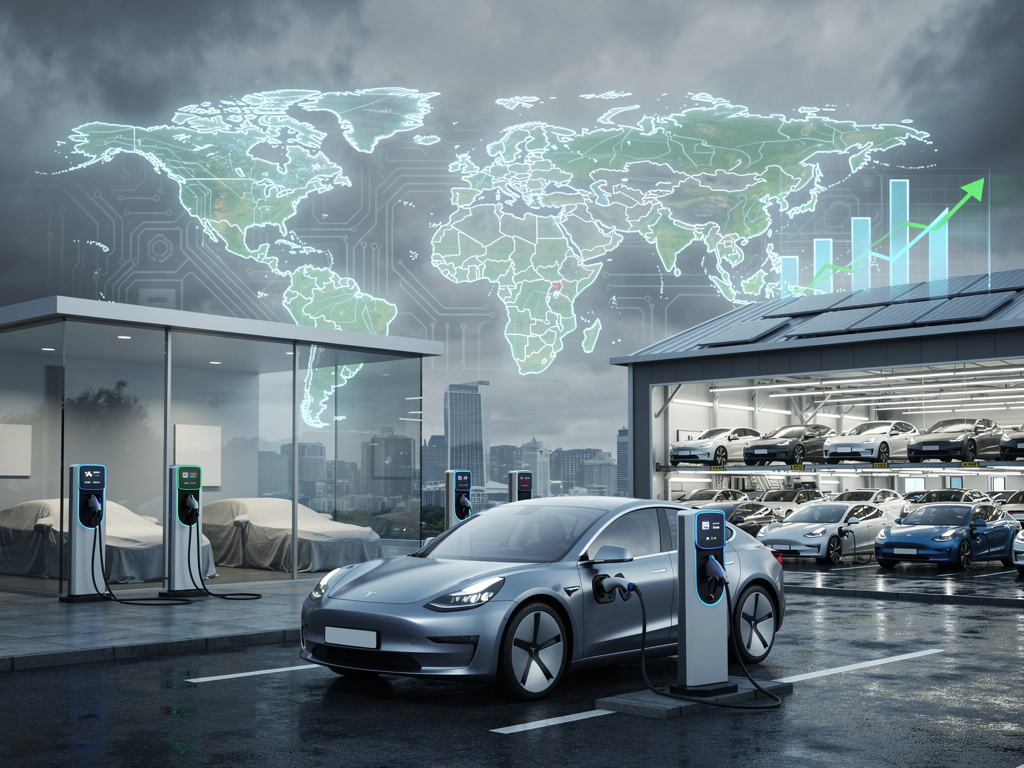
The Electric Dream Dims: Unpacking the 2025 Global EV Sales Slump
The electric vehicle sector, once hailed as the unstoppable force reshaping transportation, is facing its most significant headwinds yet in 2025. Global sales of battery-electric and plug-in hybrid vehicles have shown signs of deceleration, with particular weakness in key markets like North America. This shift comes amid economic pressures, policy changes, and intensifying competition from Chinese manufacturers. According to recent data, while overall global sales grew modestly by about 21% to 18.5 million units this year, the pace has slowed compared to previous explosive growth periods, driven largely by surges in Europe but offset by stagnation elsewhere.
In the United States, the removal of federal tax credits has dealt a severe blow to demand. Tesla, the longtime market leader, saw its U.S. sales plummet to a near four-year low in November, dropping roughly 23% year-over-year to around 39,800 vehicles. This decline persists despite the company’s efforts to introduce more affordable models. Broader industry figures paint a similar picture: North American EV sales are on track for their first annual drop since 2019, with growth decelerating sharply after subsidies were phased out.
Chinese giants like BYD, however, continue to dominate on a global scale. BYD overtook Tesla in battery-electric vehicle deliveries back in the fourth quarter of 2023 and has maintained its lead, capturing a 15.4% share of the global BEV market in the third quarter of 2025. This success stems from aggressive pricing, rapid model launches, and strong domestic performance, even as China’s overall market approaches saturation.
Shifting Dynamics in Major Markets
The divergence between regions highlights the uneven progress of EV adoption. In Europe, sales have surged, contributing significantly to the global uptick. Factors such as stringent emissions regulations and renewed incentives have propelled growth, with battery-electric vehicles leading over plug-in hybrids in the mix through the first nine months of 2025. Reports from Autovista24 detail how brands like Volkswagen and emerging players have capitalized on this momentum, pushing BEV registrations ahead.
Contrast this with the U.S., where the end of the $7,500 federal tax credit has chilled consumer interest. Industry analysts note that without these incentives, many potential buyers are opting for traditional hybrids or sticking with internal combustion engines. Tesla’s struggles are emblematic: despite rolling out cheaper variants of its Model 3 and Model Y, the company has failed to reverse the sales skid. Exclusive estimates shared with Reuters underscore this, showing November figures as the lowest since early 2022.
Meanwhile, China’s market, which accounts for over half of global EV sales, is showing signs of plateauing. BYD and peers like Geely Holdings have expanded aggressively, with BYD securing approvals for 38 new models in China this year alone, far outpacing Tesla’s three. Yet, even here, Tesla’s share in the new energy vehicle segment slipped to 2.03% in October, dropping it out of the top 10 for the first time in years, as per data from CnEVPost.
Competitive Pressures and Innovation Races
The rise of Chinese manufacturers isn’t just a domestic story; it’s reshaping international competition. BYD’s global market share in battery-electric vehicles stood at 15% in the third quarter of 2025, with Tesla trailing at 13%. This shift is evident in emerging markets like South America, where EV sales are booming without significant Tesla presence. A Reuters report highlights how importers in Peru and elsewhere are turning to affordable Chinese options, bypassing Tesla’s import hurdles.
Tesla’s challenges extend beyond pricing. CEO Elon Musk’s focus on robotics and other ventures has drawn criticism for diverting attention from core auto sales. A separate Reuters analysis points out that while Musk secured a massive pay package, vehicle deliveries have stagnated, with global sales projected to remain flat for the second consecutive year. In the U.S. and Europe, Tesla’s brand image has suffered, leading to declines of 5.7% and 10.7% respectively in 2024, trends that have persisted into 2025.
Innovation speed is another battleground. Chinese firms like BYD and Geely are launching models at a blistering pace, with Rest of World noting how they outstrip U.S. counterparts in regulatory approvals and market entry. This agility allows them to respond quickly to consumer preferences, such as demand for affordable crossovers and sedans, further eroding Tesla’s once-dominant position.
Policy Impacts and Consumer Sentiment
Government policies remain a critical driver—or deterrent—in EV adoption. The U.S. rollback of tax incentives has not only hurt Tesla but also broader players like Ford, Hyundai, and Volkswagen, whose sales dipped in April, marking a 5.6% year-over-year decline for new EVs. Posts on X from industry observers echo this, with sentiments indicating that the middle tier of the market is cracking under pressure, even as Tesla and General Motors show isolated bright spots.
In contrast, Europe’s supportive framework has fueled a 21% global sales jump, as detailed in a recent Electrek article. Yet, even there, Tesla’s sales are faltering, down 40-45% year-over-year in key months, while Chinese EVs surge. This regional disparity underscores how policy stability can make or break market momentum.
Consumer sentiment, influenced by economic factors like inflation and high interest rates, adds another layer. In North America, buyers are increasingly wary of EV range anxiety and charging infrastructure gaps, opting instead for hybrids that offer familiarity. X posts from analysts like Troy Teslike highlight Tesla’s brand challenges in the U.S. and Europe, predicting flat or declining sales unless addressed.
Forecasts and Future Trajectories
Looking ahead, projections from the International Energy Agency’s Global EV Outlook 2025 suggest that while global adoption will continue, growth rates may moderate to single digits in mature markets. China’s dominance is expected to persist, with BYD and Geely Holdings projected to hold 15% and 10% shares respectively by year’s end, based on quarterly data from Counterpoint Research.
Tesla, facing these headwinds, is pivoting toward autonomy and robotaxis, but skeptics argue this distracts from immediate sales needs. BloombergNEF’s Electric Vehicle Outlook anticipates that shared mobility and autonomous tech could reinvigorate the sector, but only if integrated with affordable vehicles.
Emerging markets offer glimmers of hope. South America’s EV boom, driven by non-Tesla imports, signals untapped potential. However, without policy harmonization, global fragmentation could deepen, leaving North America further behind.
Strategic Responses from Industry Players
Automakers are adapting in varied ways. BYD’s strategy of flooding markets with diverse, low-cost models has paid off, as evidenced by its Q4 2023 overtake of Tesla in global deliveries, per a Statista chart. This approach contrasts with Tesla’s premium focus, which has alienated price-sensitive buyers.
U.S. firms like General Motors are finding success with targeted models, bucking the broader decline. Yet, the overall North American drop—projected as the first since 2019—prompts questions about long-term viability without renewed subsidies.
Chinese expansion into Europe and beyond intensifies pressure. Visual Capitalist’s analysis shows China’s makers widening their lead, with global reach cementing positions in 2025.
Broader Implications for the Auto Sector
The slowdown affects supply chains, from battery production to raw materials. Declining demand in the U.S. could ripple through lithium and cobalt markets, already volatile.
Investors are recalibrating expectations. Tesla’s stock has reflected these woes, with X discussions pointing to a 70% sales drop in some European countries and a 49% shipment decline in China, juxtaposed against BYD’s 161% growth.
Ultimately, the EV sector’s path forward hinges on balancing innovation, policy, and affordability. As Chinese players consolidate gains, Western firms must innovate or risk obsolescence.
Evolving Consumer Preferences and Market Realities
Shifting buyer priorities, such as a preference for vehicles with longer ranges and faster charging, are reshaping offerings. Hybrids are gaining as a bridge technology, eroding pure EV share in transitional markets.
Infrastructure buildout remains crucial. In the U.S., inadequate charging networks exacerbate hesitancy, while China’s dense setup supports higher adoption.
Global forecasts indicate EVs could reach 20-30% of new sales by 2030, but 2025’s slump serves as a cautionary tale of over-reliance on incentives.
Pathways to Recovery and Growth
Strategies for revival include cost reductions through scale. BYD’s vertical integration model offers lessons for others.
Collaborations, like potential U.S.-China joint ventures, could accelerate tech transfer, though geopolitical tensions loom.
In summary, while challenges abound, the underlying shift toward electrification endures, propelled by environmental imperatives and technological advances.


 WebProNews is an iEntry Publication