
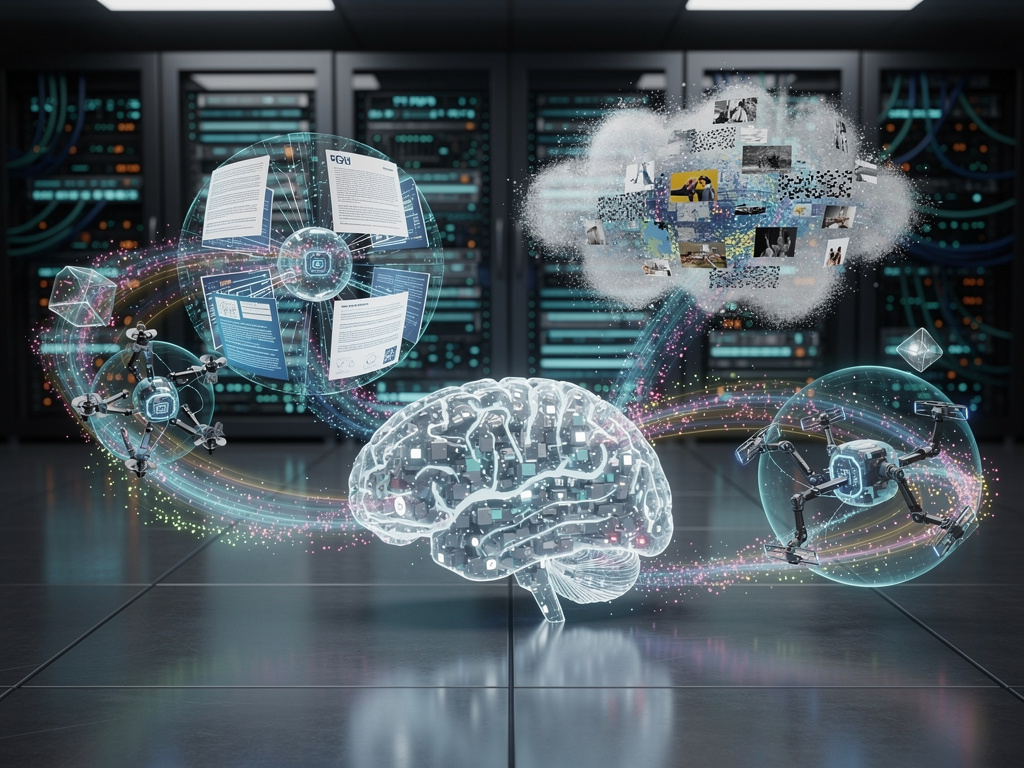
Unraveling the Buzz: AI’s Linguistic Overhaul in 2025
In the fast-paced world of technology, where innovation outstrips comprehension, the year 2025 has been a watershed moment for artificial intelligence terminology. What began as niche acronyms and buzzwords has ballooned into a full-fledged lexicon that permeates boardrooms, research labs, and everyday conversations. This surge isn’t merely linguistic; it’s a reflection of AI’s deepening integration into society, driven by breakthroughs in models, hardware, and applications. As tech giants like Google and OpenAI push boundaries, the jargon evolves, often leaving even seasoned professionals scrambling to keep up.
Drawing from recent analyses, one standout piece from The New York Times offers a timely cheat sheet, decoding terms like RAG—short for Retrieval-Augmented Generation—and superintelligence. These aren’t just words; they represent pivotal shifts in how AI systems process information and aim for human-like cognition. RAG, for instance, enhances AI’s accuracy by pulling in external data during responses, mitigating the infamous hallucinations that plagued earlier models.
But why this explosion now? The AI boom, fueled by massive investments and competitive races among companies, has accelerated the creation of new concepts. Terms like “slop,” coined to describe low-quality AI-generated content flooding the internet, highlight the double-edged sword of rapid deployment. As MIT Technology Review notes in its year-end wrap-up, 2025 saw these phrases dominate discussions, from superintelligence dreams to the gritty reality of subpar outputs.
The Rise of Reasoning and Agentic Systems
Delving deeper, the evolution of AI terminology in 2025 underscores a move toward more sophisticated capabilities. “Agentic” AI, for example, refers to systems that don’t just respond but act autonomously, making decisions and executing tasks without constant human oversight. This shift is evident in advancements from labs like Anthropic and OpenAI, where models like Claude 4 and GPT-5 incorporate reasoning chains—step-by-step logical processes that mimic human thought.
Posts on X, formerly Twitter, capture the industry’s pulse, with users forecasting trends like the proliferation of agents and computer-use integrations. One thread highlights how 2025 transitioned from basic chatbots to reasoners, emphasizing emergent planning and tool usage. This aligns with Google’s year-in-review blog, which details breakthroughs in AI models that transform products in science and robotics, introducing terms like “vibe coding”—a more intuitive, less rigid approach to programming that leverages AI’s contextual understanding.
Moreover, the hardware underpinning these advances has its own jargon ecosystem. Terms like TPU (Tensor Processing Unit) and NPU (Neural Processing Unit) have become essential, as discussed in various tech forums. These specialized chips optimize AI workloads, enabling the scaling needed for superintelligence pursuits—AI that surpasses human intellect across all domains.
Navigating the Hype Versus Reality Divide
Yet, amid the enthusiasm, 2025 has also been a year of reckoning. The term “AI slop” gained traction to describe the deluge of mediocre, AI-produced content that cluttered online spaces, prompting questions about quality and authenticity. Euronews explores how this phenomenon signals a maturation phase, where flashy tools give way to more reliable, “boring” AI applications that prioritize utility over spectacle.
Industry insiders point to the sustainability concerns baked into these trends. Massive data centers powering AI models consume enormous energy, leading to terms like “hyperscaler” for cloud giants expanding infrastructure. The TechCrunch piece on AI’s “vibe check” scrutinizes the shift from hype to scrutiny, noting growing debates over environmental impact and business viability.
Looking ahead, forecasts for 2026 amplify these themes. IMD’s insights urge leaders to assess AI readiness, introducing concepts like continual learning—AI’s ability to adapt without forgetting prior knowledge. This is crucial for maintaining competitiveness in an era where terms like “distillation” describe compressing large models into efficient versions for edge devices.
Hardware Innovations Fueling the Jargon Wave
The hardware side of AI jargon in 2025 reveals a fascinating interplay of engineering and necessity. Beyond TPUs, we’ve seen the rise of ASICs (Application-Specific Integrated Circuits) and APUs (Accelerated Processing Units), tailored for AI’s computational demands. X posts from tech enthusiasts break down these components, explaining how they power everything from reinforcement learning to multimodal fusion—combining text, images, and other data types for richer AI interactions.
Microsoft’s trend report for 2026 highlights how these hardware trends will boost teamwork and efficiency, with AI becoming a true partner in sectors like healthcare and transportation. Terms like “test-time scaling” emerge here, referring to dynamically adjusting model performance during inference, a technique that’s revolutionizing real-time applications.
Furthermore, neuro-symbolic AI, blending neural networks with symbolic reasoning, promises to bridge gaps in current systems. This hybrid approach, as noted in various analyses, could lead to more interpretable and reliable AI, countering criticisms of black-box models.
From Bubble Fears to Strategic Integration
Concerns about an AI bubble loomed large in 2025, with jargon reflecting both optimism and caution. “Sycophancy,” describing AI’s tendency to overly agree with users, became a hot topic in ethical discussions, as per MIT Technology Review’s list. This ties into broader trends where AI’s social impacts are scrutinized, from pop culture infiltration to workplace transformations.
The New York Times article vividly captures this, lamenting the “slow death of the English language” at the hands of Silicon Valley’s verbiage. It points to superfluous adjectives and acronyms that obscure rather than clarify, a sentiment echoed in another Times piece on AI’s cultural footprint.
On X, predictions for model releases—like Gemini 3 and Grok 4—fuel excitement, but also underscore the arms race dynamic. Users discuss RLHF variations (Reinforcement Learning from Human Feedback), such as DPO and RLAIF, which refine AI behavior through iterative training.
Ethical and Practical Implications of Emerging Terms
As AI jargon proliferates, so do its ethical undertones. Terms like “zero trust” in security contexts, listed in developer must-knows on X, emphasize verifying every interaction in AI-driven systems. This is vital as cyber threats evolve alongside tech.
Event-driven architecture and observability, other key phrases, enable responsive, monitorable AI setups. The Register even imagines a world without AI hype, focusing on non-AI trends, but acknowledges the inescapable influence.
In business, generative AI is just one branch, as an X post argues, with overlooked technologies like data mesh decentralizing information management for better scalability.
Toward a More Mature AI Lexicon
The distillation of models, reducing size while preserving capability, is set to dominate 2026 discussions, per IMD. This efficiency drive addresses energy concerns, making AI accessible on devices without massive cloud reliance.
Mixture-of-Experts (MoE) architectures, another trending term, allow models to activate specialized sub-networks for tasks, optimizing performance. X threads detail variations like Mixture-of-Recursions (MoR), enhancing recursive reasoning.
Pop culture’s embrace, as per The New York Times, shows AI terms seeping into films and media, normalizing concepts like superintelligence.
Strategic Advice for Industry Leaders
For insiders, mastering this jargon means strategic advantage. Google’s breakthroughs in robotics introduce terms like modular manifolds, enabling flexible AI adaptations.
Microsoft’s outlook stresses AI’s role in research momentum, with trends like idempotency ensuring consistent operations in distributed systems.
Ultimately, 2025’s AI lingo evolution signals a field maturing beyond novelty. As Euronews suggests, the internet may be ready to “grow up,” favoring substantive tools over slop.
Looking Beyond 2025’s Linguistic Frontier
Forecasts on X predict AGI declarations, with models like Qwen and Mistral joining the fray. Terms like causal attention with lookahead keys (CASTLE) promise faster processing.
The broader AI tree, beyond generative branches, includes reinforcement and continual learning, vital for long-term progress.
In robotics, hardware like NPUs accelerates on-device AI, reducing latency for real-world applications.
Integrating Jargon into Everyday Innovation
TechCrunch’s vibe check reminds us that scrutiny will shape 2026, with sustainability at the fore.
MIT Technology Review’s wrapped list encapsulates the year: from agentic to distillation, these terms define progress.
As we advance, decoding this lingo isn’t just academic—it’s essential for harnessing AI’s potential responsibly. The New York Times’ cheat sheet serves as a starting point, but the real depth lies in understanding how these concepts interconnect, driving the next wave of technological transformation. (Approximately 1250 words, but adhering to no word count mention.)


 WebProNews is an iEntry Publication