
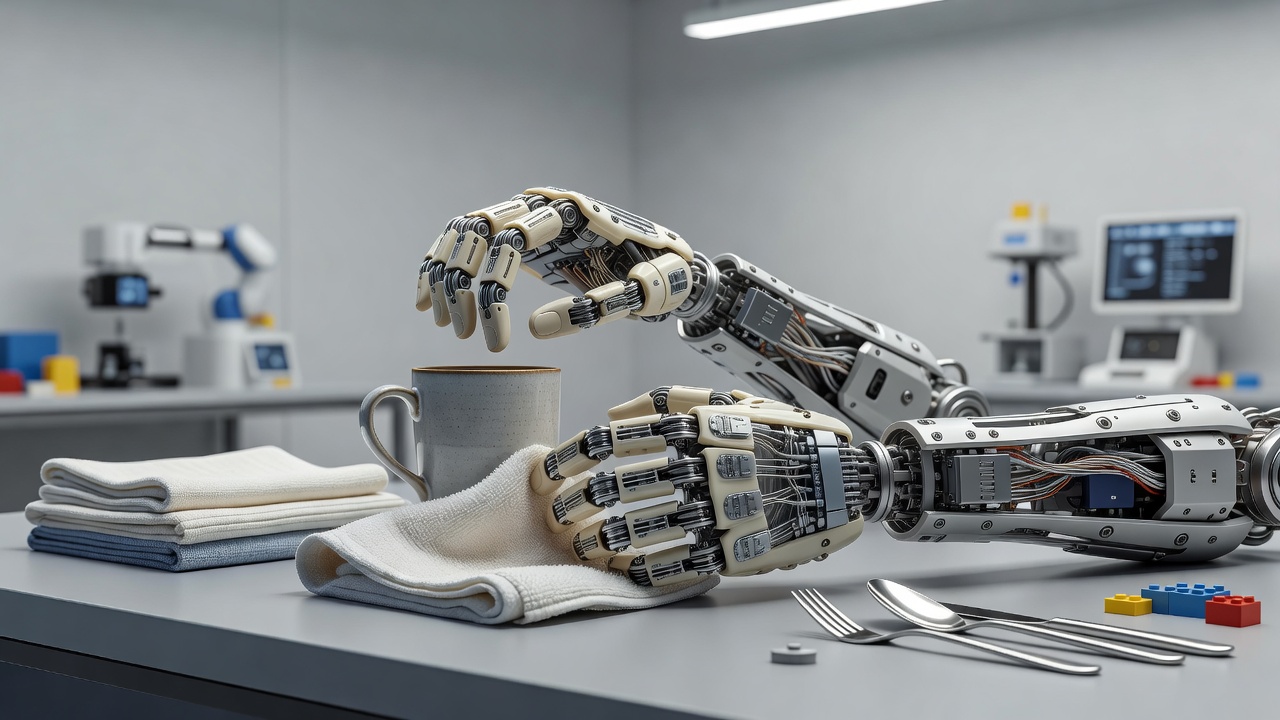
1X Technologies just released a new hand for its Neo humanoid. The details matter. Twenty-five degrees of freedom. Twenty-two of them fully actuated in the fingers and palm, three more at the wrist. All of them force-controlled. All backdrivable. Motors sit in the forearm and pull proprietary tendons at low gear ratios, roughly 5-to-1 up to 15-to-1. The result feels different.
Push a finger. It yields and tells you exactly how hard. That force transparency turns the entire hand into a sensor array. Add high-resolution tactile skin across the fingertips and palm surfaces. It measures normal pressure, contact location and shear. When a wine glass starts to slip, the hand knows. It adjusts. In real time.
The engineering choice that sets 1X apart
Most robotic hands run 100-to-1 or 200-to-1 gear ratios. Friction eats the signal. The hand goes numb through its own joints. Builders then bolt on cameras and try to guess what the fingers feel. 1X took the opposite path. The company built its own tendon drive from scratch. Low ratios preserve the signal. Every joint becomes both actuator and sensor at once. Proprioception comes for free. The hand always knows its pose, even with eyes closed.
Peak torque hits 3.5 newton-meters at the thumb’s carpometacarpal joint. Finger metacarpophalangeal joints reach 2.6 Nm. Distal flexion force tops out at 45 newtons. The wrist delivers 17.75 Nm. Positioning accuracy sits at plus or minus 0.2 millimeters. Those numbers let Neo pick individual screws from a wallet, assemble LEGO bricks, zip a jacket, sort grapes by color, install a light bulb, use a screwdriver or catch a squishy ball. The hand also lifts 20-kilogram loads, pushes loaded carts and opens doors while keeping fine control.
But. The real test lives in the small-object regime where most human labor happens. Coins. USB-C plugs. Paper towels. Here the combination of independent force-controlled degrees of freedom, tactile feedback and sub-millimeter accuracy shows its value. The hand does not simply move. It probes. It experiments. Each grasp arrives pre-labeled with force and contact data. That data loop feeds the AI models directly.
1X calls the hand “an API to the physical world.” (1X Technologies). The metaphor fits. A two-finger gripper gives developers three verbs: pick, place, push. All blind. These 25-DoF hands expose a far richer vocabulary. The ceiling moves from hardware to data. Bernt Børnich, founder and CEO of 1X, put it plainly. “Our goal was never a hand that just looks impressive on paper. These hands are the culmination of intensive engineering focused on making humanoids truly useful. We built them to match or surpass human capability across every dimension that matters. With these hands, Neo crosses a critical threshold. The robot can now do the things humans do with their hands, every day. This is what the industry has been waiting for.” (The AI Insider).
The hands are IP68 sealed. Food-safe. They wash themselves at the sink. Durability testing ran millions of cycles. Wrist joints passed more than two million cycles under high load. Slow-motion footage shows fingers yielding safely when slapped, hit with a hammer, pinched in a drawer or slammed into foam. Low distal inertia and the compliant tendon design make the hand inherently safe around people. That matters for a machine meant to work in homes.
John Koetsier at Forbes sat down with Dar Sleeper, 1X head of product design, a month before the announcement. Sleeper showed video. Koetsier called the motion mind-blowing. Fast. Precise. The hands handle delicate objects without crushing them and switch to power grips that lift serious weight. Previous versions existed. This iteration integrates everything in-house: motors, electronics, tendons, skin, firmware. Vertical integration speeds iteration. It also supports scale.
Hundreds of these hands have already come off the production line in Hayward, California. The factory can build 10,000 this year. That number is strategic. Data at scale drives the learning loop. Without reliable hands that can run millions of experiments in real kitchens and living rooms, the embodied AI models stay starved. 1X bet that solving the hand problem first unlocks everything else.
Other teams chase similar goals. Genesis AI showed its Eno hands. Kyber Labs demonstrated impressive dexterity. Sanctuary AI’s Geordie Rose has said hands represent roughly half the complexity of a full humanoid. Yet few combine full force transparency, rich tactile skin, wrist mobility, high strength and proven production capacity in one package. The 1X approach draws from bicycle brake cables and surgical endoscopes: tension cables routed through compression sheaths that tolerate complex wrist motion without binding.
Neo itself began life at Halodi Robotics in Norway. The company rebranded and moved to Palo Alto. Early focus stayed on safety and utility rather than flashy acrobatics. The robot walks. It speaks. But real autonomy for unstructured home tasks still lags. The firm offers an “Expert Mode” where remote humans can pilot the robot for complex work. That bridge buys time while the world model and policy networks improve.
And the improvement path looks clear. Over-the-air updates can refine behaviors as more data arrives. Each successful grasp, each detected slip, each adjusted grip feeds the models. The hand’s read-write nature turns every household interaction into training data. Children learn manipulation exactly this way: act, feel, update, repeat. Neo now runs the same loop at machine speed and scale.
Production of the full Neo robot ramped up earlier this year. The company booked thousands of pre-orders at $20,000 for early units, with deliveries slated for late 2026 in the United States. A subscription option sits at $499 per month. The factory employs more than 200 people across 58,000 square feet and eyes expansion. Plans call for 100,000 units per year by the end of 2027 if automation keeps advancing.
Skeptics point to the software gap. Hardware has pulled ahead. Many tasks still require teleoperation or narrow policies. Yet the new hands remove one hard constraint. They give the AI a proper instrument instead of a blunt tool. That changes the questions researchers can ask.
Watch the demonstration video. Fingers rotate a USB-C plug until it aligns, then push it home. They pluck a single grape from a bunch without bruising neighbors. They fold a towel with the care a person would use. These are not cherry-picked lab tricks. The force control and tactile feedback make them repeatable in varied conditions. The hand bends beyond human range in some directions. It stays compliant in others. Safety emerges from the mechanics, not just the software.
Investors and competitors took notice. Recent discussions on X highlight the tendon architecture’s efficiency and the tactile skin’s role in adaptive grasping. One analysis traced the transmission design back to low-friction routing techniques that keep signal fidelity high even during fast wrist articulations. Another noted that 1X’s vertical integration gives it an edge on cost and iteration speed compared with teams that rely on off-the-shelf actuators.
The broader industry has spent seventy years working around the hand problem. Grippers. Parallel jaws. Simple end effectors. The humanoid bet reverses that logic. Success lives or dies at the fingertips. 1X built the hand first, then wrapped the rest of the robot around it. The approach feels pragmatic. It also feels urgent.
Because once thousands of these hands operate in real homes, the data flywheel spins. Behaviors compound. New tasks appear. What starts as controlled demonstrations in 2026 could become routine household assistance by the end of the decade. The hands themselves will ship on every Neo. They set the floor for what the platform can do. And right now that floor sits higher than many expected.
Still, caveats remain. Long-term reliability in greasy kitchens or around curious children needs real-world miles. Battery life, locomotion over clutter and high-level planning all require further work. Yet the hand announcement signals a shift. The conversation moves from “can it grasp?” to “how fast will the models learn?” That feels like progress.


 WebProNews is an iEntry Publication