
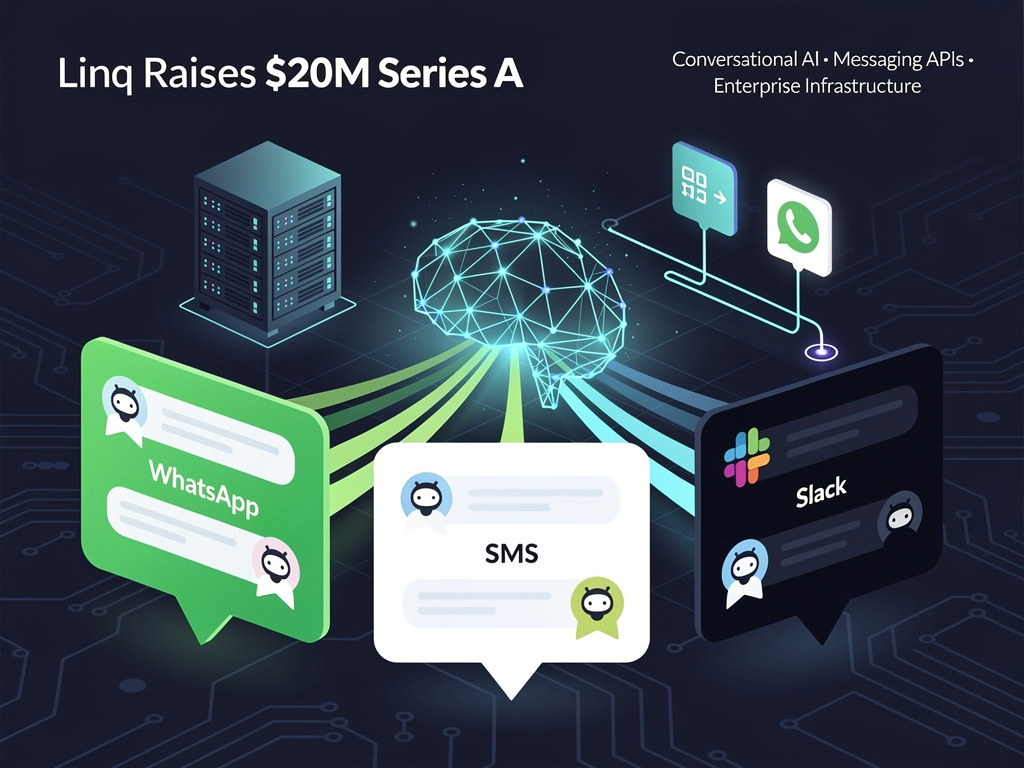
In the competitive arena of artificial intelligence startups, where Silicon Valley giants typically dominate headlines and venture capital flows, an Alabama-based company is charting an unconventional path. Linq, a startup that executed a strategic pivot to programmatic messaging APIs in February 2025, has successfully raised $20 million in Series A funding to develop AI assistants that operate natively within messaging applications—a move that positions the company at the intersection of conversational AI and enterprise communications infrastructure.
The funding round, which values the company significantly higher than its previous seed valuation, represents a validation of Linq’s thesis that the future of AI assistance lies not in standalone applications but in seamless integration with the messaging platforms where billions of users already spend their time. According to TechCrunch, the investment will fuel the development of infrastructure that allows AI assistants to function within popular messaging environments including WhatsApp, SMS, Slack, and Microsoft Teams, eliminating the friction of app-switching that has plagued previous generations of digital assistants.
The Strategic Pivot That Changed Everything
Linq’s transformation from its original business model to a programmatic messaging API platform represents one of the more dramatic pivots in recent enterprise software history. The February 2025 repositioning came after company leadership identified a critical gap in the market: while AI assistants were becoming increasingly sophisticated in their capabilities, user adoption remained constrained by the requirement to download separate applications or navigate to dedicated websites. By embedding AI functionality directly into messaging platforms where users already communicate, Linq aims to reduce friction and increase engagement rates exponentially.
The company’s approach differs fundamentally from competitors who have attempted to build proprietary messaging platforms or standalone AI applications. Instead, Linq is constructing the infrastructure layer that enables any developer or enterprise to deploy conversational AI within existing messaging ecosystems. This infrastructure-first strategy positions Linq as a potential enabler for thousands of AI applications rather than a single consumer-facing product, expanding its total addressable market considerably.
Funding Details and Investor Confidence
The $20 million Series A round attracted participation from both traditional venture capital firms and strategic investors with deep expertise in enterprise communications and artificial intelligence. According to FinSMEs, the funding will be allocated primarily toward engineering talent acquisition, API infrastructure development, and go-to-market initiatives targeting enterprise customers. The round’s size is particularly notable for a company based outside traditional technology hubs, demonstrating that venture investors are increasingly willing to back compelling technology regardless of geographic location.
Industry observers note that the timing of this funding round coincides with a broader market shift toward embedded AI experiences. As enterprises seek to integrate artificial intelligence into their existing workflows without requiring employees to adopt entirely new platforms, solutions like Linq’s messaging-native approach are gaining traction. The company’s ability to secure significant Series A funding despite the challenging venture capital environment of recent years speaks to investor confidence in both the team’s execution capabilities and the market opportunity they’re addressing.
Technical Architecture and API Innovation
At the core of Linq’s offering is a sophisticated API infrastructure that abstracts the complexity of integrating with multiple messaging platforms. Developers using Linq’s APIs can write code once and deploy AI assistants across numerous messaging channels without needing to understand the technical specifications of each individual platform. This multi-platform compatibility represents a significant engineering challenge, as different messaging services employ varying protocols, security requirements, and feature sets.
The company’s technical architecture reportedly includes advanced natural language processing capabilities, context management across conversation threads, and robust security features designed to meet enterprise compliance requirements. By handling the infrastructure complexity, Linq enables businesses to focus on the specific AI functionalities they want to deliver rather than the technical mechanics of messaging platform integration. This abstraction layer is critical for enterprises that lack the engineering resources to build and maintain integrations with multiple messaging services independently.
Market Positioning and Competitive Dynamics
Linq enters a market that includes both established enterprise communications platforms and emerging AI-focused startups. Companies like Twilio have built substantial businesses around messaging APIs, while AI-native startups are racing to capture market share in conversational intelligence. Linq’s differentiation lies in its specific focus on enabling AI assistants within messaging contexts, rather than simply facilitating message delivery or providing general-purpose AI capabilities.
The competitive advantages that Linq is cultivating include deep technical integrations with major messaging platforms, a developer-friendly API design that reduces implementation time, and specialized AI models optimized for conversational contexts within messaging applications. As enterprises increasingly prioritize AI integration, the company’s ability to offer a turnkey solution for deploying intelligent assistants within familiar messaging interfaces could prove decisive in winning enterprise contracts.
The Alabama Advantage and Regional Technology Growth
Linq’s success also highlights the maturation of technology ecosystems outside traditional coastal hubs. Alabama has been investing in technology infrastructure and talent development for years, with initiatives designed to attract and retain technology companies. The state offers lower operational costs compared to Silicon Valley or New York, while still providing access to engineering talent through universities and a growing community of technology professionals.
For Linq, being based in Alabama provides operational advantages including reduced burn rate and the ability to stretch venture capital further than would be possible in more expensive markets. The company has reportedly been able to attract talent by offering equity compensation that goes further in Alabama’s lower cost-of-living environment, while also appealing to engineers who prefer to avoid the high housing costs and competitive pressures of traditional technology hubs. This geographic positioning may provide Linq with a longer runway to achieve product-market fit and scale its operations sustainably.
Enterprise Use Cases and Early Adoption
The practical applications for Linq’s technology span numerous enterprise functions. Customer service organizations can deploy AI assistants that handle routine inquiries within messaging platforms customers already use, reducing response times and operational costs. Sales teams can leverage AI assistants that operate within Slack or Microsoft Teams to automate lead qualification, schedule meetings, and provide real-time product information without leaving their primary communication tools.
Human resources departments represent another significant use case, with AI assistants capable of answering employee questions about benefits, policies, and procedures through familiar messaging interfaces. The ability to deliver these capabilities without requiring employees to download separate applications or remember additional login credentials significantly increases adoption rates and return on investment for enterprise AI initiatives. Early customer feedback suggests that embedding AI within existing messaging workflows can increase engagement rates by 300-400% compared to standalone AI applications.
Technical Challenges and Security Considerations
Despite the compelling value proposition, Linq faces substantial technical and security challenges. Ensuring data privacy and security across multiple messaging platforms requires sophisticated encryption and access control mechanisms. Enterprise customers, particularly in regulated industries like healthcare and financial services, demand rigorous security certifications and compliance with standards including HIPAA, SOC 2, and GDPR. Linq must continuously update its infrastructure to maintain security as messaging platforms evolve their own protocols and requirements.
The company must also address the challenge of maintaining consistent AI assistant performance across platforms with different technical capabilities and user interface constraints. An AI assistant that works seamlessly in Slack’s threaded conversation model may require significant adaptation to function effectively in SMS’s more limited environment. Linq’s engineering team is reportedly developing adaptive AI models that can adjust their interaction patterns based on the specific messaging platform while maintaining consistent core functionality.
Future Roadmap and Market Expansion
Looking ahead, Linq’s product roadmap includes expanding support for additional messaging platforms, enhancing AI capabilities with more sophisticated natural language understanding, and developing vertical-specific solutions tailored to industries with unique requirements. The company is also exploring opportunities to integrate with emerging messaging platforms in international markets, recognizing that messaging preferences vary significantly across geographic regions.
The Series A funding provides Linq with the resources to accelerate development while building out its go-to-market organization. The company plans to establish partnerships with system integrators and enterprise software vendors who can incorporate Linq’s APIs into their existing offerings, creating multiple distribution channels beyond direct sales. This partner ecosystem strategy could prove critical in achieving the scale necessary to become the dominant infrastructure provider for messaging-native AI assistants.
Industry Implications and the Future of Conversational AI
Linq’s approach reflects broader trends in enterprise software toward embedded experiences and API-first architectures. Rather than asking users to adopt new platforms, successful enterprise software increasingly meets users where they already work. This philosophy aligns with the consumerization of enterprise technology, where employee expectations are shaped by the seamless, integrated experiences they encounter in consumer applications.
The success or failure of Linq’s vision will have implications beyond a single company. If messaging-native AI assistants achieve widespread enterprise adoption, it could accelerate the decline of standalone AI applications and validate the infrastructure-layer approach to AI deployment. Conversely, challenges with cross-platform consistency, security, or user experience could demonstrate that certain AI capabilities require dedicated interfaces. As enterprises continue investing billions in AI transformation initiatives, the architectural decisions being made today will shape enterprise technology for years to come, making Linq’s $20 million bet on messaging-native AI a development worth watching closely.




 WebProNews is an iEntry Publication