
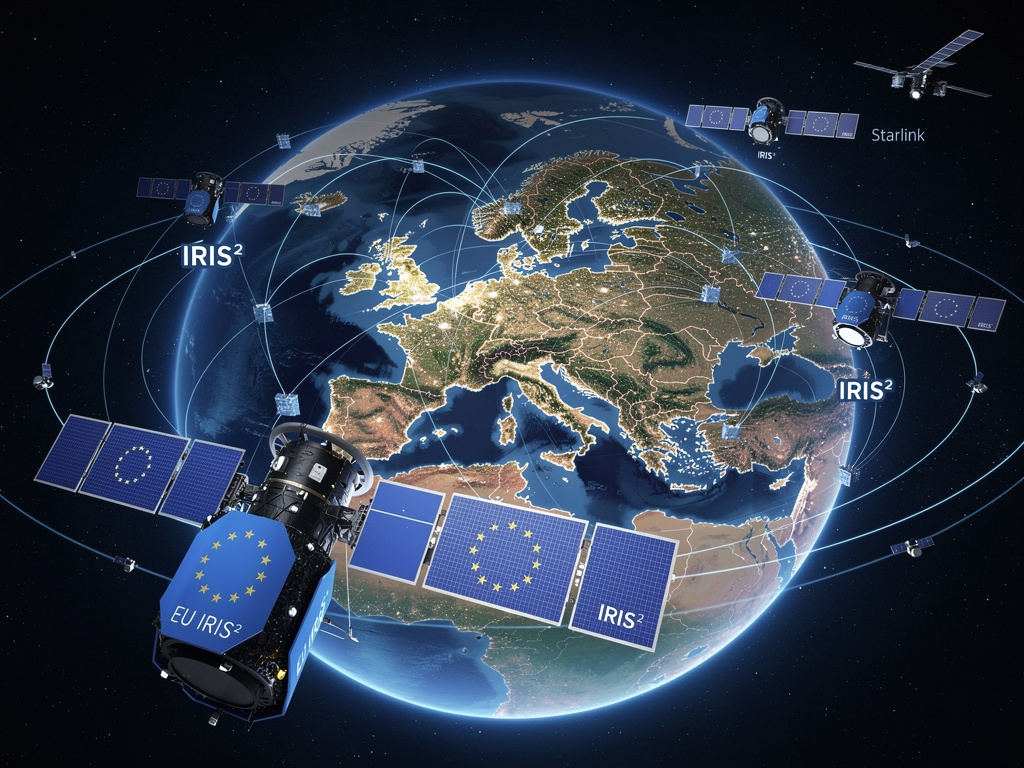
The European Union has officially launched its Infrastructure for Resilience, Interconnectivity and Security by Satellite (IRIS²) program, marking Brussels’ most ambitious attempt yet to establish digital autonomy in an era increasingly dominated by American commercial satellite networks. The €10.6 billion initiative, announced in early 2025, represents a fundamental shift in European space policy—one that positions secure governmental communications and strategic independence as priorities equal to, if not exceeding, commercial market considerations.
According to Slashdot, the program will deploy a constellation of satellites designed specifically to provide encrypted communications for European governments, military forces, and critical infrastructure operators. Unlike purely commercial ventures, IRIS² explicitly prioritizes sovereignty concerns, ensuring that European governmental communications remain beyond the reach of foreign intelligence services and outside the control of non-European corporate entities. This strategic positioning reflects growing anxiety within European capitals about dependency on systems that could be compromised, monitored, or simply switched off during geopolitical crises.
The timing of IRIS²’s deployment is no coincidence. SpaceX’s Starlink network has already launched more than 6,000 satellites and commands an increasingly dominant position in global satellite internet services. While Starlink’s commercial success has revolutionized connectivity in remote areas and conflict zones—including Ukraine, where it has proven militarily significant—European policymakers have watched this American dominance with mounting concern. The fear is not merely economic competition but strategic vulnerability: what happens when critical European communications infrastructure depends entirely on a system controlled by a single American entrepreneur with documented political volatility?
The Architecture of Digital Independence
IRIS² will consist of approximately 290 satellites operating in multiple orbital planes, combining both low Earth orbit (LEO) and medium Earth orbit (MEO) spacecraft. This multi-orbit architecture distinguishes it from purely LEO constellations like Starlink, offering different latency and coverage characteristics suited to governmental requirements. The constellation is designed to provide secure communications across all European territories, including remote regions and maritime zones, while also extending coverage to Africa and parts of the Arctic—areas of strategic interest to European security and economic policy.
The technical specifications reveal a system built for resilience and security rather than maximum commercial throughput. Each satellite will incorporate quantum encryption capabilities, anti-jamming technologies, and hardened systems designed to operate in contested electromagnetic environments. These features reflect lessons learned from ongoing conflicts, particularly Russia’s invasion of Ukraine, where electronic warfare and satellite system targeting have become routine elements of modern combat. European military planners have concluded that relying on commercial systems, however capable, leaves critical vulnerabilities that adversaries could exploit.
A Consortium Approach to Continental Ambitions
The European Commission has structured IRIS² as a public-private partnership, awarding the primary contract to the SpaceRIS consortium. This group includes major European aerospace companies: Airbus Defence and Space, Thales Alenia Space, and Telespazio, among others. The consortium model aims to distribute industrial benefits across multiple member states while leveraging existing European space industry capabilities. France, Germany, and Italy—the EU’s largest aerospace powers—will naturally capture significant portions of the work, though smaller nations have negotiated guaranteed participation shares to ensure broader industrial distribution.
Financing the program has required creative structuring. The European Union will contribute approximately €6 billion from its budget, with member states and private sector partners providing the remainder. This mixed funding model reflects both the scale of investment required and political sensitivities around defense spending. By categorizing IRIS² partially as civilian infrastructure rather than purely military expenditure, Brussels has navigated budgetary constraints and political opposition in member states where defense spending remains controversial. The private sector’s financial participation also ensures commercial services will eventually be offered alongside governmental uses, potentially generating revenue to offset public investment.
Strategic Implications Beyond Communications
IRIS² represents more than a communications system; it embodies a broader European strategy of “strategic autonomy” that has gained momentum since 2016. This concept, championed particularly by France under President Emmanuel Macron, argues that Europe must develop independent capabilities in critical domains—from defense to technology to energy—to avoid dependency on potentially unreliable partners. The United States, despite being a NATO ally, is increasingly viewed in European capitals as an unpredictable partner whose commitments cannot be taken for granted, especially following the Trump administration’s transactional approach to alliances and threats to withdraw from NATO.
The program also reflects European frustration with the pace of American technology dominance. While European companies have traditionally excelled in telecommunications and aerospace, the rapid emergence of American “New Space” companies—SpaceX, Planet Labs, Rocket Lab—has shifted the competitive dynamic. These firms, operating with different regulatory frameworks, risk tolerances, and capital structures, have achieved capabilities that European competitors have struggled to match. IRIS² is partly an attempt to create a protected market where European companies can develop competitive technologies without being overwhelmed by American rivals operating at massive scale.
The Starlink Shadow and Competitive Realities
Any assessment of IRIS² must acknowledge the formidable competition it faces. Starlink has already achieved operational status with thousands of satellites, hundreds of thousands of customers, and proven performance in demanding environments. Its head start is measured not in months but years, and its parent company SpaceX possesses launch capabilities that dramatically reduce deployment costs—capabilities European launch providers cannot currently match. The Ariane 6 rocket, Europe’s newest launcher, offers significantly higher costs per kilogram to orbit than SpaceX’s reusable Falcon 9, creating a structural disadvantage before the first IRIS² satellite even launches.
Moreover, Starlink’s commercial model generates revenue that funds continuous expansion and improvement. IRIS², by contrast, must justify its existence primarily through governmental budgets and strategic rationales rather than market demand. While the program plans to offer commercial services, competing against an established, technically proven system with global coverage will prove challenging. European consumers and businesses, if given a choice between Starlink’s existing service and IRIS²’s future offerings, may well choose the former based on performance and price—undermining the program’s commercial viability and forcing greater reliance on governmental subsidies.
Technical Challenges and Deployment Timeline
The IRIS² program faces significant technical hurdles beyond competitive positioning. Deploying 290 satellites across multiple orbits requires dozens of launches over several years. European launch capacity remains limited, and relying on foreign launch providers would contradict the sovereignty objectives driving the program. This creates a potential bottleneck: European launchers may lack the capacity to deploy IRIS² on an aggressive timeline, while using American or other foreign launch services would expose the program to the very dependencies it seeks to avoid. The European Space Agency and national space agencies are working to expand launch capacity, but building new launch infrastructure requires years and billions in additional investment.
Integration and testing of quantum encryption systems, anti-jamming technologies, and other advanced capabilities also present risks. These technologies, while conceptually proven, have limited operational track records in space environments. Satellite systems are notoriously unforgiving of design flaws—once deployed, they cannot be easily repaired or upgraded. The program must balance ambition with reliability, incorporating cutting-edge capabilities while ensuring the constellation actually functions as intended. Previous European space programs have sometimes struggled with this balance, experiencing delays and cost overruns that eroded political support and complicated financing.
Geopolitical Context and Alliance Dynamics
IRIS²’s development occurs against a backdrop of shifting transatlantic relations and evolving security threats. The war in Ukraine has demonstrated both the military importance of satellite communications and the risks of dependency on potentially vulnerable systems. Ukrainian forces have relied heavily on Starlink for battlefield communications, but this dependency has created uncomfortable moments when service disruptions—whether technical or policy-driven—affected military operations. European defense planners have taken note: what works when American and European interests align may fail when they diverge.
The program also reflects European concerns about Chinese technological advancement and potential security threats. China has developed sophisticated cyber capabilities and has demonstrated anti-satellite weapons that could threaten space infrastructure during conflicts. A European-controlled satellite constellation, with encryption and security features designed specifically against such threats, offers resilience that commercial systems may lack. This consideration has particular salience for European intelligence services and military commands, who view secure communications as fundamental to operational effectiveness and strategic planning.
Economic Dimensions and Industrial Policy
Beyond security considerations, IRIS² serves as industrial policy, channeling billions of euros into European aerospace companies and supporting high-skilled employment across the continent. The program’s structure ensures work distribution across multiple member states, creating political constituencies that will support continued funding even if technical or competitive challenges emerge. This dynamic—where space programs serve multiple objectives beyond their stated mission—is familiar in European policy, where industrial, regional, and employment considerations often shape technical decisions.
The question remains whether this approach can produce systems competitive with American and Chinese alternatives developed under different constraints. European aerospace companies operate with higher labor costs, more complex regulatory environments, and fragmented markets compared to their American counterparts. These structural factors have historically made European space systems more expensive and sometimes less innovative than American equivalents. IRIS² must overcome these disadvantages while meeting demanding technical requirements and aggressive timelines—a combination that has proven difficult in previous programs.
Future Implications for Space Policy
IRIS²’s success or failure will significantly influence future European space policy and broader discussions about strategic autonomy. If the program delivers capable satellites on schedule and within budget, it will validate the European approach of government-led development in strategic domains. Success would likely encourage similar initiatives in other technology areas where European policymakers perceive dangerous dependencies on foreign systems. Conversely, significant delays, cost overruns, or technical shortfalls would strengthen arguments for pragmatic accommodation with American technological leadership rather than expensive attempts at independent development.
The program also sets precedents for international space governance and competition. As more nations and blocs develop independent satellite constellations, questions about orbital coordination, spectrum allocation, and space traffic management become increasingly urgent. IRIS² adds another major constellation to an increasingly crowded orbital environment, raising concerns about collision risks and the long-term sustainability of space operations. These issues require international cooperation even as nations pursue independent capabilities—a tension that will shape space policy for decades to come.





 WebProNews is an iEntry Publication