
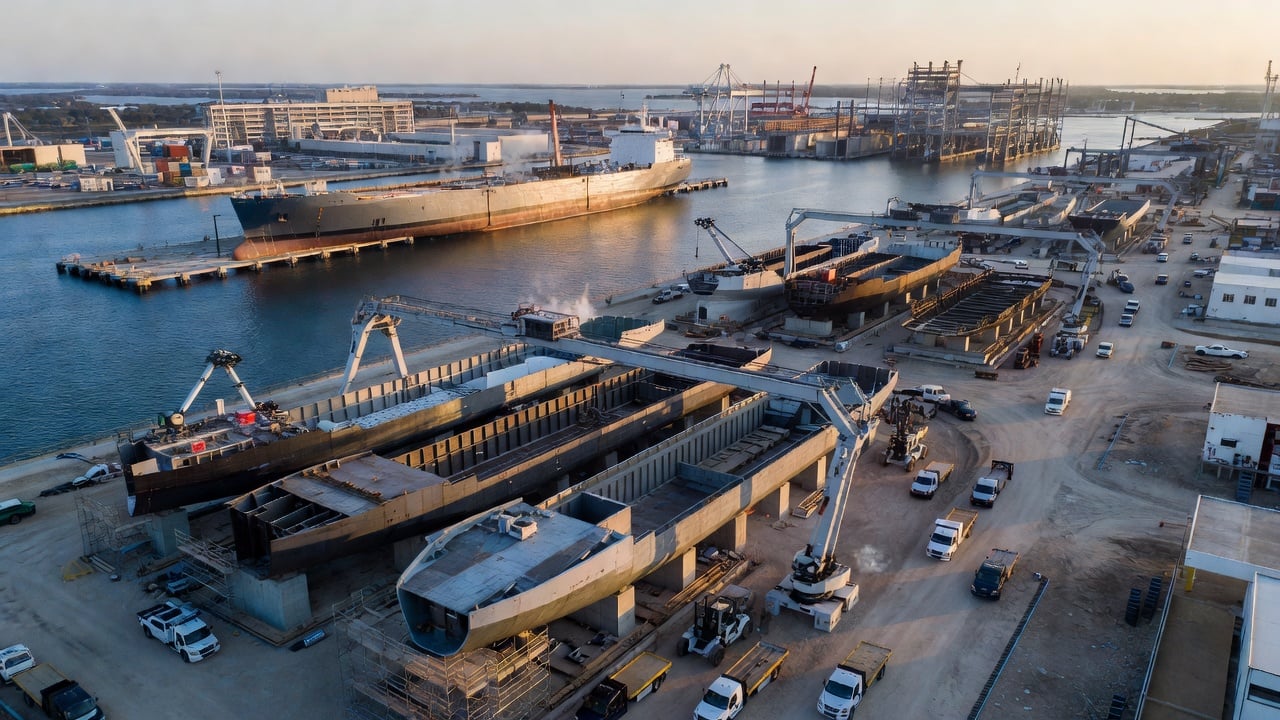
Texas just landed one of the largest industrial projects in recent memory. Saronic Technologies, the Austin-based maker of autonomous surface vessels, picked Brownsville for its Port Alpha shipyard. The $3.2 billion facility promises to produce vessels at a pace unseen in American shipyards since World War II. And the scale staggers. An initial 835-acre site at the Port of Brownsville. Room to expand to nearly 4,400 acres. Bigger, the company claims, than every 2026 World Cup stadium combined.
Construction starts next year. Operations begin in 2028. The yard will handle ships up to 850 feet long at first. Later phases could accommodate hulls exceeding 1,200 feet. Think Wasp-class amphibious ships or larger. Renderings show vessels resembling San Antonio-class amphibious transport docks under construction on vast waterfront aprons. Yet the real story lies in what these ships will do. Not just traditional crewed warships. Saronic envisions autonomy woven into larger hulls from the start. “Those ships might not be fully autonomous or fully unmanned on day one,” CEO Dino Mavrookas told reporters, per USNI News. “But over time, as we look at building out the tech and building out the industry as a whole, there’s no reason that you can’t unman those ships completely.”
The announcement landed amid growing alarm over America’s shrinking shipbuilding edge. China launched 1,400 commercial ships in 2024. The United States managed five. Federal efforts to close that gap gained momentum with President Trump’s April 2025 executive order on maritime dominance, the SHIPS for America Act, and the Maritime Action Plan. Port Alpha fits squarely into that push. “America’s maritime future depends on our ability to build again,” Mavrookas said in Saronic’s official release on Medium. “Port Alpha is our commitment to that mission. Built from the ground up to deliver ships at a speed and scale not seen since World War II.”
Texas officials wasted little time celebrating. Governor Greg Abbott called it history in the making. “When this shipyard gets fully built out, there will be about 10,000 employees,” he said, according to the same Saronic announcement. “Saronic is going to be providing about $750 million in annual paychecks to Texans.” The state sweetened the deal with an $80 million grant from the Texas Enterprise Fund. Cameron County commissioners approved a 95 percent tax abatement for 19 years. That deal came with strings. At least 35 percent of hires must come from local workers. Miss the target and the abatement shrinks.
Not everyone cheered. Forty residents testified against the project during hearings, citing concerns over environmental effects and community impact in the border region already home to much of the nation’s shipbreaking industry. Still, the incentives and infrastructure won out. Brownsville offered deep-water access, multimodal transport links, and room to grow. Saronic spent a year scouting sites across the country, including California and Virginia. Texas prevailed.
The economic projections border on the enormous. More than $160 billion in impact for Cameron County. Another $264.5 billion statewide over time. Up to 10,000 direct jobs in welding, machining, robotics, software engineering, and naval architecture. Saronic plans partnerships with local colleges, universities, and technical schools to train that workforce. Apprenticeships will play a central role. The company already operates two other facilities. A central Texas plant builds its 24-foot Corsair drone boats. Last year it acquired the former Gulf Craft yard in Franklin, Louisiana, and committed $300 million to add 300,000 square feet of production space for the 180-foot Marauder autonomous vessel. Port Alpha becomes the third pillar. And the most ambitious.
Saronic burst onto the scene in 2022. By late 2025 the Navy had awarded the firm roughly $350 million to $392 million in contracts for small autonomous systems. The company competes in the medium unmanned surface vessel program, with at-sea testing continuing through October. Its vessels have already seen real combat. In July three Corsairs struck an Iranian naval base at Bandar Abbas, hitting a repair pier and a midget submarine. That marked the first combat use of such U.S. Navy-operated drones. Weeks earlier a Corsair helped rescue two downed American soldiers near the Strait of Hormuz. Firsts keep piling up.
Yet questions remain. Saronic has not disclosed exact production targets for Port Alpha or the specific mix of platforms it will build there. Will the yard focus purely on unmanned systems? Or will it produce hybrid autonomy-capable ships for both commercial and defense customers? Mavrookas has hinted at the latter. The facility combines software-defined manufacturing, advanced robotics, and artificial intelligence. Traditional shipbuilding relies on manual labor and long timelines. This approach promises speed and repeatability. The kind of output that could help the U.S. regain industrial primacy at sea.
Recent coverage adds texture. Defense News noted the project’s alignment with broader federal initiatives while highlighting local opposition and the precise tax incentives. Naval Today emphasized how the yard could accelerate production of autonomous maritime systems at a moment when such technology shifts naval tactics worldwide. Even social media buzz on X reflected the moment. Posts celebrated Texas beating California on business climate. Others tied the project to national security gains against peer competitors.
The original vision for Port Alpha first surfaced in February 2025. Back then Saronic outlined the concept without naming a location or full price tag. Now the pieces have fallen into place. The company raised $1.75 billion in a Series D round earlier this year, pushing its valuation to $9.25 billion. That capital, plus government support, gives it runway. Partnerships with suppliers, technology providers, and manufacturers will matter. So will execution. Shipbuilding has frustrated many defense primes with delays and cost overruns. Saronic bets its software-first model avoids those traps.
Look closer at the site itself. The Port of Brownsville already supports heavy industry. Its location near the Gulf of Mexico offers strategic access for testing and deployment. Expansion potential to 4,400 acres could make it one of the world’s largest shipyards. Phase one alone targets vessels the size of major amphibious warships. Future growth pushes into destroyer or even larger categories. Autonomy does not stop at small drone boats. Mavrookas sees it scaling up. Over time those large hulls could operate with minimal or no crews. Reduced manning lowers costs and risk. It also multiplies fleet size without proportional increases in personnel.
Critics might argue the economic forecasts seem optimistic. Ten thousand jobs and hundreds of billions in impact require sustained demand. The Navy’s unmanned surface vessel programs still face technical and doctrinal hurdles. Congress must fund them at scale. Commercial interest in autonomous cargo or survey ships remains nascent. Yet the momentum feels real. Saronic’s recent combat demonstrations proved the technology works in contested waters. Its rapid growth from startup to major contractor shows investor confidence.
Texas clearly sees the upside. Abbott’s administration positioned the state as pro-business and defense-focused. The tax abatement and grant reflect that bet. Brownsville gains high-tech manufacturing jobs in a region that needs them. Training programs could lift local skill levels for decades. But success depends on delivery. If Port Alpha produces vessels faster and cheaper than legacy yards, it could force the entire industry to adapt. Traditional shipbuilders might adopt more automation. The Navy could accelerate its shift toward unmanned fleets.
So far Saronic has kept details close. No firm order book for the new yard. No public renderings of specific autonomous systems beyond conceptual large hulls. The focus stays on capacity. On rebuilding the industrial base. On matching China’s output tempo. “The state of Texas and city of Brownsville give us the foundation to turn that vision into reality,” Mavrookas added in the company statement.
The coming years will test whether that vision holds. Groundbreaking in 2026. First ships in 2028. Workforce ramp-up to thousands. Integration of robotics and software at unprecedented scale. Challenges abound. Supply chains for specialized components. Regulatory approvals for large autonomous vessels. Workforce retention in a competitive tech economy. Still, the project signals a shift. American maritime strategy no longer accepts slow, expensive, crew-heavy fleets as the only option. Autonomy offers another path. Port Alpha intends to pave it. At a cost of $3.2 billion and with the full backing of state leaders, the gamble looks serious. The U.S. Navy and its allies will watch closely. So will competitors abroad.


 WebProNews is an iEntry Publication