
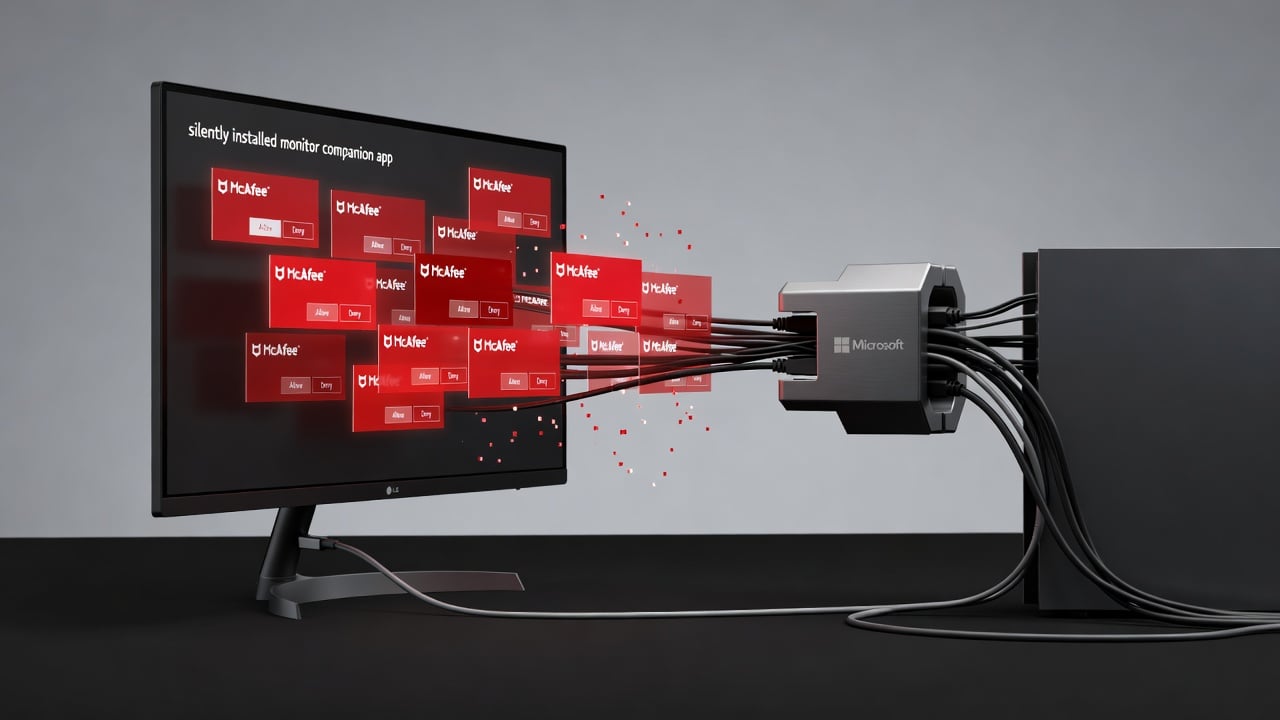
Microsoft has moved quickly to shut down one particularly annoying form of advertising that appeared on Windows machines connected to certain LG monitors. The company worked directly with LG after widespread complaints and a detailed exposé from the YouTube channel Gamers Nexus. Yet the underlying mechanism that let the ads slip onto systems without user consent remains untouched. And that leaves plenty of room for similar intrusions in the future.
The trouble centered on an application called LG Monitor App Installer. It arrived automatically via Windows Update whenever users plugged in compatible LG displays. No prompt. No consent screen. Just a background download that added the app to the system and set it to run at startup. Gizmodo first reported on the forced ads and Microsoft’s intervention.
Once installed, the app displayed pop-up promotions in the lower right corner of the screen. Steve Burke, editor-in-chief at Gamers Nexus, documented the behavior in a video published this month. The McAfee advertisement appeared 31 times across 32 consecutive system boots. Other promotions pushed LG’s own services such as LG Channels or Calibration Studio, but McAfee dominated. Ars Technica covered the Gamers Nexus findings in detail on July 23, 2026.
Burke purchased an LG UltraGear 45GX950-B gaming monitor for $1,200 to test the issue. The price dropped to $600 shortly after. His team replicated the silent installation across multiple Windows 11 machines. The app’s Microsoft Store page described it as a tool to “easily install and use apps supported by your monitor.” It listed McAfee as one of those supported applications. A recent changelog update explicitly called out “Additional App – McAfee” and promoted a 30-day free trial that converted to a paid subscription.
Users who paid premium prices for these monitors, some exceeding $1,000, found themselves staring at repeated commercial pitches. Worse, the app carried broad permissions. It gained access to all system resources and an internet connection. Burke noted that LG technically possessed permission to collect geolocation, device data, online activity, contacts, user credentials, transactions and more. Privacy worries spread fast on Reddit and technology forums.
The installation relied on a feature Microsoft built into Windows. When a device connects, Windows queries metadata from its servers. That metadata can specify companion applications. If the user has not opted out of recommended settings during Windows setup and remains connected to the internet while signed into a Microsoft account, the app downloads silently. No notification appears. A Microsoft developer support page acknowledges that some users may find the experience “confusing and frustrating” and could leave bad ratings. Still, the system permits it.
Pavan Davuluri, executive vice president of Windows and devices at Microsoft, responded publicly on X. “We’ve connected with the team at LG and as an immediate next step, they have agreed to disable the McAfee pop-up from their app,” he wrote. “We appreciate LG working with us toward a shared goal of a better experience for our mutual customers. We will keep improving here with our ecosystem partners.” The statement came after Epic Games CEO Tim Sweeney highlighted the issue. Neowin reported Davuluri’s confirmation on July 23, 2026.
LG defended its approach in statements to multiple outlets. The company insisted McAfee installs only with explicit user consent. “The LG Monitor App Installer is distributed through Microsoft’s official Windows distribution process, which included McAfee as an option,” it told Windows Latest. It also claimed the app does not access, collect or transmit any customer personal data. Yet the permissions granted upon installation suggested otherwise. LG did not respond to further questions from Ars Technica before that story published.
Microsoft’s action stops the McAfee pop-ups. The Microsoft Store listing for the LG app still references McAfee, though updates to the description are expected. The broader practice of automatic installation continues. Device manufacturers have exploited this pathway for years. Razer pushes its Synapse software when users connect mice, keyboards or webcams. Logitech, Asus and Gigabyte have drawn similar criticism for companion utilities that arrive without clear approval.
Some affected LG models include the 34GX900A-B, 45GX950-B.AEU, 32GS95UE-B, 39GX950B, 27GP83B-B, 27GN800, 27GN850-B and others. The behavior reportedly appeared on monitors purchased three years earlier, indicating the practice predates recent updates. Windows Latest examined the changelog and confirmed LG’s own documentation admitted the McAfee bundling. That July 21 report detailed how the app appeared in the Start menu’s recommended section and ran at boot.
Tech observers note the selective speed of Microsoft’s response. McAfee competes directly with Microsoft Defender. Removing a rival’s advertisements aligns with Redmond’s interests. Yet the company has faced its own backlash over intrusive features such as the now-shelved Recall tool. Addressing one partner’s ads while preserving the auto-install framework raises questions about consistency.
Users can block the behavior through Group Policy. Set “Prevent automatic download of applications associated with device metadata” to Enabled under Computer Configuration, Administrative Templates, System, Device Installation. The app can also be uninstalled manually through Settings or tools such as BCUninstaller. These steps require technical knowledge that most consumers lack. And they do not prevent other hardware partners from using the same metadata channel.
But the episode reveals deeper tensions. Hardware makers seek to control the user experience and monetize their devices beyond the initial sale. Microsoft wants to maintain a clean, trustworthy platform while retaining flexibility for partners. The compromise so far satisfies neither side completely. LG stops the specific McAfee pitch. Microsoft promises continued improvements. The silent installation path stays open.
Industry insiders have watched similar incidents for more than a decade. OEMs have preloaded trial software, toolbars and utilities since the early days of Windows. What changed is the delivery method. Modern Windows Update and device metadata make the process invisible. A monitor, once a simple display, now serves as a Trojan horse for applications that demand system-level access.
Tim Sweeney and others amplified user frustration on social media. Their pressure prompted Davuluri’s direct reply within days. That responsiveness stands in contrast to years of accumulated complaints about Windows bloat. Whether the LG case signals a genuine shift in policy or a one-off concession remains unclear. Microsoft has not announced changes to its device-metadata rules or stricter consent requirements for companion apps.
Consumers pay premium prices for high-end monitors expecting quality and reliability. Discovering repeated advertisements and hidden software erodes trust. The fact that LG’s most expensive displays triggered the loudest outcry only sharpens the point. When a $1,000 screen injects commercial messages on every boot, the value proposition frays.
So the fix feels incomplete. Disabling one pop-up addresses the symptom. The permission structure, the silent delivery and the lack of explicit consent persist. Microsoft says it will keep working with partners. Hardware vendors will likely test the boundaries again. And users will continue searching for registry tweaks and policy settings to reclaim control of their own machines.
Recent coverage from TechSpot and Slashdot echoed these points, noting that the core Windows feature enabling the scheme has not been altered. The conversation on X this week focused on calls for explicit user approval before any peripheral can install software. Those demands have not yet produced policy changes. For now, the LG McAfee episode stands as both a small victory for consumers and a reminder of how much work remains.


 WebProNews is an iEntry Publication