
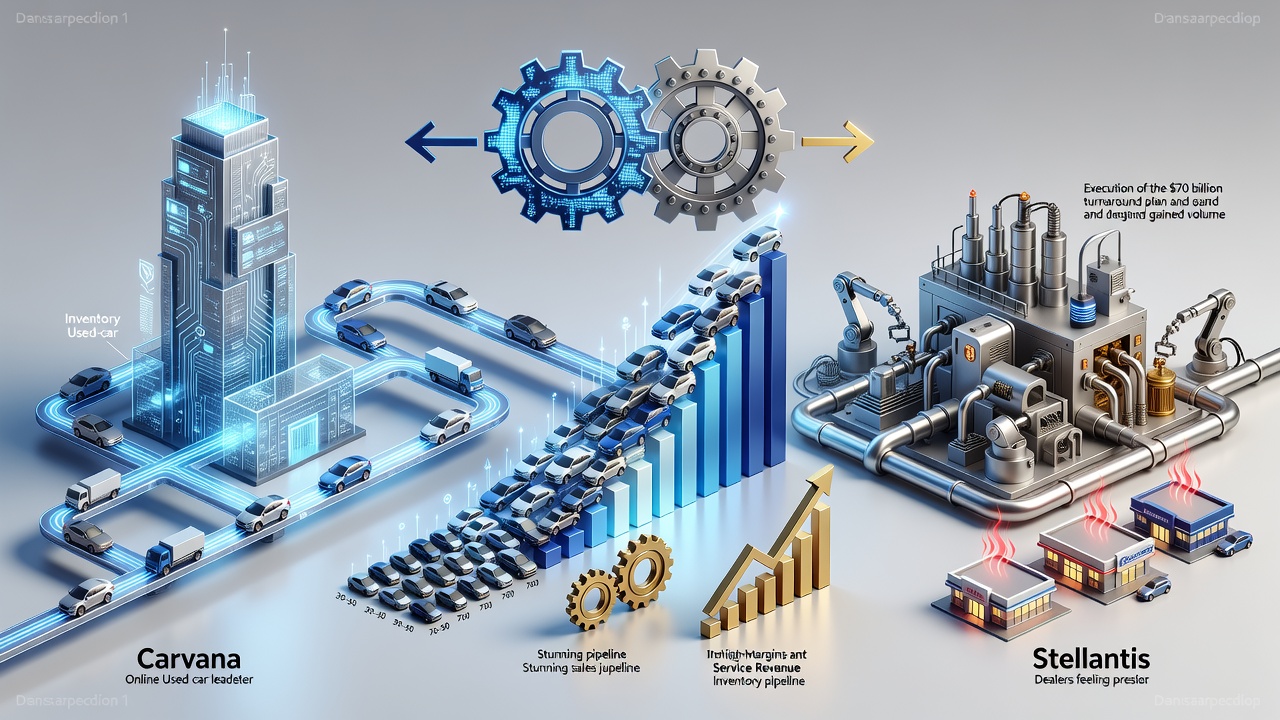
Carvana built an empire on used cars sold from towering vending machines. No haggling. No pushy salespeople. Just a few clicks and a delivery to your door. But lately the online retailer has done something unexpected. It started buying physical dealerships. And not just any dealerships. Mostly ones selling vehicles from Stellantis.
The pairing looks odd on paper. Stellantis, the parent of Chrysler, Dodge, Jeep and Ram, has staggered through years of market share losses, executive churn and product missteps. Carvana, meanwhile, rose on a promise of digital purity. Yet early results suggest this odd couple may have found real chemistry. Sales at one acquired Arizona store exploded from 30 or 50 vehicles a month to more than 700 in a single month, according to figures Stellantis shared with dealers.
The Motley Fool first highlighted the potential in a July 22, 2026 analysis. Read the full Motley Fool article here. But the story runs deeper. Carvana has now acquired at least seven Stellantis franchises since 2025. These outlets serve a new purpose. Customers visit for test drives or to inspect features. The actual purchase still happens online. The physical sites also feed Carvana a steady supply of trade-ins. That inventory flows straight into its core used-car business.
Service bays remain open too. Traditional dealerships earn most of their profit not from vehicle sales but from repairs, parts and financing. Carvana lacked that high-margin engine. Now it has one. The Arizona location, once average, became Stellantis’s top U.S. volume store. Numbers like these turn heads. They also rattle longtime franchise owners.
Dealers See the Writing on the Wall
Many traditional dealers view Carvana’s move as a threat. Some call it desperation on Stellantis’s part. Others see an inevitable shift. John Murphy, an analyst, told CNBC that Carvana entering the new-vehicle franchise business “may be one of the most disruptive forces that auto retailing has seen in the U.S. market in decades.” See the CNBC report from June 16, 2026.
Brian Gordon, another observer, pointed to untapped profit pools. “After stabilizing their core business, I think they realized, by looking at the franchise model, that there was a significant amount of revenue and gross profit opportunity that their business model didn’t even contemplate,” he said in the same CNBC piece.
Sean Hogan, a dealer himself, struck a pragmatic note. “I’m curious to see what their strategy is and, in the long run, I think competition is good. So, if they’re doing something better than we are, then we will need to adapt, or we’re going to be irrelevant.” His words capture the unease spreading through the industry.
The Wall Street Journal captured customer sentiment too. One buyer, Joshua Higginbotham, swore off traditional Jeep-Ram dealers after poor experiences. He ended up purchasing a $51,000 Jeep Wrangler online from a Carvana-owned store more than 1,000 miles away. “I don’t want to spend a whole day in a dealership, and they always like to make it take an entire day,” he explained. Read the Wall Street Journal story.
Carvana operates these stores differently. No parts counters at the vending-machine sites. Heavy reliance on digital tools and logistics that echo Amazon’s playbook. Stellantis has even certified Carvana as a direct website provider, bypassing usual third-party requirements. That decision raised eyebrows among existing dealers who worry about territorial protections.
Yet Stellantis needs volume. The company launched its FaSTLAne 2030 plan on May 21, 2026. The five-year roadmap calls for more than €60 billion in investments, roughly $70 billion. About 60 percent targets brands and products, with a heavy emphasis on North America. New Ram pickups, both compact and midsize, sit in the pipeline. Nine upcoming models aim for starting prices below $40,000. Two target under $30,000. The focus has shifted away from expensive electric vehicles toward more affordable options that match current buyer demand.
Stellantis CEO Antonio Filosa described the plan as the product of “months of disciplined work.” He added that it centers the customer and seeks “long-term profitable growth.” WardsAuto covered the announcement in detail on May 22, 2026. See the WardsAuto coverage.
Carvana timed its dealership purchases well. Stellantis’s recent troubles let the online player buy in at attractive prices. The automaker’s renewed push, backed by tens of billions, could lift those same outlets in coming years. Early data supports the thesis. One Carvana Stellantis store in Texas now functions mainly as a test-drive hub for online buyers. Inventory flows efficiently. Trade-ins feed the used-car machine. Service revenue adds margin.
But risks remain. State franchise laws still favor traditional dealers. Some Stellantis partners have pushed back, leading to limits on how many additional stores Carvana can acquire each year, according to recent discussions on X. Carvana’s own history includes sharp ups and downs. Its stock once cratered during the pandemic-era chip shortage and high interest rates. Recovery came through cost cuts and a renewed focus on efficiency.
Now the company reports a market capitalization above $70 billion. Last year it sold fewer than 600,000 vehicles but boasts reconditioning capacity for 1.5 million. That gap shows room to grow. Its first 2026 auto asset-backed securitization included new-vehicle loans for the first time. Auto Finance News reported the $1.1 billion prime deal on July 22, 2026. Read the Auto Finance News update.
So what does this mean for the broader market? The franchise system that has dominated U.S. auto sales for decades faces pressure. Carvana proves digital tools can drive massive volume when paired with physical touchpoints. Traditional dealers must decide whether to fight the change or copy elements of it. Some have already begun investing in better online experiences.
Stellantis gains too. More sales help reverse market share erosion. Access to Carvana’s platform exposes its brands to younger buyers comfortable with apps and touchscreens. Jeep and Ram, the two North American priorities, stand to benefit most. The automaker plans to roll out 11 new vehicles in the U.S. over the next five years.
Analysts debate how far Carvana can push. Larry Dominique, a former Stellantis executive, told CNBC that the company “is showing the franchise dealer community how the power of digital can be applied to make a future direction retail model.” The implication is clear. Adaptation is no longer optional.
Recent chatter on X echoes the tension. One industry voice noted that Carvana came within two vehicles of matching the monthly sales of Longo Toyota, long the highest-volume Toyota dealer in America. Another post described the Stellantis-Carvana link as a “fundamental shift” that blurs old franchise boundaries. OEMs need to move metal. They may partner with whoever delivers results.
Carvana still trails pure-play new-car giants in total volume. Its experiment remains young. Yet the speed of progress at that first Arizona store suggests the model works. Combine affordable upcoming Stellantis products with Carvana’s logistics muscle and customer-friendly interface. The result could attract buyers tired of traditional dealership friction.
Investors have taken notice. Carvana shares have climbed significantly from pandemic lows. Stellantis trades at modest multiples, reflecting past struggles but also the hope tied to its new strategy. If the partnership scales, both companies stand to gain. Carvana adds new revenue streams and higher-margin services. Stellantis regains footing in a tough North American market.
The auto industry rarely changes overnight. This time, though, the pieces appear to be moving faster than many expected. Physical stores that once seemed destined for disruption now serve as bridges between old habits and new expectations. Test drives still matter. So do service relationships. But the transaction itself has broken free from the showroom floor.
Watch the Arizona numbers. Track Stellantis’s product launches. Listen to what dealers say as they face this new competitor. The strange pairing that once raised eyebrows may soon look like a blueprint. And if it succeeds, the rest of the retail world will have no choice but to catch up.


 WebProNews is an iEntry Publication