
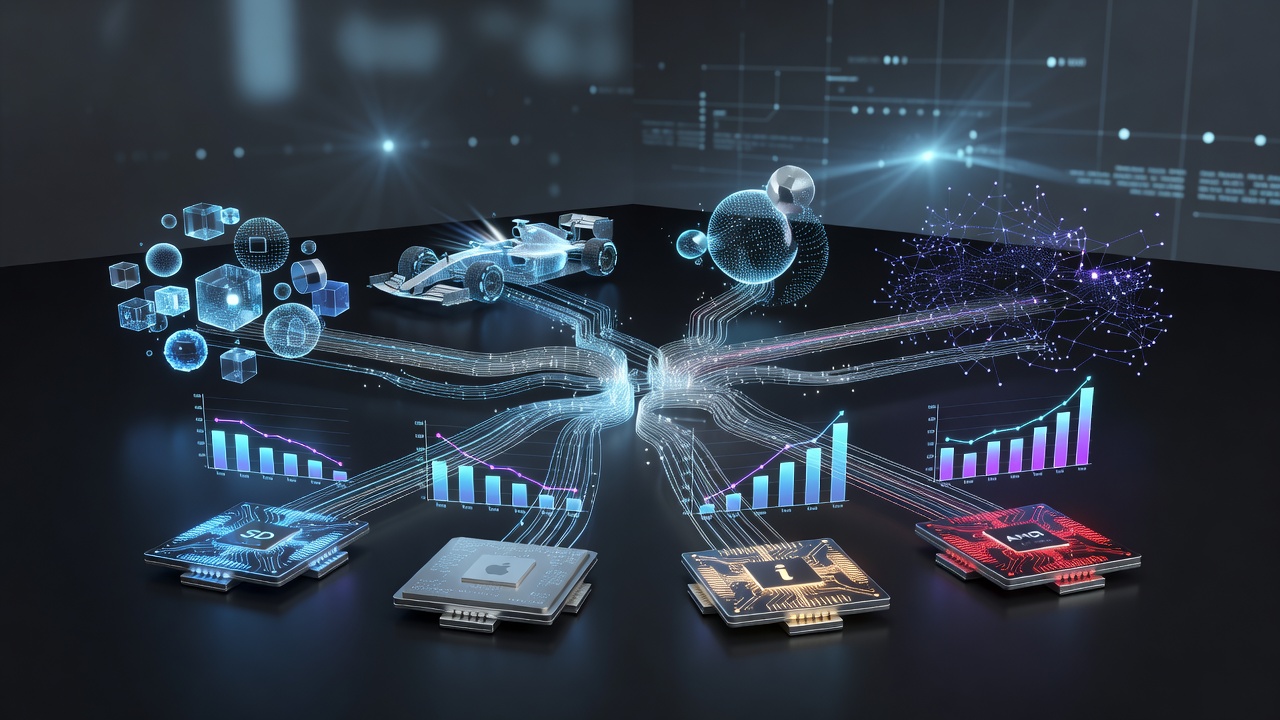
Primate Labs dropped Geekbench 7 today. The cross-platform tool arrives with a complete rethink of how it measures processors and graphics chips. Scores from this version won’t match those from its predecessor. Yet early data already shows how the changes highlight strengths in modern chips from Apple, Qualcomm, AMD and Intel.
New Tests Meet Modern Usage Patterns
The update adds media workloads that test audio and video encoding, decoding and processing. These mimic video calls, screen sharing and content playback. Whisper speech recognition, AV1 decoding and Opus audio appear. A Game Physics test runs on the Jolt engine found in many current video games. Photo Editor gains more realistic edits. Photo Library now handles JPEG XL and DNG files.
File Compression and PDF Viewer workloads carry heavier, more varied data. Developer and image processing tests include additional assets and formats. The changes make results feel closer to daily computing. But they also push hardware harder. Single-core numbers drop across tested systems.
Signal65 ran Geekbench 7 alongside version 6.7.1 on laptops with Snapdragon X2 Elite, Core Ultra X9 388H, Ryzen AI 9 465 and Apple M5 chips. Single-core scores fell 9 percent on the Ryzen to 15 percent on the Snapdragon. The baseline now sits at 2,500. Direct numerical comparisons between versions don’t work.
Multi-core results tell a different story. The redesign runs a workload in multiple threads only if real applications do the same. This favors designs with many efficient cores. Snapdragon X2 Elite multi-core jumped nearly 16 percent to 22,871. Core Ultra lost ground. Apple M5 kept its single-core lead. Snapdragon turned a 12 percent single-core gap into a 30 percent multi-core advantage.
Battery performance split by architecture. Qualcomm systems held scores when unplugged. Intel and AMD chips gave up 16 to 23 percent. These numbers come from one device per platform. More testing will follow. Still, the pattern matches how laptops behave under mixed loads in 2026.
GPU tests received equal attention. The benchmark now focuses on machine learning and content creation. Face tracking and real-time video filters appear. Machine learning upscales images. Background blur simulates video conference calls. New tasks cover RAW image processing, LUT-based color grading, path tracing and fluid simulation. CUDA returns alongside OpenCL, Vulkan and Metal. Nvidia hardware stands to benefit.
Hardware Busters noted the odd launch. Primate Labs prepared embargoed materials but never distributed them before publishing builds, documentation and browser results. Enthusiasts quickly filled the public database with Apple M-series, AMD and Intel numbers. The irony runs deep. Geekbench Browser has long served as a primary source for pre-launch CPU and phone leaks.
John Poole, founder of Primate Labs, outlined the goals in the official blog post. “Geekbench 7 includes new media workloads that measure how well your CPU handles audio and video encoding, decoding, and processing,” he wrote. The multi-core benchmark “has been redesigned to better reflect how real applications behave.” (Geekbench Blog)
MacRumors covered the announcement in detail hours after release. The site highlighted the smarter multi-core approach and GPU focus on machine learning tasks. It also noted the 20 percent discount on the Pro version through August 6. (MacRumors)
AppleInsider forums discussed early iPad Pro results. On an 11-inch M4 model running iPadOS 27, Geekbench 6 returned 3,719 single-core and 13,635 multi-core. Geekbench 7 scored 3,197 and 12,959. The gap shows the heavier workloads and recalibration at work. (AppleInsider Forums)
Real-world device makers already post numbers. Samsung Galaxy S25 variants appear in user-shared screenshots on X. One S25 showed 2,720 single-core and 9,534 multi-core. Galaxy Z Fold 8 results also surfaced quickly. These early mobile scores give a first look at how the new tests treat Arm-based phone chips.
The CPU workloads document details the calibration. Scores target a baseline of 2,500. Compression, encryption, image processing and other tasks receive updated data sets to stress memory and cache in ways that match 2026 software. (Geekbench CPU Workloads PDF)
Industry watchers on Hacker News and Reddit reacted within minutes of the launch. Threads filled with questions about score compatibility and calls for broader platform testing. One Reddit post called the overhaul Geekbench’s “biggest yet” because of the real-world focus, AI workloads, media tests and CUDA support.
Yet not every reaction stayed positive. Some users complained about the paid upgrade model even though the basic version stays free for personal use. Others missed older graphical interfaces from early Geekbench releases. The debate feels familiar. Benchmark tools evolve. User expectations lag.
So what does this mean for chip designers? Companies now face a test suite tuned to actual application threading behavior rather than artificial parallelism. High core-count designs may shine brighter in multi-core. Battery-conscious Arm architectures could separate themselves when power limits kick in. GPU vendors get clearer signals on machine learning and rendering performance.
Early laptop data from Signal65 already hints at shifts. Qualcomm’s Snapdragon shows strength in sustained and multi-core scenarios. Apple’s M5 holds single-threaded speed. Intel and AMD results vary by workload mix. These patterns will sharpen as more systems reach the public database.
Primate Labs kept the interface simple. Press one button. Get scores. The real complexity sits inside the workloads. That combination of ease and depth helped Geekbench become the standard reference for phones, laptops and desktops. Version 7 tries to keep that balance while closing the gap between benchmark and everyday experience.
Developers and reviewers will need time to adjust. Old score tables lose meaning. New baselines must be built. But the payoff could prove substantial. Better alignment with real software behavior makes benchmark wins more predictive of user satisfaction. In a market crowded with AI PCs, foldables and high-core laptops, such relevance matters.
Downloads are live now for Android, iOS, Windows, macOS and Linux. The browser database grows by the hour. Expect vendor announcements, independent analyses and heated forum debates to follow. Geekbench 7 just reset the scoreboard. The numbers that matter most will emerge over the weeks ahead.


 WebProNews is an iEntry Publication