
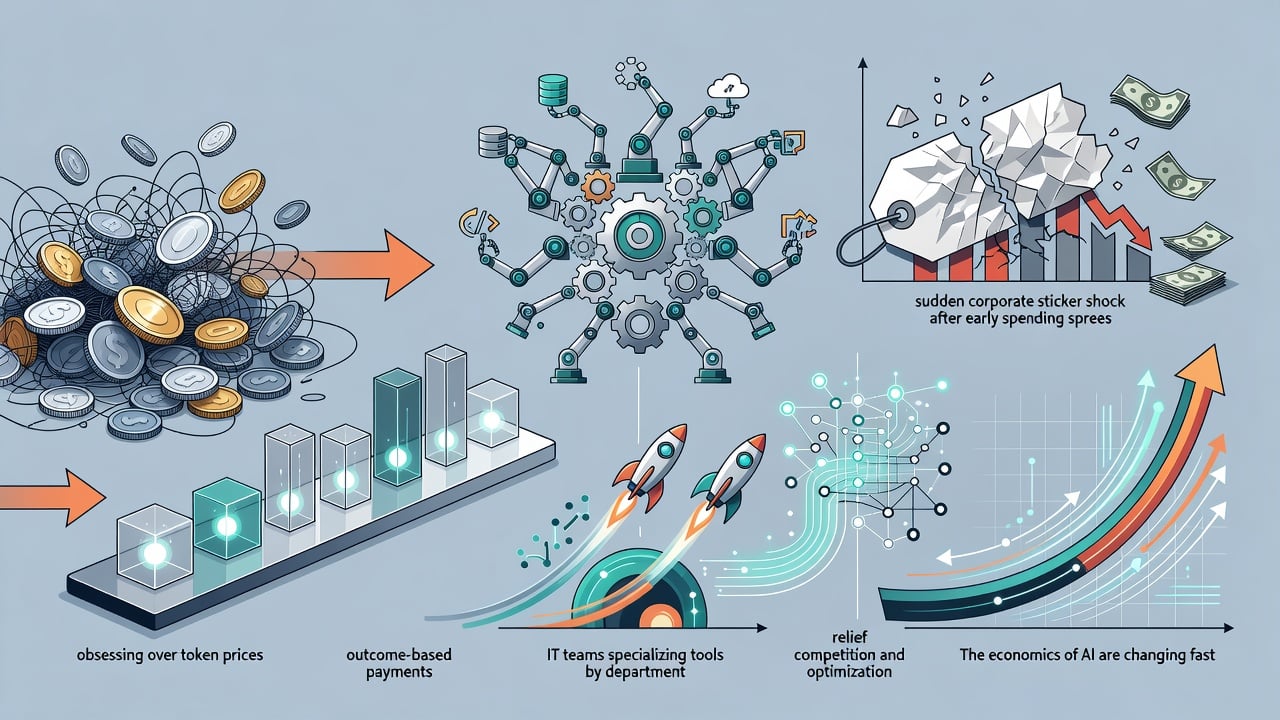
Bret Taylor thinks companies will soon quit obsessing over AI token prices. The OpenAI chairman laid out that view in a recent CNBC appearance. He expects IT departments to master the details within a year. Departments will pick specialized tools. Marketing gets one setup. Software engineers get another. The word “token” fades from conversation.
Pay for results instead. That marks the change Taylor described. “I believe where the world is going is paying for outcomes,” he said, according to a Business Insider report. The prediction comes as corporate AI spending hits walls. Executives report burning through full-year budgets in the first quarter. Sam Altman noticed the sudden shift.
“The issue never came up. People were totally happy with the amount they were spending,” Altman observed earlier this year. Then everything flipped. “All of a sudden [AI costs] are a huge issue.” He quoted the now-common complaint at an enterprise event. “My company spent my entire 2026 budget in Q1, can you make this more efficient?” The remark, reported by Financial Express, captured the mood. Agentic systems multiplied token use five to 30 times. High-volume users pushed past 100 billion tokens a month.
Yet Taylor sees relief ahead. He draws parallels to the early internet. Bandwidth costs once dominated discussion. They receded as the technology matured. AI follows a similar path. “We’re just in the early stages of the technology, and I think it’s a call for entrepreneurs to develop solutions so businesses don’t need to deal with this stuff,” Taylor added in the same interview. Tools already emerge. Ramp built spend trackers for tokens. Harvey created legal-specific AI that abstracts away the metering.
Competition accelerates the trend. Cheaper models match performance. Moonshot’s Kimi K3 rivals top systems at lower cost. Taylor remains cautious. “‘Is it cheaper to use’ is the most important part for anyone considering it. And I think the jury’s out on that.” Still, the direction feels clear. OpenAI itself faces margin pressure. Executives there have discussed launching a price war against Anthropic, per a Futurism article citing Wall Street Journal reporting. Altman has pledged to make models “great and affordable” so users “never worry about it.” More data centers should drive costs down.
Current pricing shows the stakes. Flagship models charge $5 to $30 per million input tokens. Output runs higher. Smaller variants drop to fractions of a cent. Yet at enterprise scale the numbers add up fast. A single chatbot deployment can rack up hundreds of thousands of dollars monthly. CEOs warn that expenses must fall 90 percent for sustainable large-scale use. YouTube analysts and industry voices echo the alarm. One recent video highlighted Uber as an example of sticker shock hitting hard.
But the market responds. Startups race to optimize. Caching, prompt compression, model routing, all cut token burn. Open-source alternatives gain traction. Meta, Google, xAI, and Chinese labs price “barrels of intelligence” at $1 or less. The gap with premium offerings shrinks. Chamath Palihapitiya framed it bluntly on a recent podcast. One million tokens equal one barrel. Prices range from 50 cents to $56 depending on the seller. The capability delta narrows each month. Pricing must adjust.
Taylor’s vision goes further. He predicts specialized industrial applications. No single model rules every task. IT teams will orchestrate portfolios. One system for creative work. Another for code generation. A third for data analysis. Abstraction layers hide the underlying economics. Developers never see the token meter. Business leaders buy guaranteed outcomes. Accuracy targets. Speed commitments. Cost per task. The unit of account changes.
Skeptics point to OpenAI’s own trajectory. The company projects massive cash burn. $25 billion this year. More next. Revenue climbs but losses mount. Some analysts warn of a bubble. Ed Zitron called it an “OpenAI bubble” that could trigger a Lehman-like moment across infrastructure and tech stocks. Others note Microsoft diversifying inference options. Adding models like Kimi to Azure. Reducing reliance on any single provider.
Recent X discussions reflect the tension. Posts from July 20 show real-time debate. One highlighted Fireworks AI processing 40 trillion tokens daily. Another noted commoditization. “OpenAI’s product is becoming commoditized. They will never have pricing power.” As inference costs fall, so must prices. Competition from Anthropic, Meta, and others intensifies. Chinese models at 50 cents per million tokens reset expectations.
Still, adoption continues. Enterprises integrate AI into core workflows. The efficiency gains justify expense for now. But the honeymoon ends. Boards demand ROI proof. Finance teams scrutinize bills. That pressure spurs innovation. New architectures. Better orchestration. Hardware advances that slash compute needs.
Taylor believes the next 12 months bring sophistication. Companies master the industrial use of AI. They stop counting tokens. They measure business impact. Did the campaign generate more leads? Did the code ship faster with fewer bugs? Those become the metrics. Pricing models evolve to match. Subscription tiers based on value delivered. Not volume consumed.
The shift carries risks. Vendors may underprice to win deals. Quality suffers. Or they overpromise outcomes they cannot guarantee. Buyers grow wary. Clear benchmarks matter. Independent evaluation gains importance. Yet the trajectory seems set. Early internet companies once charged by the megabyte. That practice sounds quaint today. AI token pricing may follow the same fate.
OpenAI positions itself at the center. Altman talks of personal agents and superapps. The company reorganizes around enterprise needs. Coding tools. Agent bundles. Higher revenue before any public listing. Success depends on delivering efficiency alongside capability. If costs do not fall, enthusiasm wanes. If they do, the market explodes.
Taylor’s optimism rests on entrepreneurship. New solutions will appear because the pain is real. Startups already attack the problem from every angle. Some focus on monitoring. Others on automatic optimization. A few build entirely new inference stacks. The collective effort should yield progress. Fast.
By this time next year the conversation may sound different. Executives will ask about outcomes achieved. Not tokens spent. Departments will run AI like they run electricity. Always on. Metered invisibly. Priced for value. The technology becomes infrastructure. Background. Essential. And no longer a line item that keeps CFOs up at night.
That future isn’t guaranteed. Execution matters. Competition must stay fierce. Innovation cannot stall. But the signals point forward. From Taylor’s CNBC comments to Altman’s event remarks to the frantic activity on X and in boardrooms. Companies spent the budget early. Now they hunt for ways to stretch the next one. And the industry races to help them. So they stop worrying. And start winning with AI.


 WebProNews is an iEntry Publication