
General Motors has spent years pouring resources into electric vehicles. Billions in investments. New battery plants. A full lineup of models from the Chevrolet Equinox EV to the Cadillac Lyriq. Yet profits have stayed elusive. Slowing demand, policy shifts and high costs forced a reckoning.
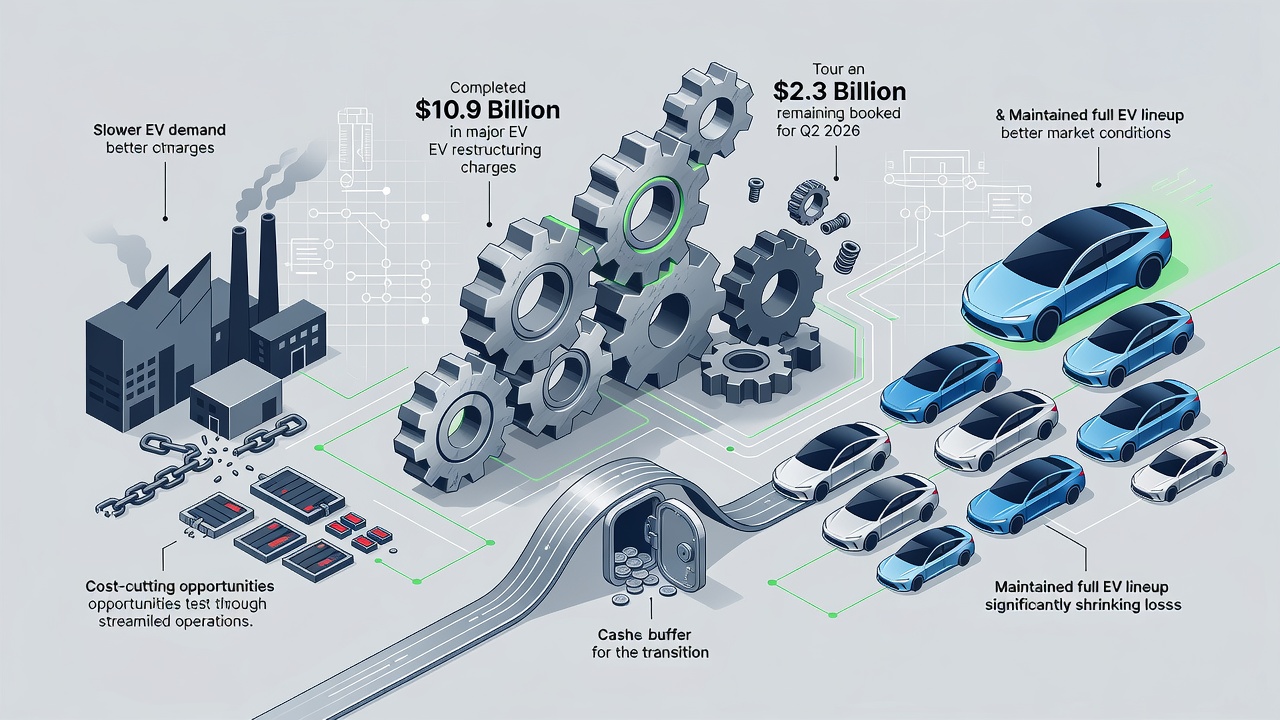
Now the company’s finance chief says the painful part draws to a close. Paul Jacobson, GM’s chief financial officer, has signaled that major restructuring charges tied to the EV business will largely wrap up soon. The automaker took $2.3 billion in incremental charges in the second quarter alone. That brought the total EV-related charges since the second half of 2025 to $10.9 billion. But Jacobson believes the heavy lifting is done.
“I’m proud to say that we believe these actions substantially complete the material cash charges we expect to incur as we align our EV capacity and manufacturing footprint with the changes in regulatory policy,” he told analysts after earnings. “While circumstances may change in the future, and we may have some true-ups, it’s important to get this work behind us.”
The statement comes from a Yahoo Finance report drawing on the latest earnings transcript. It marks a shift in tone. For months GM has absorbed write-downs and adjusted production. In late 2025 the company recorded roughly $6 billion in EV-related charges for the fourth quarter as it scaled back output and resized its footprint. Of that, $4.2 billion represented cash outlays for canceled contracts and supplier settlements.
Jacobson laid out the timeline clearly in March at Bank of America’s Global Automotive Summit. “We are working very aggressively to get that behind us,” he said of the 2026 cash headwind. “My goal would be to have all of this behind us by the end of the second quarter.” The CFO Dive article captured those remarks in detail.
Slower EV adoption has actually helped. Jacobson called the lower growth rate an opportunity. It gives GM time to pull more costs from the system. Fewer competitors chasing subsidized sales means the market can settle at a level that matches real buyer interest. “Fewer competitors leaves a really interesting market for us to grow into,” he told the Detroit Free Press.
Loss of federal tax credits under the current administration? Jacobson views it as a blessing in disguise. The previous incentives had distorted demand. They encouraged discounting and overproduction. Without them the industry can focus on vehicles customers actually want at prices that cover costs. GM still plans no reduction in its EV model count. The goal remains long-term dominance. “Electric vehicles are going to win in the end… but it’s going to take some time.”
Improved cash flow gives the company breathing room. GM’s balance sheet stands strong. That strength lets executives accept short-term EV losses while they fix the economics. “We have improved our cash flow and we have a lot of cash on hand, so we can tolerate some short-term losses,” Jacobson said in early 2026 at a Federal Reserve Bank of Chicago event. The Automotive News report highlighted those comments.
Battery costs represent the biggest lever. GM aims to cut fixed costs per vehicle by thousands of dollars. One tactic involves switching to lithium manganese-rich chemistries. These formulations promise lower expense without sacrificing range or performance. The company has also restructured its battery supply arrangements. It sold a stake in a joint venture plant to partner LG Energy Solution in late 2024. Such moves trim capital commitments and reduce exposure.
Production discipline has sharpened too. GM idled certain EV lines and adjusted output to match demand. Chevrolet still posted strong sales growth in some months even as overall EV registrations fell sharply. Industry-wide new EV sales dropped 26.8 percent year-over-year in February 2026, according to Cox Automotive data cited in the CFO Dive coverage. GM’s own EV deliveries reached 189,000 units in 2024, below initial forecasts. Yet the company reported its EV business turned variable-profit positive in early 2025.
Analysts and investors have taken notice. GM raised its full-year guidance twice in 2025 despite the charges. Shares reacted positively after recent results even as net income fell on the write-downs. Jacobson has described the stock as inexpensive on forward earnings. The message is clear: the EV drag is shrinking.
Tariffs add another layer of complexity. GM paid $3.1 billion in tariffs in 2025. The broader industry has shouldered more than $35 billion since 2025. Yet the company mitigated over 40 percent of its exposure through resilient operations and adjusted free cash flow. Jacobson called 2025 a setup year. The administration, he noted, recognized autos as vital and carved a narrow path on trade policy. Tariffs act as a speed bump rather than a roadblock.
Looking ahead, GM expects EV losses to shrink by at least $2 billion in 2025 from prior levels. Some projections put the improvement as high as $4 billion. The combination of lower fixed costs, better battery economics and disciplined capacity should drive progress. Jacobson has consistently said the company remains committed to EVs as the long-term direction. The recent restructuring simply puts the business on sustainable footing.
Other automakers face similar pressures. Ford has booked large losses on its electric models. Honda has announced major EV-related charges. The entire sector is recalibrating after years of rapid expansion fueled by subsidies and low interest rates. Higher borrowing costs and inflation changed buyer behavior. Many consumers still prefer hybrids or conventional vehicles. GM’s broad portfolio across ICE, hybrid and pure EV gives it flexibility that some rivals lack.
The CFO’s latest comments suggest a turning point. The big cash outflows tied to restructuring should end by mid-2026. That frees up capital for further investment in software-defined vehicles, OnStar subscriptions and next-generation battery technology. GM plans to introduce new architectures in 2028 that promise additional cost savings and performance gains.
Challenges remain. Global competition, especially from Chinese manufacturers, continues to intensify. Raw material prices can swing. Consumer acceptance of EVs still depends on charging infrastructure and total ownership costs. Yet Jacobson’s tone has grown more confident. The company has the financial cushion. It has adjusted its footprint. And it sees a clearer path to profitability.
Recent coverage reinforces the momentum. A July 2026 CFO Dive update reiterated that restructuring efforts near completion. Earnings reports show GM beating revenue and EPS targets while lifting guidance again. The market appears to believe the worst is past.
Jacobson has avoided bold promises. He speaks in measured terms about timelines and potential true-ups. That realism resonates with investors who remember past cycles of hype and disappointment in the auto sector. The focus stays on execution. Get costs down. Match production to demand. Build on the cash flow strength. Then let the product portfolio do the rest.
GM’s story is no longer one of unchecked EV ambition. It has become a case study in adaptation. The CFO has played a central role in communicating that evolution. As the second quarter of 2026 closes, his stated goal of putting the restructuring work behind the company looks increasingly achievable. What comes next will test whether those efforts translate into sustained profits. For now the foundation appears steadier than it has in years.


 WebProNews is an iEntry Publication