
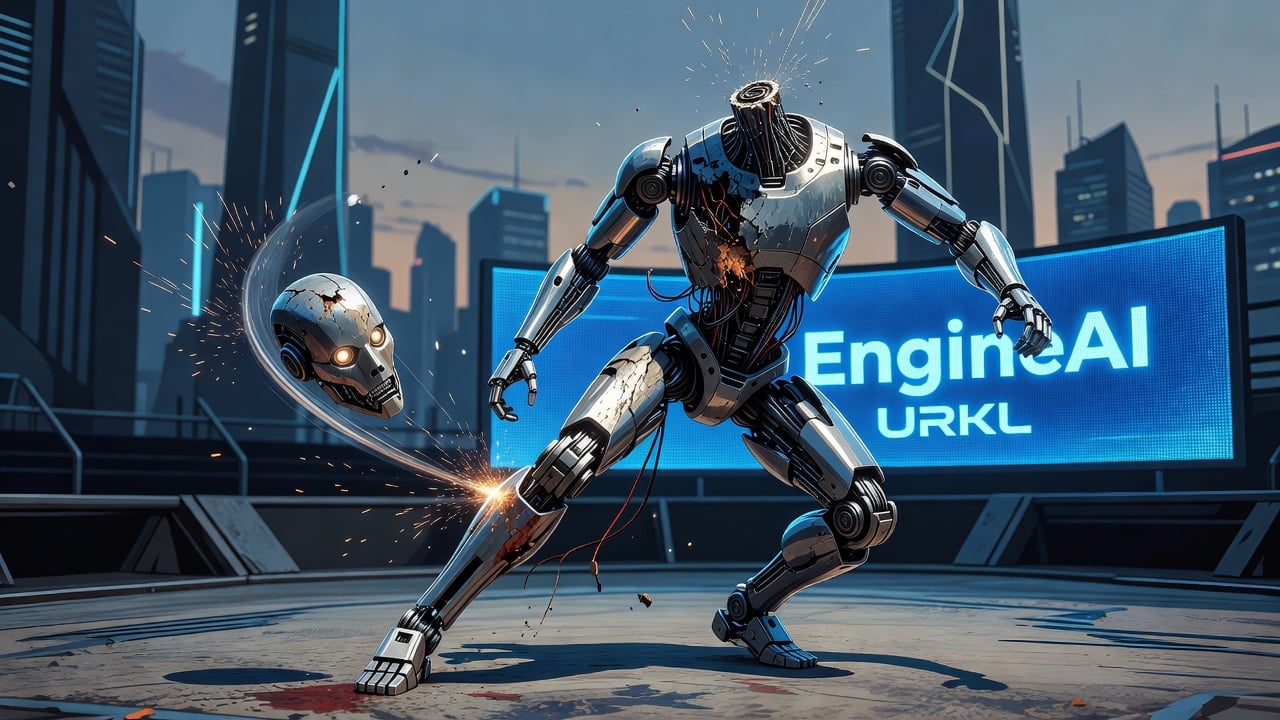
Shenzhen’s Nanshan Cultural and Sports Center pulsed with anticipation last week. Two humanoid robots stepped into an octagon-style cage. One delivered a spinning high kick. The other’s head flew loose. Yet the fight did not stop. The headless machine kept swinging. Spectators, including martial-arts star Donnie Yen, watched in disbelief.
This was no movie set. It marked the debut of the Ultimate Robot Knock-out Legend, or URKL, organized by Chinese robotics firm EngineAI. Billed as the world’s first full-scale humanoid robot fighting competition, the event featured 32 teams from across the globe. All competitors piloted the same standardized platform: the company’s T800 android, priced at roughly $50,000 per unit.
The white robot known as White Eagle faced off against its black-clad rival Matador. White Eagle landed a precise kick that severed Matador’s head. According to TechRadar, the damaged machine continued throwing punches through torso-based core systems after losing its head-mounted sensors. The sequence underscored durability under sustained impact.
But the bout revealed far more than shock value. EngineAI designed the T800 to handle uppercuts, spinning kicks and rapid recoveries after falls. Standing 1.73 meters tall, each unit boasts strong posture control, dynamic perception and shock-absorbing joints built for combat stress. Judges scored matches on effective strikes, body stability, defensive maneuvers, evasion and overall resilience. Victory required more than raw power.
Founder and CEO Zhao Tongyang laid out the company’s ambition. “We want to use competition to drive research and industry development,” he said. “Let the event feed back into technology, and let technology drive the industry.” His words echo a deliberate strategy. Push machines to their limits in public. Gather performance data. Feed insights back into design cycles. So far the approach appears to be working.
Recent coverage adds context to the spectacle. A VnExpress International report from three days ago describes how the opening bout unfolded at the Shenzhen venue on July 17, 2026. The white robot’s flying kick tore the opponent’s head clean off. The damaged unit pressed forward, throwing strikes until it finally toppled. Organizers called it a demonstration of resilience rather than failure.
Newsweek, referenced within Common Dreams coverage published this week, detailed the moment further. “One brutal kick sent the robot’s head hanging loose.” White Eagle’s strike left Matador’s head swinging from its socket before it rolled free. The black robot kept sparring until its body crashed down, crushing the detached component underneath. The footage spread rapidly across social platforms.
Yen, known for his roles in action films, attended the opening ceremony. “Honestly, I used to see robot fighting only in science fiction movies. But today, for the first time, I got to watch real robots fighting up close,” he remarked. His presence lent Hollywood gloss to an event rooted in engineering rigor. And the contrast felt deliberate. Fiction met prototype in real time.
EngineAI rolled out the T800 in December 2025 as a combat-ready platform. The firm positioned it for controlled fighting scenarios that could accelerate broader humanoid development. Each robot in the tournament underwent rigorous pre-event testing for stability and responsiveness. Standardization ensured the contest tested software, control algorithms and mechanical toughness instead of hardware disparity.
Yet the decapitation moment also exposed vulnerabilities. Head-mounted sensors provide vision and balance data. Their sudden loss forces reliance on secondary systems. That the T800 adapted and continued fighting speaks to redundant design. It also hints at future safety questions should similar machines operate outside controlled arenas.
Public reaction mixed excitement with unease. Clips circulated on X and Instagram showing the kick, the detachment, the continued flailing. Some users compared the scenes to Real Steel or Terminator films. Others raised concerns about normalizing combat robotics. Common Dreams framed the event against growing international warnings over lethal autonomous weapons. The timing felt pointed. One day experts caution against killer robots. The next, a crowd cheers as one android beheads another.
Still, Zhao’s vision extends beyond entertainment. Real-world data from these bouts could refine balance algorithms, impact absorption and decision-making under duress. Similar competitions have emerged at smaller scales. Unitree has staged controlled fights with its G1 model. Yet URKL stands apart as the first major league using full-sized, commercially priced humanoids in MMA-style formats.
Analysts watching the sector note rapid progress across the board. Boston Dynamics’ Atlas, Figure 03, Agility Robotics’ Digit and Apptronik’s Apollo all demonstrate increasing dexterity and deployment in warehouses or factories. Combat testing adds another data dimension. Physical confrontations expose weaknesses that lab simulations miss. A high kick that dislodges a head. A torso that keeps operating without visual input. Each failure becomes a lesson.
The tournament format itself rewards more than brute force. Points accumulate across categories. A robot that dodges effectively may outscore one that lands heavy blows but topples easily. This structure mirrors human MMA judging. It also pushes developers to balance aggression with self-preservation routines. Early footage shows combinations, feints and recovery maneuvers that look eerily lifelike.
EngineAI plans to expand the league. Future events may incorporate varied robot designs once the core technology matures. For now the standardized T800 creates a level playing field. It also lets the company collect uniform telemetry across all matches. That data trove could prove more valuable than any single winner’s trophy.
Critics worry such spectacles distract from practical applications. Humanoid robots could transform logistics, elder care or hazardous environments. Staging gladiatorial contests risks framing them as novelties or worse, weapons. Yet proponents counter that public engagement accelerates investment and talent recruitment. Yen’s amazement suggests the emotional pull works.
Technical achievements hide in the details. The T800’s shock-absorbing joints dissipate force from direct hits. Its dynamic perception system adjusts stance in milliseconds. When the head detached, internal processors switched to alternative balance cues. The machine did not freeze. It adapted. That behavior points to sophisticated redundancy rarely seen outside research labs.
Global interest spiked immediately. YouTube channels and TikTok accounts reposted fight highlights within hours. One clip from TMZ captured the moment the head detached and the crowd’s reaction. Another Instagram reel focused on the headless robot’s continued punches. Views climbed into the hundreds of thousands. The spectacle sells itself.
EngineAI has not released full telemetry from the event. Observers expect deeper analysis in coming weeks. How much damage did the kick actually inflict? What sensor fusion allowed continued operation? Answers could shape next-generation designs. They might also influence regulatory conversations about combat robotics.
For now the image lingers. A white android poised after its decisive strike. A black one staggering, head swinging by residual connections before it drops. The referee’s signal. The roar from the stands. Science fiction no longer feels distant. It unfolded under arena lights in Shenzhen last Thursday.
And the machines keep improving. What looked impossible a year ago now plays out in highlight reels. A $50,000 robot that loses its head yet refuses to quit. The implications stretch beyond sport. They touch on autonomy, resilience and the boundary between tool and performer. URKL has only begun to test those lines.


 WebProNews is an iEntry Publication