
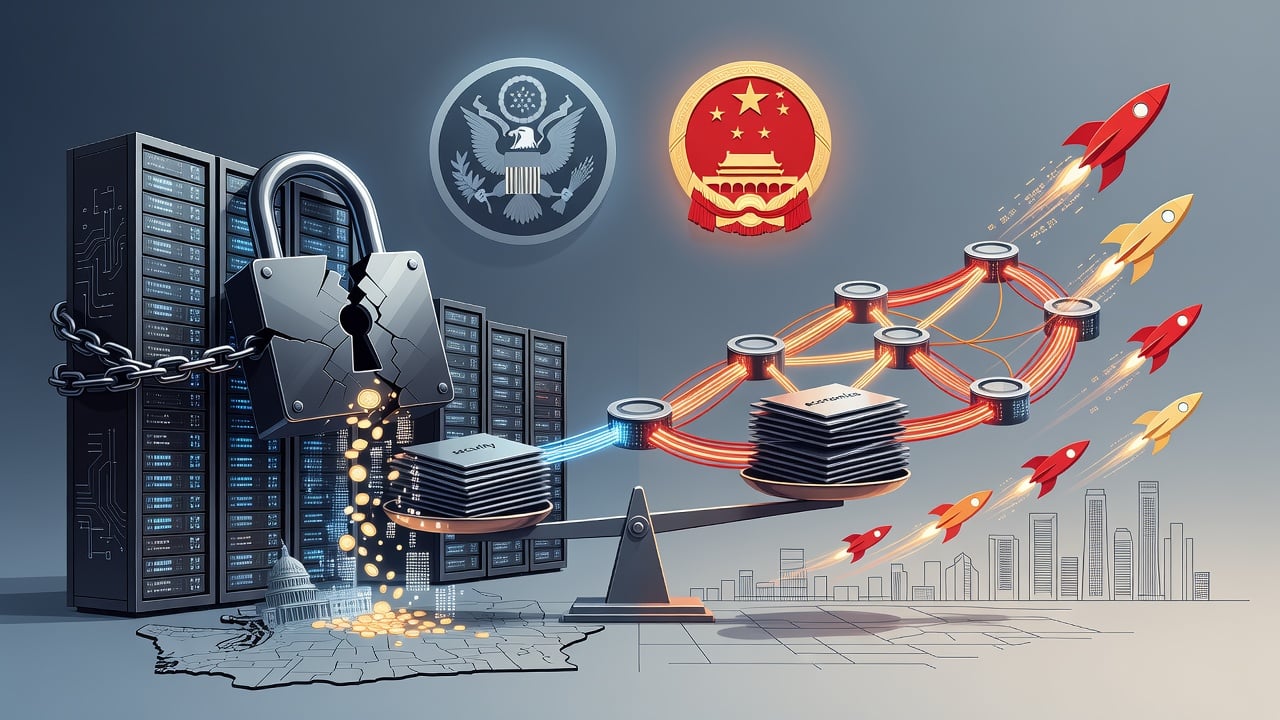
Larry Ellison had a rough one. The Oracle co-founder watched as Chinese labs unleashed models that undercut American pricing power and challenged long-held assumptions about technological superiority. Yet the bigger story stretches far beyond one executive’s frustration. It centers on a fierce debate gripping Washington and Silicon Valley alike: whether open-weight AI from China represents an economic lifeline or a strategic trap.
Releases like Zhipu’s GLM 5.2 and Moonshot’s Kimi K3 have rattled investors and policymakers. These systems deliver performance within striking distance of top U.S. frontier models. They do so at a fraction of the cost. Enterprises now face real choices. Self-host on local hardware. Avoid recurring API fees. Keep data under tighter control. Short sentences capture the shift. Long ones reveal the stakes.
The Information captured the moment in real time. Its briefing highlighted Ellison’s discomfort and the Trump administration’s protectionist instincts. Tariffs come easy. Banning affordable Chinese models could drive up costs for U.S. businesses. That tension defines the current moment. But does it solve the underlying competition?
Events accelerated in June 2026. The Commerce Department pulled global access to Anthropic’s Fable 5 and Mythos 5 models over cyber-risk worries. The shutdown lasted 18 days. One day after it began, Zhipu dropped GLM 5.2. The timing proved exquisite. Zhipu’s founder took to X to lament the “sudden restriction of certain frontier models.” Users noticed. Adoption of the Chinese alternative spiked. And the pattern repeated.
GLM 5.2, a 744-billion-parameter mixture-of-experts model with 40 billion active parameters and a 1-million-token context window, carries an MIT license. It ranks first among open-weight systems on key indexes. It beats GPT-5.5 on SWE-bench Pro. It approaches Claude Opus 4.8 on FrontierSWE benchmarks. All at roughly one-sixth the cost. Facts like these fuel the debate. They also expose policy contradictions.
Policy Backfire Creates Unexpected Openings
Restrictions meant to safeguard American leadership instead handed market share to Beijing-backed labs. The R Street Institute laid out the dynamic in early July. Author Mark Dalton argued that fear of open-source AI has become self-defeating. “Openness is how adversaries can advance their capabilities on the cheap,” he wrote, describing the prevailing view. Yet the piece flips the script. U.S. openness built Linux and Apache. Those precedents suggest innovation flows from transparency, not gates.
Beijing appears ready to restrict overseas access to its most advanced models, according to Reuters reporting from July 7. If that window closes, both sides lose. American developers forfeit cheap, capable tools. Chinese labs face the same innovation drag that restrictions impose here. The symmetry feels uncomfortable.
DeepSeek’s R1 release in January 2025 delivered the first strategic shock. Subsequent models from Alibaba’s Qwen, Moonshot’s Kimi, and others reinforced the trend. They run on domestic chips when necessary. They adapt through fine-tuning. Enterprises love the flexibility. Microsoft has tested Kimi K3 internally for Copilot workloads, according to recent X discussions. Savings could reach $600 million per billion dollars in AI spend. Numbers that large change boardroom calculations fast.
But security experts raise alarms. Open weights invite supply-chain risks. Poisoned training data. Hidden backdoors. Political bias baked in during pre-training. The Resilient Cyber analysis from July 8 pulls no punches. “The gap has closed, and the debate has stopped being academic,” it states. “It is now a live architectural decision that CISOs, security engineers, and platform teams are making right now.”
The Mythos episode drove the point home. Anthropic’s closed models reportedly enabled AI-orchestrated cyber espionage. Operators caught the activity precisely because it ran on monitored infrastructure. Open models remove that visibility. Attackers migrate to ungoverned environments. Defenders lose patching insights and continuity. “Gating the frontier does very little to gate the capability,” the piece observes. You cannot un-release a model once weights circulate.
Yet bias concerns cut both ways. Former NSA leadership sits on OpenAI’s board. Does that introduce American-style filtering? Queries about sensitive Chinese history rarely surface when using Kimi. The question lingers. Trust becomes relative. Enterprises weigh visibility against convenience. Open models win on the latter. Closed ones promise the former but falter under real-world pressure.
The Economist took a harder line on July 14. Xi Jinping promotes these models as “shared asset for all humanity” and “global AI for good.” Phrases like “those who walk together go far” frame the effort as benevolent. American analysts see something else. A vector for influence. A way to erode U.S. dominance by distributing customizable intelligence to allies and adversaries alike. The trap springs when nations grow dependent on Chinese weights. Customization leads to fragmentation. Standards diverge. Influence accrues to the source.
Recent X chatter reflects the chaos. Startups worry about forced model-agnostic architectures. One founder outlined consequences: higher burn rates, political risk at the model layer, advantages for neutral hubs like Singapore. Another noted Chinese models’ density advantage. The language itself may suit transformer architectures better. Context dependence per character could explain performance gains. Speculation abounds. Data remains thin.
Nvidia released Nemotron open models amid the boom. The move signals recognition that openness drives adoption. Hardware makers want software ecosystems that pull demand. Chinese labs deliver both models and pressure on pricing. Token economics have reversed. Companies now minimize usage. Amazon shuttered a developer leaderboard. Uber capped AI spend per employee. High-volume security analysis becomes expensive under closed APIs. Open alternatives look attractive by comparison.
Policy circles return to the same question. How do we keep China from catching up at the frontier? Hudson Institute contributor Jason Hsu examined the loop in late June. Open-source and open-weight strategies must sit at the center of any American response. Dominance across the full stack matters more than any single model. Huawei silicon or Nvidia GPUs. The choice determines downstream ecosystems. U.S. labs risk ceding that ground if they double down on closed systems.
Proposals vary. Some advocate validation infrastructure over outright bans. Test models for backdoors. Publish results. Let markets decide with better information. Others push entity-list additions for Chinese AI labs. The Trump administration weighs an executive order. Commerce weighs its options. Each path carries trade-offs. Higher costs. Slower innovation. Fragmented global standards.
History offers parallels. Oracle once fought open-source databases. Ellison’s company tried to contain MySQL and PostgreSQL. The market chose flexibility. Developers built around free options. Enterprise sales adapted. The pattern feels familiar. AI may follow software’s path. Or it may diverge because capabilities diffuse differently. Weights travel. Orchestration layers replicate performance. The genie stays out.
Enterprises already experiment. Finance teams run cost models. Security teams audit weights where possible. Developers fine-tune for domain tasks. The data-control argument resonates. No one wants sensitive information leaving the perimeter through third-party APIs. Self-hosted Chinese models solve that problem. Until they introduce new ones.
So the debate continues. Cost savings pull one direction. Security concerns push another. Geopolitical rivalry complicates both. Ellison’s bad day may prove symptomatic. When proprietary giants face pricing pressure from state-supported open alternatives, discomfort follows. American innovation thrived on openness before. Whether it can again, against a competitor that mixes state resources with public weights, will shape technology for the next decade.
Recent reports suggest Beijing’s restrictions could tighten soon. If true, the current window narrows. U.S. firms gain breathing room. Yet they also lose the forcing function that drives efficiency. Innovation under constraint produced these Chinese models in the first place. Remove the pressure, and progress may slow on both sides. The irony accumulates. Short-term protection risks long-term stagnation. Openness carries risks. Closure carries others. Policymakers must choose which set they prefer. Businesses will adapt regardless.


 WebProNews is an iEntry Publication