
Stephen Schwarzman didn’t mince words. On a conference call Thursday, the Blackstone CEO laid out how his firm plans to tackle the growing uproar over data centers powering artificial intelligence. Opposition has hardened. Projects have stalled. And communities from Virginia to Texas have drawn a line.
Blackstone and peers have funneled tens of billions into compute infrastructure. The goal? Fuel power-hungry AI models racing ahead. Yet that push now runs headlong into unified resistance. Democrats and Republicans alike balk at new facilities in their backyards. A June Reuters/Ipsos poll found just 14% of Americans would back one nearby for tech companies.
Communities Push Back Hard
Schwarzman acknowledged the tension. “Major change of this type also creates anxiety due to the uncertainty of how the technology will evolve,” he said. The AI surge, he added, might mirror the industrial revolution’s eventual lift to living standards. But the immediate fallout hits harder. Noise. Water draw. Skyrocketing power bills. Lost green space.
Blackstone-owned QTS Realty Trust felt it firsthand. The firm, acquired for $10 billion in 2021, terminated a massive Virginia project this month. Years of planning. County approvals secured. Then came litigation and fierce local pushback. The Prince William Digital Gateway would have been the world’s largest data center campus. Over 2,100 acres. 22 million square feet. Dozens of buildings. Near the Manassas National Battlefield. Residents mobilized. Courts questioned zoning notices. The county pulled support in April after spending $1.7 million. Compass Datacenters exited earlier. QTS walked away in July. Energy News Beat reported the collapse highlights how legal technicalities, grassroots organizing and infrastructure bottlenecks can derail even well-funded plans.
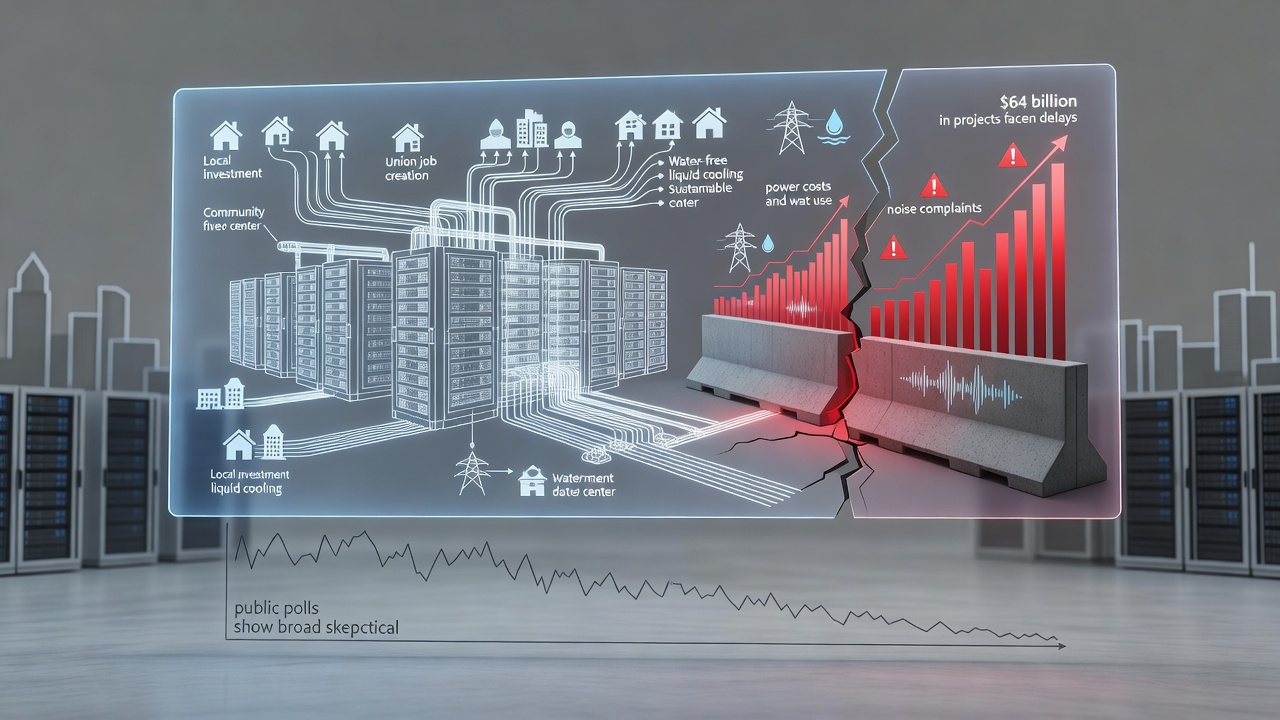
And it’s not isolated. A new report tallies $64 billion in data center projects blocked or delayed nationwide over two years. $18 billion killed outright. Another $46 billion stalled. Common complaints? Higher utility bills. Heavy water consumption. Constant noise from cooling systems. Drops in property values. Pressure on green spaces. At least 142 activist groups across 24 states have organized. More than 23 petitions gathered over 31,000 signatures since 2022. “Opposition to data center construction is largely motivated by local concerns,” the Data Center Watch report states. Virginia sites dominate the list. Prince William’s $24.7 billion delay. Culpeper County’s $12 billion hold. Others in Arizona, Missouri, Indiana and Oregon.
Experts back the worries. Ben Green, assistant professor at the University of Michigan School of Information and Public Policy, didn’t hedge. “I think the public is quite right to be concerned about data centers.” Rising electricity rates. Enormous water use. Tax breaks that drain local revenue. Limited job gains. More than 4,000 centers operate now, concentrated in Virginia, Texas and California. Some 3,000 more are planned or building. One OpenAI-linked project in Michigan eyes 2 million square feet and 1.4 gigawatts. Enough power for a million homes. States have handed out over a billion dollars in breaks in Virginia and Georgia alone. Thirty-five states offer incentives. Data centers could claim 10% to 15% of U.S. electricity demand within years. That strains renewables. Keeps fossil plants online longer. The Harvard Gazette captured Green’s view in April. Concerns aren’t exaggerated. They’re grounded. Many towns have passed moratoriums. Local groups fight what feels like a David versus Goliath battle.
But. Schwarzman insists Blackstone acts. The firm works closely with portfolio companies, including data center operators. “To address the workforce, environmental and community implications of development through the creation of union jobs, workforce training, water-free cooling systems, expanded power generation and significant local economic investment,” he explained. No vague promises. Concrete steps. Training programs. Union labor. Cooling tech that skips water entirely. New power capacity. Dollars flowing back into towns.
So the firm isn’t retreating. It sold other Virginia assets for $3.5 billion earlier. Keeps a vast portfolio. Pours capital into Pennsylvania, Japan and partnerships like one with Google. The AI race against China demands it. President Donald Trump’s administration frames the technology push that way too. Yet it also aims to protect households from energy price spikes. Schwarzman, a longtime Trump donor, has logged hours with industry figures and policymakers. The focus? Balance. Advance U.S. leadership. Mitigate the downsides.
Recent protests underscore the stakes. Opponents held 142 actions across 42 states in one coordinated Saturday in July. X posts buzzed with frustration. One from @HighWireTalk noted a Utah senator’s primary loss after supporting data centers. Teachers asked to dim lights to save power. Neighborhoods enduring 24/7 industrial hum. “When politicians who greenlight these projects start losing their jobs over it, that’s a message,” the post read. Another from @MorePerfectUS celebrated the Prince William win. “Fierce opposition and organizing from residents of Prince William County ultimately beat out Blackstone.”
Power demands dominate complaints. A Senate letter to private equity firms, including Blackstone, raised alarms in June. It questioned ownership of data centers, power plants and related assets. “While American customers see their utility bills skyrocket, private equity firms want to have their cake and eat it too,” the Senate Banking Committee document stated. Blackstone controls significant load in Virginia. It bought the Potomac Energy Center plant. Critics see vertical integration that profits at both ends while rates climb for everyone else.
Still, the economic pitch persists. Jobs. Investment. Tax base growth. Schwarzman points to those outcomes. Training builds local skills. Union roles offer stability. Expanded generation eases grid strain. Water-free systems cut resource use. Yet skeptics counter that many centers deliver few permanent positions relative to their footprint. Tax abatements erode benefits. And the anxiety Schwarzman mentioned runs deep. Uncertainty about AI’s path. Fear of becoming collateral in a tech arms race.
Recent coverage shows the pushback gaining traction. A Gallup poll from March found 71% oppose AI data centers locally. Forty-eight percent strongly so. Pew Research echoed the negativity. Communities organize faster now. Moratoriums spread. Litigation succeeds more often. The QTS termination in Virginia sends a signal. Even approved projects aren’t safe. Years of effort. Millions spent. Then reversal.
Blackstone’s approach mixes engagement and adaptation. Schwarzman spends time in rooms with leaders who shape policy. The firm tweaks designs. Pushes partners toward sustainable tech. Invests in workforce pipelines. Whether that sways skeptics remains open. The divide feels stark. On one side, hyperscalers and investors chasing exponential compute growth. On the other, residents guarding quality of life, affordable power and local control.
And the tension won’t fade soon. AI models grow more demanding. Hyperscalers order capacity years out. Private capital fills the gap. But building the physical plants? That happens in someone’s community. The next fights loom in remaining Virginia counties, Texas suburbs and beyond. Blackstone says it listens. It acts. The question is whether its measures match the scale of unease. Polls suggest many aren’t convinced yet. Projects keep facing delays. Cancellations mount. The AI boom meets its earthly limits.


 WebProNews is an iEntry Publication