
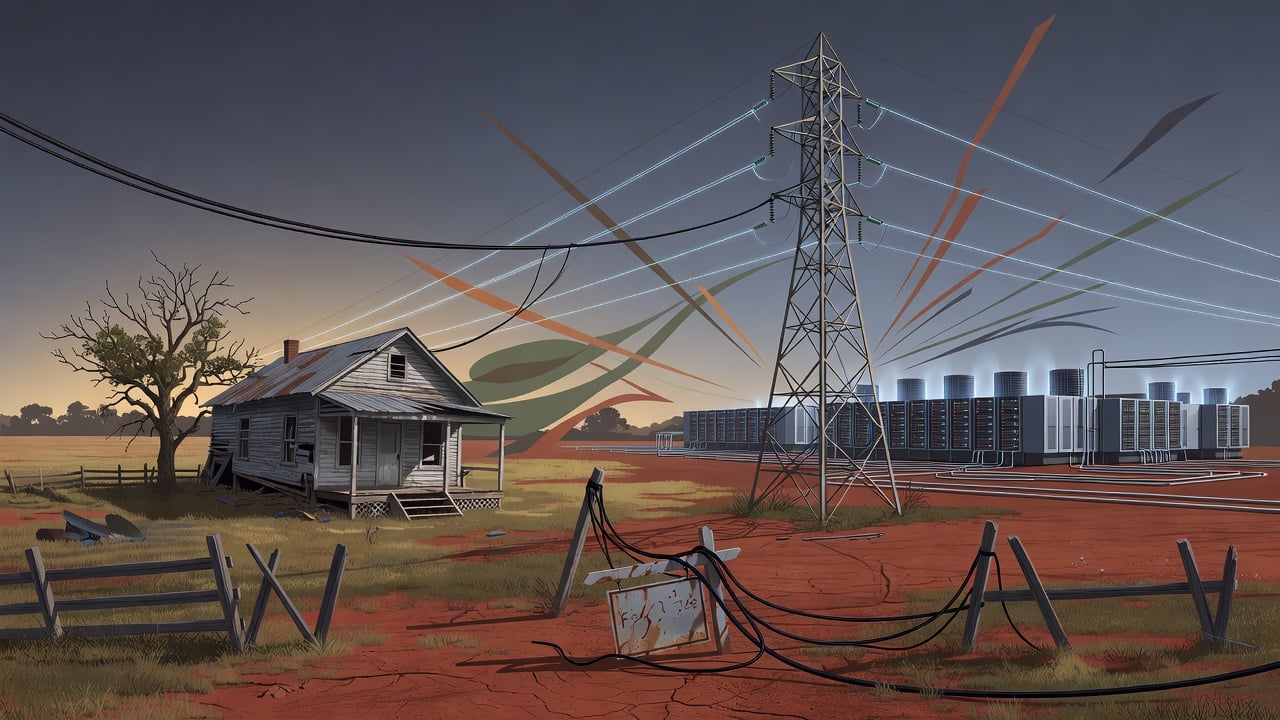
In the rolling hills of Coweta County, Georgia, a family home stands no more. Not because of flood or fire. But because a utility giant needed the land to feed electricity to the insatiable appetite of artificial intelligence.
The Browns didn’t want to sell. They fought the idea for a year. Yet in the end, they signed the papers. Georgia Power, a subsidiary of Southern Company, made an offer. The alternative was seizure through eminent domain. So the family chose the path that at least gave them some control. Some money. But not peace.
“It’s us,” Ansley Brown told CBS News. “It’s our family. We belong here.” Her mother had bought the property in 2003. She built it as generational wealth. Now that dream lies stripped away.
The reason hits hard. Georgia Power plans a new 35-mile transmission line. It will carry power to a surging load. Company officials say 70 to 80 percent of that electricity will serve data centers. The rest goes to homes and businesses. Those data centers don’t just hum along. They devour megawatts at a scale once reserved for small cities. And the boom comes from one source above all. AI.
But this isn’t an isolated tale. Across the United States, similar stories unfold. Data centers sprout in rural fields and former industrial parks. They promise jobs and tax revenue. They deliver noise like jet engines, heat that bakes nearby homes, and power draws that force schools to cut back. One Pennsylvania community watched its character change almost overnight, according to reports that echo the Georgia experience.
The Browns’ case gained attention after Ansley took their fight to TikTok. Videos captured raw emotion. Neighbors shared parallel struggles. One post from a congressional candidate in northwest Georgia noted the project sits close by. Up to 80 percent of the new line’s capacity heads toward data operations. The family wasn’t alone. More than 300 parcels of land fall in the path. Some owners will lose only easements. Others, like the Browns, face total loss. Roughly 20 to 30 homes may be demolished.
“To us it’s theft,” Brown’s mother said in the CBS News report. “It’s literally a billion-dollar company stealing land from smaller people, people who can’t fight back. We don’t have the money to fight Georgia Power.” The words carry weight. They reflect a power imbalance felt in many communities where tech’s growth meets local limits.
Georgia Power pushes back. Spokeswoman Holly Lovett called eminent domain a last resort. The company claims it negotiated in good faith. It worked to stay transparent. It aimed to ease the process. “We have worked hard to be transparent, negotiate in good faith and make the process as easy as possible,” officials told CBS. Yet the Browns want more than process. They want an apology. “My mom wants an apology,” Ansley said. “For an entire year, they have bullied her and there is no sorry.”
The broader picture reveals why this tension keeps rising. Electricity demand from data centers has accelerated faster than forecasts. A few years ago, analysts predicted steady growth. Now projections show data centers could consume 8 percent or more of U.S. power by 2030. Some regions already see spikes. In Virginia’s data center alley, utilities scramble to add capacity. In Georgia, the same forces press forward. Southern Company, Georgia Power’s parent, has acknowledged the surge in recent earnings calls and regulatory filings. The utility doesn’t name specific customers for security reasons. But the link to AI training and inference clusters is clear.
And recent coverage adds fresh urgency. A June report from GPB News detailed pink surveyors’ tape marking easements across Coweta County for a 500-kilovolt line. Residents there asked the same question the Browns pose. Who is this for? One homeowner suspected data centers above all. The utility said load growth includes manufacturing and residences too. But the percentages tell a story. Data centers dominate the new demand.
Energy News Beat explored the issue in May. Its article outlined how Project Sail, a proposed hyperscale data center campus spanning 829 acres in the area, ties directly to the infrastructure push. Facebook groups and local discussions buzz with concern over hundreds of miles of lines and rights-of-way. Not every taking destroys a house. Many carve strips through farms or woodlands. The cumulative effect still reshapes communities.
11Alive, the local Atlanta station, covered the Browns’ dispute back in May. It reported the company undervalued the home in initial offers. The piece noted the project links to a major data center in neighboring Fayette County. Officials reiterated that the Ashley-Park Wansley line addresses overall growth. Yet the human cost lingers. “You can’t tear down 35 miles of rural Georgia and it not hurt something or somebody,” Brown’s mother told CBS. “And to say that you’re doing it in the name of data centers is a slap in the face to us, our community, our animals.”
Critics argue the system favors big players. Tech firms sign massive power purchase agreements. Utilities earn returns on new infrastructure. Landowners receive compensation. But that payment rarely matches sentimental value or long-term loss. Eminent domain exists for public use. Courts have broadened the definition over decades. Economic development counts. So does grid reliability. Still, when the public benefit flows mainly to private data centers owned by trillion-dollar corporations, questions arise. Is this truly public purpose?
Ansley Brown knows the fight for her home has ended. She sold. The deal is done. Her goal now shifts. She hopes to spare others the same pain. Her videos highlight similar cases. They urge residents to speak up early. They warn that quiet acceptance leads to lost ground. Literal ground.
The AI race shows no signs of slowing. Models grow larger. Training runs demand more compute. Inference at scale adds steady load. Hyperscalers plan dozens of new facilities. Each one needs reliable, high-capacity power. Transmission lines form the arteries. Without them, the centers sit dark. So utilities act. They file for permits. They survey routes. They approach owners. And sometimes, they take.
Georgia isn’t unique. Similar battles play out in Virginia, Illinois, and the Midwest. A family in Pennsylvania saw its quiet town transform into a data center hub. Schools there rationed power during peaks. Residents complained of constant roar. Heat from the facilities raised local temperatures. The pattern repeats. Rural areas absorb the infrastructure. Urban centers and cloud users reap the benefits.
Regulators face tough choices. They balance reliability against cost. They weigh environmental impact against economic gain. Some states offer tax breaks to attract data centers. Others tighten rules on water use and noise. Few address the land-use conflicts head-on. Eminent domain remains a blunt tool. It works. It also wounds.
The Browns’ mother sought simple recognition. An apology. Acknowledgment that the process caused real grief. Georgia Power offered none in public statements. It pointed to its efforts at fairness. The gap between corporate language and personal loss feels wide. One side sees progress. The other sees theft.
So the transmission line will rise. Towers will march across former pastures. Power will flow. Servers will spin. AI models will train on ever-larger datasets. And somewhere in Coweta County, a family will remember the home they once held. The one that carried their history. Until the grid claimed it.
That tension defines this moment. Tech’s hunger for energy collides with communities’ attachment to place. Resolutions won’t come easy. More lines will be built. More deals will close. Yet each case like the Browns’ adds a human face to the abstract charts of rising demand. It forces a harder look at the trade-offs. At who pays. And at what price society accepts for the next leap in machine intelligence.


 WebProNews is an iEntry Publication