
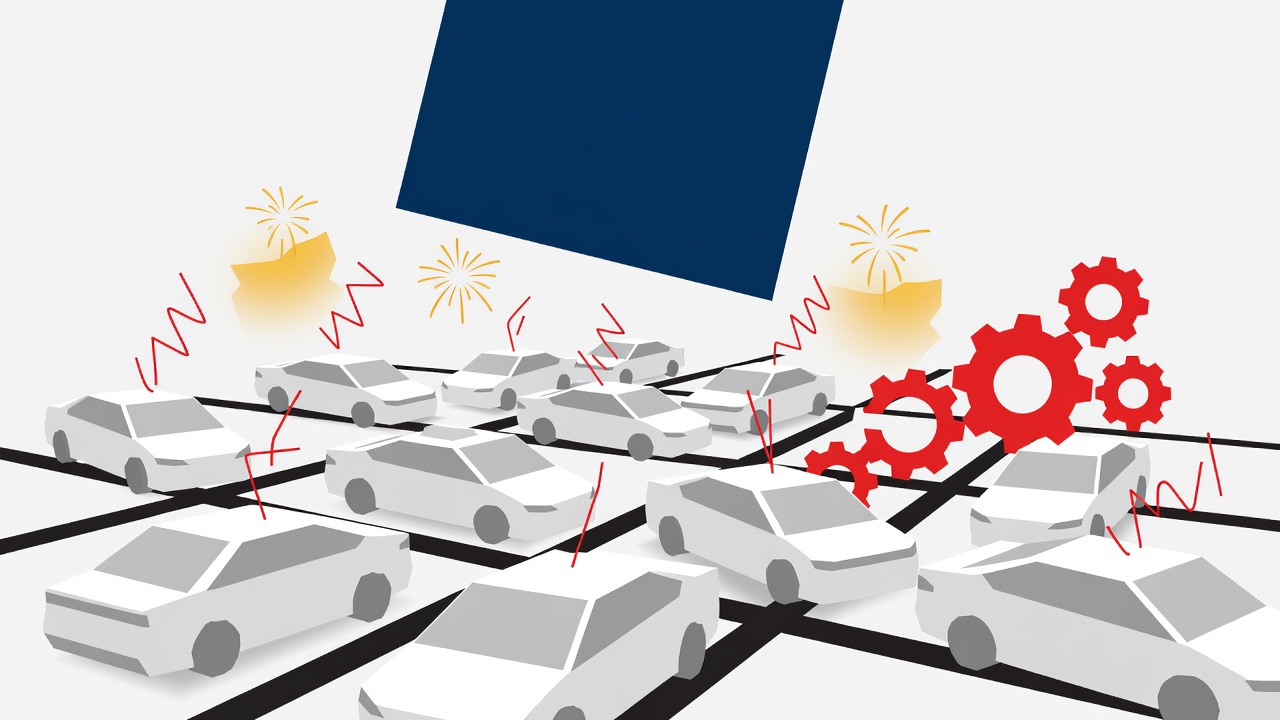
San Francisco Mayor Daniel Lurie once called his city a natural testbed for new technology. That enthusiasm met its limit on July 4.
Dozens of Waymo robotaxis ground to a halt in heavy post-fireworks traffic. Some ran out of battery and needed towing. One drove over a lit firework with passengers inside. Videos captured long lines of immobile Jaguar I-PACE vehicles blocking key roads in the Presidio. Thousands sat in gridlock for hours. Municipal shuttles got trapped. Frustrated drivers left their cars to yell at the empty robotaxis.
Mayor Lurie Calls for New Standards
Nearly two weeks later Lurie sent a pointed letter to the California Department of Transportation. He cited both the July 4 chaos and a widespread December power outage that similarly stranded Waymo vehicles. “These events demonstrated that California’s current regulatory framework does not adequately address how autonomous vehicles operate during major incidents, planned or not,” the mayor wrote, according to TechCrunch.
Lurie wants regulators to require four core capabilities from every robotaxi operator. Companies must immediately remove or relocate vehicles from active travel lanes. They need to adapt routes, service areas, and stops in real time. Real-time data sharing on disruptions, immobile cars, and recovery efforts must flow to local agencies. And operators have to prove through testing they can manage sudden surges in people and traffic. “These requirements will not undermine autonomous vehicles; they will strengthen them,” he added.
But. The proposal lands at a delicate moment. Waymo now runs roughly 1,000 vehicles across 11 cities and completes more than 500,000 paid rides per week in the Bay Area alone. California’s two-permit system through the DMV and CPUC already ranks among the nation’s stricter frameworks. Yet voluntary cooperation clearly fell short when crowds swelled to 100,000 for the Golden Gate Bridge fireworks show.
Waymo told reporters the extreme congestion, high traveler volume, and unplanned road closures simply overwhelmed normal operations. The company worked with officials to clear vehicles. It promised to evaluate the events and strengthen resilience. A spokesperson said the firm takes such situations seriously. Still, some cars sat idle long enough for tow trucks to arrive.
Passenger Rose Peterson described pure terror. Her Waymo approached a four-way stop when someone lit a firework in the intersection. The vehicle kept going. “We were pulling up to a four-way stop and this guy was shooting off a firework in the middle of the road, and then our Waymo starts driving, and we’re like, ‘Wait, what’s happening?’” she recalled in NBC News. “The more me and my fiancé were talking about it, something really bad could have happened to us… It was a very scary situation.”
Another unoccupied Waymo caught fire after driving over fireworks. No one was hurt. Witness Jermaine Ellis counted about 20 stalled robotaxis in the Presidio. People lost cell service. Traffic barely moved. Dave Guingona waited two hours before the jam eased. “We realized people were getting out of their cars, yelling and screaming at these Waymos because there were no drivers,” he told NBC.
Even competitors joined the criticism. Uber sent an email to the San Francisco Board of Supervisors blaming Waymo for blocking Edie Road, a critical connector to the Girard Road roundabout in the Presidio. On that night 66 percent of Uber drivers crawled at 10 mph or slower in the area. The figure was twice as bad as during the previous year’s Fleet Week, SFist reported. Uber called the event an outlier. Yet the pattern now spans multiple high-profile incidents.
Carnegie Mellon professor Phil Koopman offered a technical explanation. When communications fail, vehicles lose remote help. A small team of assistants cannot rescue dozens or hundreds of cars at once. “If there’s no communications, it can’t get the help, and it’s stuck. But you also have a problem, they don’t have that many remote assistants,” he said in ABC7 News.
Lurie’s letter marks a shift. He previously supported expanded testing. Now he argues that fleet size has grown too large for ad-hoc measures. A dedicated company representative at the city’s emergency operations center on July 4 proved insufficient. Real-time adaptation and mandatory data sharing could prevent future meltdowns. So could mandatory relocation rules that treat stalled robotaxis like any other disabled vehicle.
The stakes extend beyond one holiday weekend. San Francisco’s streets already host testing permits for six companies, including Amazon’s Zoox and Uber’s partnership with Nuro. Waymo leads by a wide margin. Its safety record shows fewer serious crashes than human drivers in some analyses. Yet these edge cases expose gaps in how systems handle rare but predictable crowds, power failures, and sudden road changes.
State regulators face a choice. They can maintain the current framework that focuses on normal operations. Or they can adopt Lurie’s standards and force every operator to prove readiness for chaos. The latter approach risks slowing deployment. It also risks leaving cities unprepared when the next big event arrives.
Recent coverage reinforces the tension. The San Francisco Standard documented how one robotaxi drove through an exploding firework in the Mission while others clogged the Presidio. Social media clips spread quickly. Public patience wears thin. Uber’s letter to supervisors, first reported by the San Francisco Chronicle, adds pressure from industry peers.
Lurie’s proposals aim for balance. They do not ban robotaxis. They do not demand human backup drivers. They simply insist on demonstrated performance when conditions turn extraordinary. Whether Caltrans agrees remains unclear. The agency has not yet commented publicly on the letter.
One thing is certain. The July 4 images of empty cars blocking San Francisco’s scenic roads have become a symbol. They show the promise of driverless technology. They also reveal its current limits in dense urban settings under stress. The coming regulatory response will shape how quickly that technology scales. And how much trust city leaders and residents are willing to extend.


 WebProNews is an iEntry Publication