
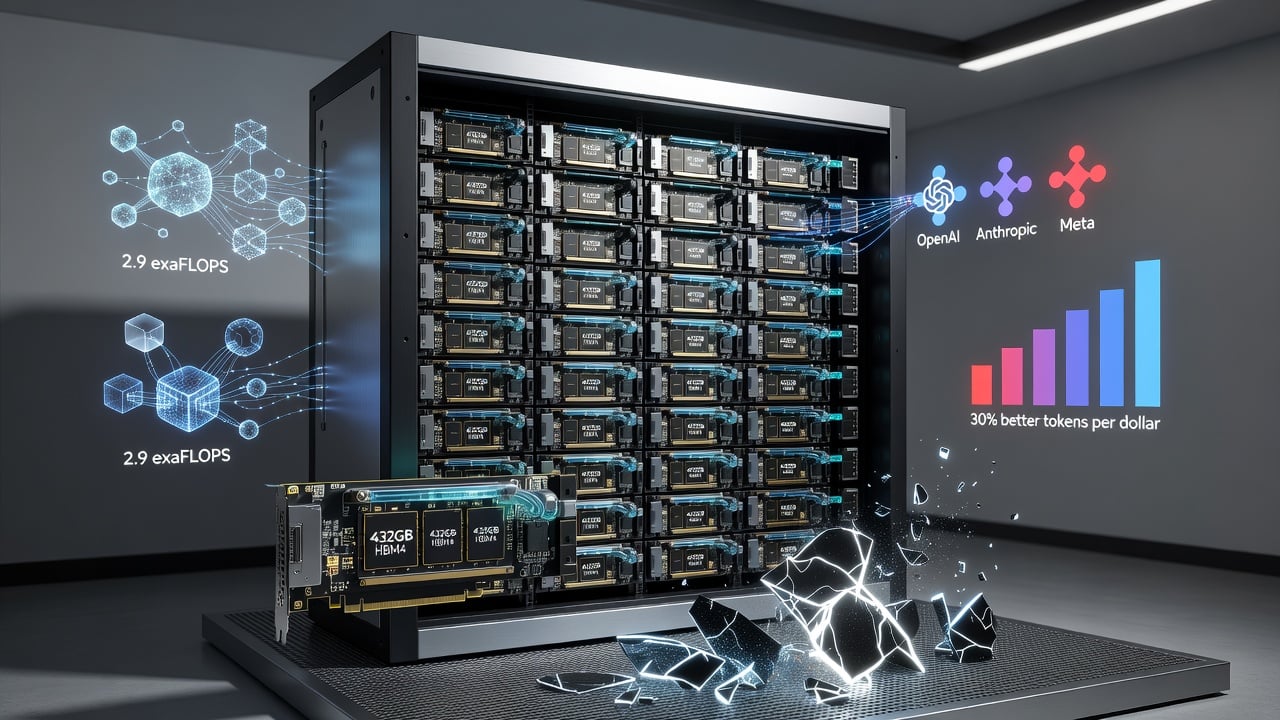
AMD just dropped its heaviest hardware yet in the race for AI dominance. At the Advancing AI 2026 event in San Francisco, the company unveiled the Instinct MI455X accelerator and the Helios rack-scale system built around it. The numbers look staggering on paper. Yet the real test will come when these systems power actual workloads at hyperscalers later this year.
Lisa Su, AMD’s chair and CEO, framed the launch in broad terms. “The next phase of AI will span frontier models, agents and physical AI, creating new opportunities to bring intelligence everywhere,” she said in the AMD press release. “Realizing that potential will take the entire industry working together.” Her words signal a shift. AMD no longer sells chips alone. It now pushes full racks optimized from silicon to software.
The MI455X sits at the center. Each GPU packs 432 GB of HBM4 memory. That’s a big jump. Phoronix reported the 50% capacity increase over the prior generation, enough to hold far larger models without splitting them across cards. Bandwidth hits 19.6 TB/s to 23.3 TB/s per GPU depending on the source. Twelve HBM4 stacks feed a 2048-bit bus. Data moves fast. Very fast.
Compute peaks impress too. The chip delivers up to 40.26 PFLOPS in OCP MXFP4 format, according to analysis in Chips and Cheese. FP32 matrix and vector operations reach 315 TFLOPS. Those figures represent roughly four times the MXFP4 performance of the MI355X. AMD claims the MI455X delivers 34 times higher token throughput for inference compared with its predecessor. A single number. But one that matters when running large language models at scale.
Inside, the architecture marks a departure. CDNA 5 uses 256 work group processors spread across eight accelerator complex dies. Or four, depending on how the dies are counted in different reports. Clocks top out near 2.4 GHz. The design borrows from RDNA, ending the long GCN era. Wavefronts narrow to 32-wide from 64. Matrix units handle 8K FP4 operations per cycle. Multicast loads amplify bandwidth up to four times for shared tensor data. These changes target efficiency in the data movement that often bottlenecks AI training and inference.
One rack changes the conversation further. Helios crams 72 MI455X GPUs alongside 18 sixth-generation EPYC “Venice” CPUs. AMD Pensando networking ties it together with UALink for scale-up and Ethernet for scale-out. The result? Up to 2.9 exaFLOPS in MXFP4 and 1.4 exaFLOPS in MXFP8 per rack. Aggregate HBM4 memory exceeds 31 TB. Direct liquid cooling keeps thermals in check inside a double-wide Open Compute Project rack.
Performance claims extend beyond raw flops. AMD says Helios offers up to 30% more inference tokens per dollar than the leading competitive solution on a Kimi K2 Thinking workload. The figure comes straight from the company’s materials. Independent validation remains pending. Still, the pitch lands with customers already lining up.
OpenAI plans to bring Helios online in the fourth quarter of 2026. Deployments will accelerate through 2027. The company works with AMD to optimize GPT-class models using the Triton framework on top of ROCm software. Anthropic committed to as much as 2 gigawatts of MI455X GPUs in Helios racks. The partnership includes a multiyear effort to use Claude itself to speed ROCm development. Meta has started validating EPYC Venice platforms and testing workloads on the new racks as it prepares gigawatt-scale rollouts. Microsoft will deploy Helios in Azure. The list of partners also includes Oracle, Vultr, TensorWave, Supermicro, HPE and Lenovo.
Those commitments matter. They show hyperscalers want alternatives to single-vendor lock-in. Nvidia still leads the market. Its NVL72 racks set the standard with similar GPU counts. But AMD’s higher memory per GPU — 432 GB versus roughly 288 GB on current Nvidia offerings — gives it an edge for models that demand vast context windows. Helios also leans on an open ROCm stack. That openness appeals to organizations tired of proprietary toolchains.
Software has long been AMD’s weak spot. The company knows it. ROCm.ai, a new AI-assisted development platform, aims to close the gap. It lets agents like Claude and Cursor understand AMD hardware natively. PyTorch, Hugging Face, vLLM and SGLang already run on the MI455X with promising early results. AMD also highlighted work with Cerebras to combine low-latency inference with Helios throughput. Details remain thin. Results will decide whether the software story holds.
Production status adds urgency. Helios racks have entered full production. Shipments begin later this quarter and ramp through the fourth quarter into the first half of 2027. That timeline aligns with customer plans. Yet scaling to gigawatts will test supply chains, power delivery and cooling infrastructure. Each rack pulls serious electricity. Liquid cooling becomes mandatory.
Analysts and journalists reacted quickly. Tom’s Hardware called the MI455X AMD’s strongest AI chip yet. The review noted 320 billion transistors and hybrid bonding between compute and cache dies. It highlighted tripled L2 cache bandwidth and improved data movers. On paper, the system competes directly with Nvidia’s Rubin generation. Real-world benchmarks will tell.
Chips and Cheese went deeper on microarchitecture. The site observed that CDNA 5 adopts an RDNA-based approach. It ends years of GCN lineage. The piece also detailed the Helios tray layout — nine compute trays per group, each holding four GPUs and one EPYC CPU. Six switch trays handle networking. The entire cabinet measures roughly 1.2 by 1.3 meters. Tight integration. No room for error in manufacturing or deployment.
Broader context reveals AMD’s ambition. The company raised its total addressable market for data center AI accelerators to $1.4 trillion by 2030, with overall silicon TAM reaching $2 trillion. That includes CPUs, GPUs, networking and edge devices. Roadmaps extend the cadence. MI500 series arrives in 2027. MI600 follows in 2028. Next Helios versions will pair them with future EPYC chips and updated Pensando NICs.
Enterprise users get attention too. AT&T deploys AMD gear across cloud, on-premises and air-gapped setups. It trains an open telecom model called OTel 2.0 on Instinct GPUs. Cisco combines AMD inference engines with its networking for hybrid agentic AI. Even robotics enters the picture with new Kria AI modules and developer platforms.
Skeptics remain. One X user captured the mood. “Wake me when it ships to a data center that isn’t a press render.” Another noted the software moat around CUDA still looms large. AMD must prove consistent performance gains in independent tests over the next several quarters. Early customer wins help. But sustained traction requires more.
Memory constraints add another layer. The MI455X’s appetite for HBM4 strains global supply. Racks delivering 31 TB per unit multiply demand. Industry projections show HBM taking a larger share of DRAM production. Relief may not arrive until 2028 or later. Power and cooling present parallel challenges. Not every data center can absorb these racks without major upgrades.
AMD positioned Helios as the world’s most powerful AI rack. The claim rests on its blend of compute, memory capacity and tokens per dollar. Whether it displaces Nvidia at scale depends on execution. For now the hardware exists. Partners commit capacity. Software improves. The industry watches closely as first systems roll out before year’s end.
And the pressure only grows. Agentic AI and physical systems will demand even more efficient inference. Frontier training clusters keep expanding. AMD’s latest bet puts it squarely in the fight. The coming months will reveal if the specs translate into market share.


 WebProNews is an iEntry Publication