
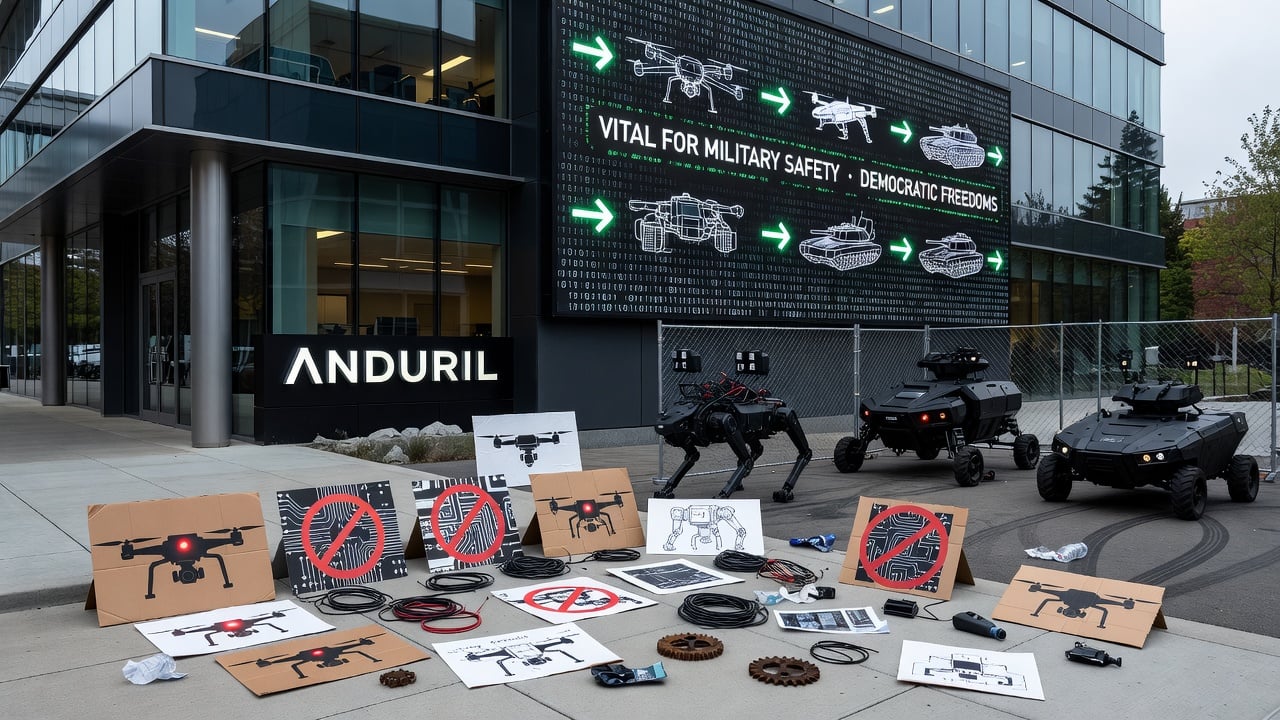
Palmer Luckey built Anduril Industries to remake American defense. The 2017 startup, named for a sword from fantasy tales, now commands a $61 billion valuation after a $5 billion funding round in May 2026. Its systems power autonomous drones, underwater vessels and surveillance towers. They rely on artificial intelligence to spot threats and act with speed. Yet that same technology has drawn protesters to the streets of Seattle this weekend.
Sunday’s demonstration outside Anduril’s downtown office drew more than 50 people. Organizers from BAYAN Washington, the International Coalition for Human Rights in the Philippines and the International League of Peoples’ Struggle gathered at 9:30 a.m. They carried signs. They gave speeches. They performed short plays. Their message cut sharp. “The rally will respond to urgent developments in the expansion of AI weapons companies in Washington State and will expose Anduril as an engine of U.S.-led wars of aggression and a domestic threat to migrant and working class communities,” the groups said in a joint statement reported by GeekWire.
Anduril answered quickly. “We respect the right to protest,” the company told the publication. “It is perplexing when people choose to protest a company dedicated to supporting the very military that safeguards those rights. At Anduril, we’re proud of our role in helping the brave men and women who risk their lives to defend the freedoms that we all enjoy, freedoms that include the right to stand outside and protest our existence. We’ll continue to honor those serving our country, even when others stand in opposition.”
The exchange captures a larger clash. Defense contractors race to field AI systems that decide targets faster than humans. Critics warn of machines that kill without meaningful oversight. The debate has spilled into campuses, boardrooms and now city sidewalks. Anduril sits at its center.
Luckey, the founder who once created Oculus VR before selling to Facebook and clashing with its leadership, turned to military work with intent. He set up headquarters in Costa Mesa, California, far from Silicon Valley’s hesitations about Pentagon contracts. The company now runs offices in Boston, Atlanta, Washington, London and Sydney. Its Seattle footprint grew fast. Anduril took over the historic Foss Shipyard on Lake Washington Ship Canal. There it tests autonomous surface vessels for the Navy. It added space in Bellevue last summer. A downtown office hosts engineers focused on connected warfare.
That local presence fueled the protest. Activists point to Anduril’s role in multinational exercises like RIMPAC, which ran through late July 2026 around Hawaii. The drills featured the firm’s autonomous systems alongside dozens of allied nations. For opponents, such tests signal preparation for conflict with China. They see AI weapons as escalatory. They fear errors in target selection. They question accountability when code pulls the trigger.
Yet Anduril’s backers see necessity. The Pentagon has poured resources into collaborative combat aircraft. It awarded Anduril a production contract for the Air Force’s CCA program earlier in 2026. The goal is a fleet of cheap, smart drones that fly alongside manned jets. They identify threats. They provide cover. They overwhelm adversaries through numbers and autonomy. The Washington Post described the pitch in January 2025: cheap, smart, deadly. The tech industry wants the military to buy in big.
Luckey has spoken of building these systems responsibly. In a 2025 interview aired on 60 Minutes, he discussed AI-powered autonomy that exceeds current Pentagon platforms. No human required for some operations, he noted. International groups call such machines killer robots. Luckey pushes back on heavy regulation. He offers vague assurances of human oversight while opposing outright bans. His pitch materials claim the company will “save western civilization,” according to reporting in The Guardian.
The firm’s growth reflects that ambition. Anduril raised funds from Founders Fund, Andreessen Horowitz and Thrive Capital. It plans hyperscale factories. Arsenal-1, under construction south of Columbus, Ohio, will churn out autonomous weapons at volume. Similar manufacturing ideas appear in its UK efforts. The Bureau of Investigative Journalism reported in July 2025 that Anduril lobbied British officials aggressively. It held 19 meetings with the Ministry of Defence since 2023. It hired 11 former MoD staff. It won more than £48 million in contracts, including work on base protection and AI-driven surveillance towers. A company executive told the outlet, “We find ourselves locked in a critical race – a race for upholding democratic values.”
Critics see a different race. They worry about a future where algorithms accelerate lethal decisions. Reports have surfaced of Anduril’s autonomous weapons stumbling in tests and combat. Reddit discussions in Seattle communities highlight local unease over warship construction on the historic ship canal. One post called it quiet expansion of deadly tech. Instagram accounts tied to anti-war groups have documented earlier actions against Anduril, including kayak protests and rallies at defense supplier summits.
Student demonstrations add another front. At Cornell University in February 2026, protesters shut down an Anduril tech talk after seven minutes. They distributed flyers about the Fury, an AI-powered unmanned combat aircraft. “Does this look sleek? Soon, it’ll slaughter a family,” the materials read, per The Cornell Daily Sun. The group linked the firm to border surveillance and sales to nations they labeled genocidal.
Anduril does not hide its purpose. Its Lattice software platform fuses sensor data into real-time intelligence. Sentry towers stand guard along borders. Ghost helicopters and Anvil interceptors, shown in demonstrations, hunt enemy drones. These tools, the company argues, protect troops. They deter aggression. They give democratic nations an edge against authoritarian rivals racing their own AI programs.
But the ethical questions linger. Who writes the rules of engagement for machines? What happens when data biases lead to mistaken strikes? How does proliferation affect global stability? Activists in Seattle this month echoed concerns raised by groups worldwide. They tie Anduril’s work to broader U.S. foreign policy. They see domestic expansion as profit from conflict.
The company’s valuation tells its own story. From startup to tens of billions in a few years. Investors bet on software-defined defense. They see a shift from expensive manned platforms to swarms of affordable autonomous units. The Air Force aims for a thousand such aircraft. Anduril wants a large share.
Protests alone won’t slow that momentum. Similar actions at Microsoft conferences and aerospace summits in Seattle show a pattern of local resistance. Yet contracts keep flowing. The Pentagon’s budget for AI and uncrewed systems climbs each year. Allies from Taiwan to Ukraine line up for the gear.
So the weekend rally in Seattle was both symbolic and pointed. Organizers used the moment to highlight Anduril’s maritime manufacturing. They connected it to larger campaigns against what they call militarism. Performances dramatized the human cost. Testimonials from affected communities added voices.
Anduril, for its part, stayed on message. Defense work safeguards the very freedoms that permit dissent. The statement carried confidence. It also revealed frustration with critics who, in the firm’s view, misunderstand the mission.
That divide will not close soon. New contracts will emerge. Fresh protests will follow. AI’s role in combat grows more concrete with each test flight and software update. Industry insiders watch the tension closely. They weigh innovation speed against calls for restraint. They note that bans on autonomous weapons have failed to gain universal traction. Nations pursue the technology anyway.
In Seattle, the ship canal once launched wooden vessels for trade and war. Today it hosts trials of robot boats guided by code. The contrast is stark. History, technology and ethics collide there. Sunday’s gathering was one more chapter. The story, however, stretches far beyond one office and one protest. It reaches into how nations will fight the next wars. And who, or what, makes the fatal calls.


 WebProNews is an iEntry Publication