
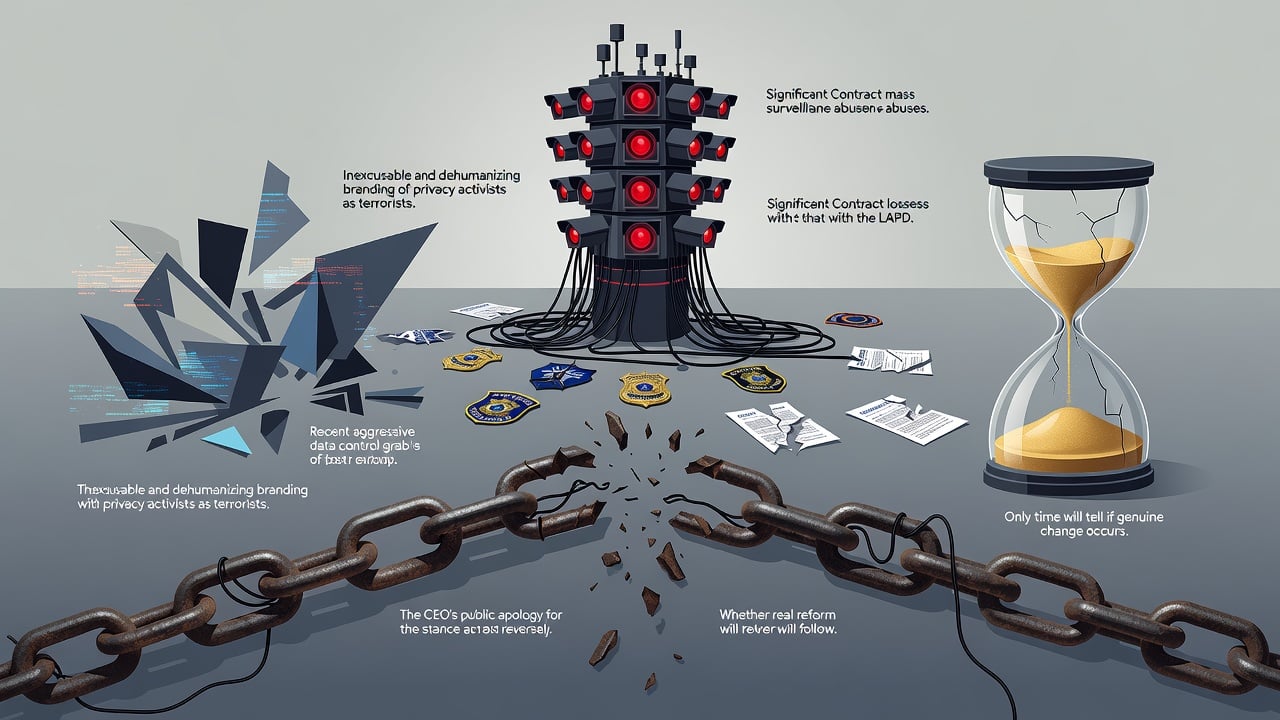
Garrett Langley finally said it. The chief executive of Flock Safety admitted his past description of privacy activists as terrorists was wrong. He apologized. Yet the damage lingers. His words weren’t a slip. They captured a mindset that treated legitimate concerns about mass surveillance as threats to be crushed.
Langley made the original comments in a 2025 interview with Forbes. He labeled the DeFlock project a “terroristic organization.” He sent cease-and-desist letters. He emailed customers to warn that critics wanted to “defund the police, weaken public safety, and normalize lawlessness.” Those statements went far beyond rhetoric. They revealed a company viewing dissent as danger.
Now Langley says otherwise. “My comments were a mistake and I apologize,” he told Forbes this month. He added that being concerned about privacy “isn’t terrorism, it’s American.” DeFlock, he conceded, is an open-source effort born from Flock’s own failure to address public questions. The shift sounds reasonable on paper. But Langley had doubled down for months. Only after dozens of cities canceled contracts and bipartisan pushback mounted did the about-face arrive. Time will tell whether this represents real change or damage control.
Absolutely inexcusable. Calling non-violent advocates for constitutional rights “terrorists” crosses a line. It dehumanizes. It chills speech. It equates mapping public cameras with aiding crime. Langley himself now acknowledges as much. Privacy advocates had warned for years that Flock’s automated license plate reader network created a dragnet. The CEO’s language proved their point better than any report could.
Flock Safety sells cameras that capture billions of license plates. Police departments in nearly 7,000 jurisdictions use them. The company, valued at $8.3 billion with roughly $500 million in annual revenue, has expanded into drones, gunshot detection and searchable video. Its network spans the country. One query can pull data from more than 83,000 cameras. That reach fuels efficiency in solving crimes. It also enables something darker.
The Electronic Frontier Foundation documented abuses throughout 2025. Its year-end review laid bare the problem. Law enforcement ran more than 12 million searches across 3,900 agencies between December 2024 and October 2025. Some targeted protests. Others focused on the “No Kings” demonstrations. Nineteen agencies queried the system dozens of times in connection with those events. Direct Action Everywhere activists faced nine searches from Delaware State Police in March 2025 alone. The pattern was clear. Surveillance followed speech.
Discrimination appeared too. Over 80 agencies searched using terms like “roma,” ethnic slurs or “g*psy.” Grand Prairie Police Department in Texas ran a slur six times alongside its “Convoy” feature. A Harvard survey cited by EFF noted that 40 percent of Romani people report profiling by police. The technology didn’t create bias. It amplified it at scale.
Reproductive rights suffered as well. Texas deputies used the system in an abortion-related death investigation under the guise of a “missing person” query. In Johnson County, an official searched for a woman who “had an abortion” and pulled results from 83,345 cameras nationwide. These cases, detailed in the EFF report, show how Flock’s architecture lowers barriers to invasive tracking. Warrants often aren’t required. Volume replaces precision.
Even Flock’s promised fixes fall short. In June 2025 the company announced geofencing and retention limits. EFF called them inadequate. The core issue isn’t configuration. It’s the nationwide interconnected database itself. No software tweak erases the risk of mission creep or unauthorized access. Abuses flow from design.
Recent developments underscore the skepticism. The Los Angeles Police Department let its contract expire in July 2026. Dean Gialamas, LAPD’s chief information officer, cited unresolved issues. “The sticking point is around having very clear terms about who owns the data, what happens with the data once they collect it,” he told the Los Angeles Times. An inspector general audit had recommended pausing new deployments until rules could be enforced. Data sharing with immigration authorities raised particular alarms. LAPD’s move marks a significant blow for a company that once counted the department among its users.
Other cities have walked away. Austin, Evanston and Eugene ended contracts after EFF’s findings. Backlash spreads. A Malwarebytes report published three days ago notes growing resistance in agency decisions. Vandals target cameras. Activists map them with apps downloaded hundreds of thousands of times. Tucker Carlson amplified the criticism, questioning whether sharing camera locations qualifies as terrorism. Public sentiment has shifted.
Flock’s 2026 contract changes only heighten distrust. The American Civil Liberties Union flagged major revisions in April. The company removed language stating it “does not own and shall not sell Customer Data.” It granted itself “the exclusive right to determine and control the method, timing, format, and medium” of data access. Customers receive degraded, low-resolution copies without timestamps or metadata. And Flock secured a perpetual license to use the data for improving its services even after a city terminates the relationship. That data lives on in Flock’s systems forever.
The ACLU analysis pulls no punches. These updates shift power from municipalities to the company. They create an “own-nothing” illusion for cities that believe they control their records. IPVM and HaveIBeenFlocked.com first exposed the changes. Local debates intensified as a result. Washington state passed SB 6002 in 2026, imposing new restrictions on automated license plate readers. Illinois launched an audit after EFF revealed Customs and Border Protection accessing state data in violation of local law. Federal lawmakers joined in. Representatives Raja Krishnamoorthi and Robert Garcia opened an investigation into Flock’s practices.
Langley now says he welcomes regulation. He claims Flock has listened. He points to default 30-day data retention, shortened to 21 days in Washington. He says the company will answer more questions from X users. These steps arrive late. The privacy practices that drew so much fire remained deplorable for years. Mass collection without meaningful oversight. Easy access for broad queries. Partnerships that blurred lines between local policing and federal enforcement.
DeFlock’s Will Freeman called the apology “awesome.” Others remain unconvinced. The movement against Flock has momentum. Lawsuits challenge warrantless searches. San Jose faced litigation from EFF and the ACLU of Northern California after nearly 4 million searches in a single year. The numbers stun. They illustrate the scale.
So the apology stands. Langley deserves credit for issuing it. But words alone won’t restore confidence. Flock must demonstrate change through actions. That means tighter controls on data sharing. Transparent audit logs. Genuine collaboration with civil liberties groups rather than legal threats. Reduced retention periods by default. Limits on query volume. Architectural shifts that prevent one query from touching the entire network.
Only time will tell if this about-face is genuine. Will Langley and his team actually listen to privacy advocates? Will they work with them instead of against them? Will Flock implement meaningful reforms to practices long criticized as overreach? The company’s history suggests caution. Its business model depends on the very surveillance infrastructure that invites abuse.
Public safety matters. No one disputes that stolen vehicles should be recovered or violent criminals located. Yet safety cannot come at the expense of a surveillance state that tracks everyday movements without cause. The balance Langley now claims to seek requires more than rhetoric. It demands concrete limits, accountability and respect for the critics he once maligned.
Activists mapped over 115,000 cameras through DeFlock’s efforts. They did so openly. They faced smears. Their persistence forced this moment of reflection. If Flock truly turns the page, it will thank them. It will engage. It will shrink the dragnet. Anything less and the apology rings hollow. The cameras will keep watching. The questions will keep coming. And trust, once shattered, proves hard to rebuild.


 WebProNews is an iEntry Publication