
Google Voice just made a notable shift. After years of requiring a full Google Workspace subscription to access paid business features, the company now lets individual Gmail users buy two professional-grade plans on their own. The change lowers the barrier. It brings features once locked behind company accounts to freelancers, solopreneurs and side-hustle operators who want more than the free tier offers.
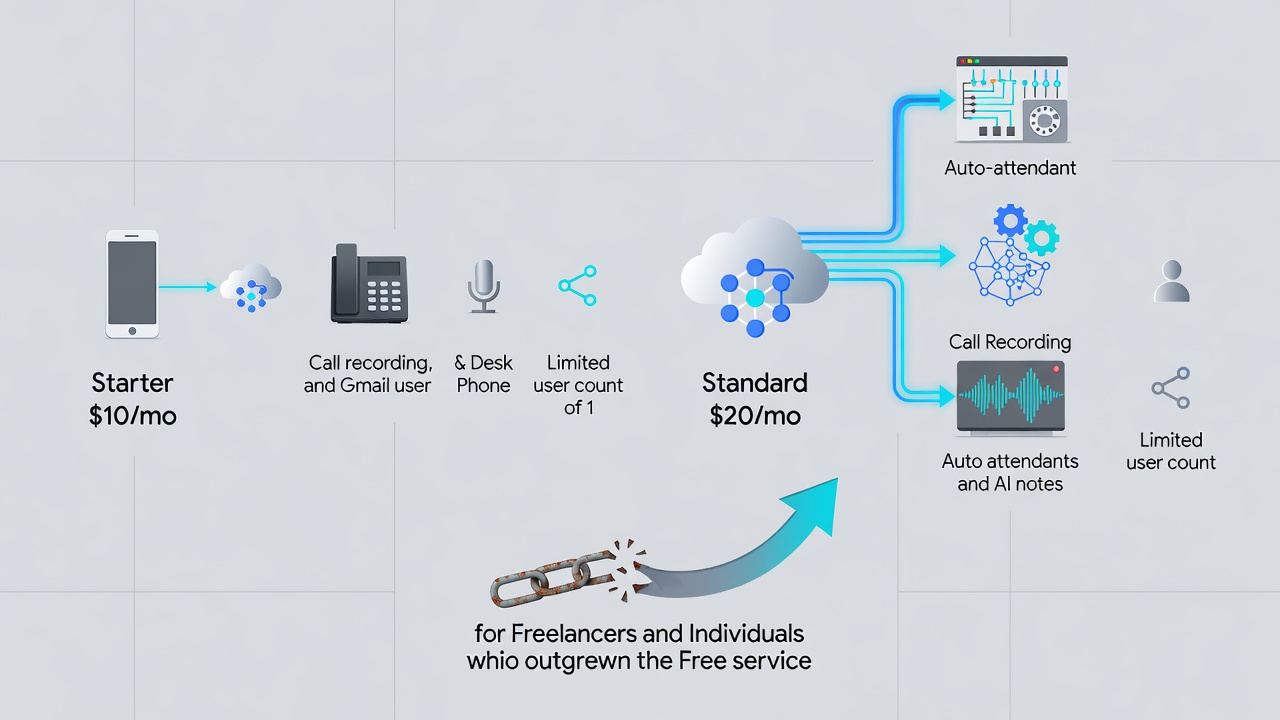
The new options arrived quietly in recent weeks. Android Police reported the details on July 7, 2026, citing an earlier scoop by Android Authority. Google confirmed the standalone plans in its support documentation. Starter runs $10 a month. Standard costs $20. Both target single users with a personal @gmail.com address in the U.S. No Workspace required. Previously those same capabilities demanded an add-on to a paid Workspace plan that started around $7 to $14 per user before the Voice fee.
That’s real money saved. A solo operator no longer pays for an entire productivity suite just to get call recording or desk phone support. But the plans come with clear limits. Only one user. U.S. numbers only. No ring groups. No call delegation. No BigQuery exports. Those remain reserved for Workspace-linked accounts.
Who stands to benefit from these new options
Consider the typical Gmail user who adopted Google Voice years ago. Free service gave a second number, voicemail transcription and basic forwarding. It worked fine for personal calls. Then business picked up. Clients expected professionalism. Three-way calling became routine. The ability to answer on a physical desk phone mattered. Yet upgrading meant buying Workspace for one person. The math didn’t always add up.
Now it does. The standalone Starter plan adds several practical upgrades. Users gain 24/7 support. Their number stays protected from expiration. Three-way calling works. Call recording is available. Desk phones and analog telephone adapters gain compatibility. Emergency 911 support arrives. No more verifying the account with a separate phone number. These additions turn a hobbyist tool into something closer to a business line without the overhead.
Standard builds on that foundation. It includes everything in Starter. Then it layers on AI note-taking powered by Gemini technology. Call routing with auto attendants makes the line sound more polished for customer inquiries. The support page lists these distinctions clearly in comparison tables updated as recently as June 29, 2026. Google’s own help document spells out the differences between free, Starter and Standard tiers.
But here’s the catch. Many advanced team features stay absent. No ring groups. No call queuing on the standalone Standard plan. No corporate directory integration. No automatic call recording on demand. Those appear only in Workspace add-on versions of Standard or the top-tier Premier plan that runs $30 per user. The comparison matrix on Google’s Workspace knowledge base drives that point home. Workspace administrators see a fuller feature grid that highlights exactly where standalone falls short.
Industry observers have tracked Google Voice pricing for months. A March 2026 Forbes Advisor guide still described the $10 Starter as an add-on to Workspace. It praised the low entry point for unlimited domestic calling yet noted the extra Workspace cost pushed real-world pricing higher. The new standalone structure changes that equation for individuals. Forbes Advisor had not yet updated its guide to reflect the shift as of early July.
Google’s move looks strategic. The company wants to expand Voice beyond its legacy free user base without forcing every customer into Workspace. Standalone plans carry the same core telephony strengths. Unlimited domestic calling in the U.S. Voicemail transcripts that actually work most of the time. Mobile apps that sync across devices. International calling at competitive rates remains available though not unlimited.
Still, gaps persist. RCS support, a frequent user request, has not arrived. The Android Police reporter noted that addition alone would convince him to pay. Users on X echoed similar sentiments in recent posts, complaining that modern messaging standards still feel missing from a service two decades old.
Eligibility rules add friction. Buyers must use a personal Gmail address. No domain-verified accounts. Users under 18 need not apply. Porting an existing number requires separate handling first. Google Fiber customers face restrictions. The signup process routes through a specific workspace signup link even for these personal plans. Small hurdles. Yet they matter for the exact audience Google aims to serve.
Analysts see this as part of a broader pattern. Google continues to refine its communication offerings while facing pressure from pure-play VoIP providers that offer more flexible team features at similar prices. The standalone plans give Google a way to capture revenue from millions of free Voice users who have outgrown the basic service. A $10 or $20 monthly charge adds up across a large base.
Early reaction on X mixed curiosity with caution. Some users welcomed the lower cost of entry. Others questioned whether the single-user limit defeats the purpose for growing operations. One thread highlighted that freelancers in creative fields could finally justify a dedicated business number with recording and auto attendants without signing up for enterprise tools they don’t need.
The discount on Standard adds immediate appeal. New subscribers can grab the $20 plan at 50% off for the first six months, according to the Android Police report. That brings the effective price to $10 monthly during the trial period. A low-risk way to test whether the extras deliver enough value.
Longer term the plans could evolve. Google has updated Voice features incrementally over the years. AI note-taking already appears in the Standard tier. Expect further integration of Gemini capabilities. Yet core limitations around multi-user support on standalone may stay in place to protect Workspace sales.
For IT managers and telecom decision-makers the development carries implications. Companies with scattered contractors or remote workers might shift some lines to standalone plans rather than expand Workspace licenses. The approach keeps costs predictable. It avoids forcing every user into the full productivity bundle.
Of course the free Google Voice tier remains untouched. Millions continue to use it for personal calls and texts without issue. The new plans simply fill the gap between that basic experience and full business deployments. They acknowledge that many users sit somewhere in the middle.
Google’s support pages now carry detailed tables that let potential buyers compare every checkbox. Free offers forwarding and transcripts but lacks recording, three-way calling and desk phone integration. Starter fills those holes. Standard adds the professional polish of auto attendants and AI notes. The progression feels logical. The pricing strikes a balance between accessibility and capability.
Whether these plans spark wider adoption remains to be seen. Voice has loyal users but rarely makes headlines. This quiet expansion could change that. It gives the service fresh relevance for a generation that expects every app to handle business functions without extra subscriptions.
One thing feels certain. The days of needing a full Workspace account for basic professional telephony features have ended for individual Gmail users. That alone marks a meaningful adjustment in Google’s approach to its long-running communication product.


 WebProNews is an iEntry Publication