
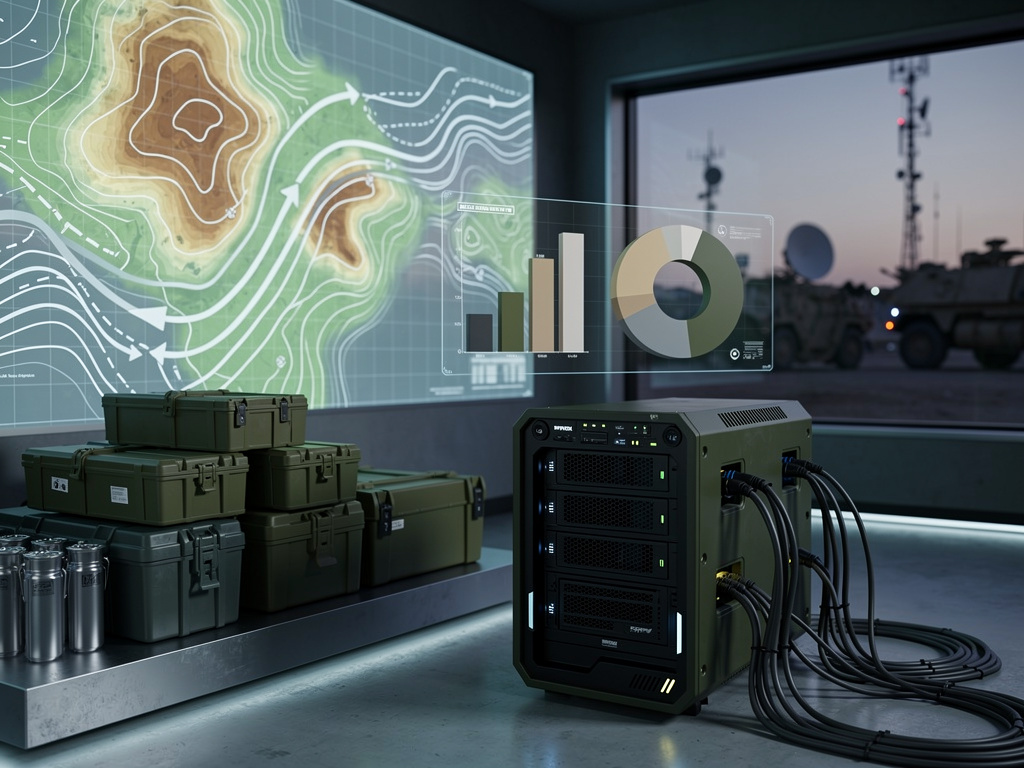
The United States Army is deploying a revolutionary artificial intelligence system that can predict ammunition requirements and anticipate enemy movements before combat operations begin, marking a fundamental shift in how military logistics operations are conducted. The technology, which represents years of development and billions of dollars in investment, promises to eliminate the supply chain bottlenecks that have plagued military operations since the dawn of modern warfare.
According to Business Insider, the Army’s new predictive software is expected to be fully operational by 2026, offering commanders unprecedented foresight into their logistical needs. The system analyzes vast amounts of historical combat data, current intelligence reports, and real-time battlefield conditions to forecast ammunition consumption rates with remarkable accuracy. This capability addresses one of the most persistent challenges in military planning: ensuring that fighting forces have sufficient supplies without overburdening supply lines with unnecessary materiel.
The implications extend far beyond simple inventory management. By accurately predicting enemy actions and corresponding ammunition needs, the system enables proactive rather than reactive logistics planning. This represents a paradigm shift from traditional supply chain management, where commanders often relied on rough estimates and historical averages that frequently proved inadequate in rapidly evolving combat situations.
Machine Learning Meets Military Strategy
The artificial intelligence driving this system employs sophisticated machine learning algorithms trained on decades of combat data from conflicts spanning multiple theaters of operation. The software examines patterns in enemy behavior, terrain characteristics, weather conditions, and unit compositions to generate predictive models that become more accurate with each engagement. Defense officials familiar with the program indicate that early testing has shown prediction accuracy rates exceeding 85 percent in controlled scenarios, a significant improvement over conventional forecasting methods.
The technology builds upon existing Army logistics systems but introduces capabilities that were previously impossible without human-level analytical reasoning. The AI can simultaneously process thousands of variables that would overwhelm even the most experienced logistics officers, identifying subtle correlations between seemingly unrelated factors that influence ammunition consumption. For instance, the system might recognize that specific enemy formations, when combined with particular terrain features and weather patterns, consistently result in ammunition usage that deviates significantly from standard projections.
Addressing Historical Supply Chain Failures
Military historians have long documented the critical role that logistics plays in determining combat outcomes. From Napoleon’s disastrous Russian campaign to more recent conflicts in Iraq and Afghanistan, supply chain failures have repeatedly undermined otherwise sound military strategies. The Army’s new predictive system directly addresses these historical weaknesses by providing commanders with tools to anticipate and prevent supply shortages before they impact operational effectiveness.
During recent military exercises, units equipped with the predictive software demonstrated significantly improved operational readiness compared to control groups using traditional logistics planning methods. The AI-enabled units maintained optimal ammunition levels throughout extended operations while reducing the total volume of supplies transported by nearly 20 percent, according to internal Army assessments. This efficiency gain translates directly into reduced logistical footprints, faster deployment times, and decreased vulnerability to supply line interdiction.
Integration with Existing Command Systems
The predictive software is designed to integrate seamlessly with the Army’s existing command and control infrastructure, providing real-time updates to logistics officers and combat commanders through familiar interfaces. The system generates automated alerts when predicted ammunition requirements deviate significantly from current stock levels, enabling proactive resupply operations. Additionally, the software can recommend optimal distribution strategies that balance the need for forward-positioned ammunition against the risks of concentrating supplies in potentially vulnerable locations.
Technical implementation has required extensive collaboration between military logistics specialists, data scientists, and software engineers. The development team has worked to ensure that the system’s recommendations are presented in formats that align with existing military decision-making processes, avoiding the introduction of unnecessary complexity into time-sensitive operational planning. User interface design has been a particular focus, with the goal of making sophisticated AI-generated insights accessible to personnel with varying levels of technical expertise.
Predictive Intelligence on Enemy Movements
Beyond ammunition forecasting, the system’s ability to predict enemy actions represents perhaps its most strategically significant capability. By analyzing patterns in adversary behavior, communications intercepts, and observable preparations, the AI can identify indicators of impending enemy operations with sufficient lead time to enable preemptive countermeasures. This predictive intelligence allows commanders to position forces and supplies optimally before engagements begin, potentially decisive advantages in modern combat where the initiative often determines outcomes.
The enemy prediction capabilities rely on continuous learning algorithms that adapt to evolving adversary tactics. As opponents modify their operational patterns in response to U.S. military actions, the AI system automatically adjusts its predictive models to account for these changes. This dynamic adaptation prevents the system from becoming obsolete as adversaries develop countermeasures, a critical consideration given the rapid pace of tactical innovation in contemporary warfare.
Cybersecurity and Operational Security Concerns
The Army has implemented multiple layers of security protocols to protect the predictive system from cyber threats and ensure that adversaries cannot exploit its capabilities. The software operates on isolated networks with stringent access controls, and all data transmissions are encrypted using military-grade cryptographic protocols. Defense officials acknowledge that the system represents a high-value target for foreign intelligence services, necessitating continuous monitoring and updating of security measures.
Operational security considerations extend beyond protecting the system itself to preventing adversaries from inferring its capabilities through observation of U.S. military logistics patterns. The Army has developed procedures for introducing controlled variability into supply operations to obscure the predictive nature of logistics planning, ensuring that enemies cannot reverse-engineer the system’s algorithms by analyzing American resupply activities. This operational deception component adds another layer of complexity to an already sophisticated technological system.
Training and Human-Machine Collaboration
Successful implementation of the predictive software requires extensive training programs to ensure that military personnel can effectively interpret and act upon AI-generated recommendations. The Army has established specialized courses for logistics officers and commanders that focus on understanding the system’s capabilities and limitations, recognizing when to trust AI predictions, and knowing when human judgment should override algorithmic recommendations. This emphasis on human-machine collaboration reflects lessons learned from other military AI applications where over-reliance on automated systems sometimes led to suboptimal outcomes.
The training curriculum includes scenarios where the AI system’s predictions prove inaccurate, teaching personnel to recognize warning signs and maintain situational awareness independent of technological aids. Military educators emphasize that the predictive software is a decision support tool rather than a replacement for human expertise, and that effective utilization requires personnel who can critically evaluate AI-generated insights within the broader operational context.
Future Developments and Expanding Applications
Looking beyond the 2026 deployment target, Army planners are already considering expanded applications for predictive AI technology across the full spectrum of military logistics. Future iterations may incorporate predictions for fuel consumption, spare parts requirements, medical supply needs, and other critical materiel categories. The underlying AI architecture has been designed with scalability in mind, allowing for the addition of new prediction modules without requiring fundamental system redesigns.
Research is also underway to extend the system’s predictive capabilities to longer time horizons, enabling strategic-level planning that accounts for ammunition production capacity, global supply chain constraints, and geopolitical factors that influence materiel availability. These extended-range predictions could inform defense procurement decisions and industrial base planning, ensuring that the United States maintains sufficient production capacity to support sustained military operations across multiple theaters simultaneously.
Implications for Allied Forces and Coalition Operations
The Army’s predictive logistics system has significant implications for coalition warfare and interoperability with allied forces. Defense officials are exploring frameworks for sharing AI-generated logistics predictions with partner nations while protecting sensitive algorithmic details and intelligence sources. Successful implementation could enhance the effectiveness of multinational military operations by improving coordination of supply chains and reducing duplication of logistics efforts among coalition partners.
International military observers have expressed strong interest in the technology, with several allied nations reportedly pursuing similar capabilities through their own defense research programs. The potential for standardized predictive logistics systems across NATO forces could represent a major advancement in alliance military effectiveness, though technical, security, and sovereignty considerations will need to be carefully navigated. As artificial intelligence continues to reshape military operations, the Army’s predictive ammunition and enemy action software stands as a significant milestone in the ongoing transformation of warfare through advanced technology.


 WebProNews is an iEntry Publication